
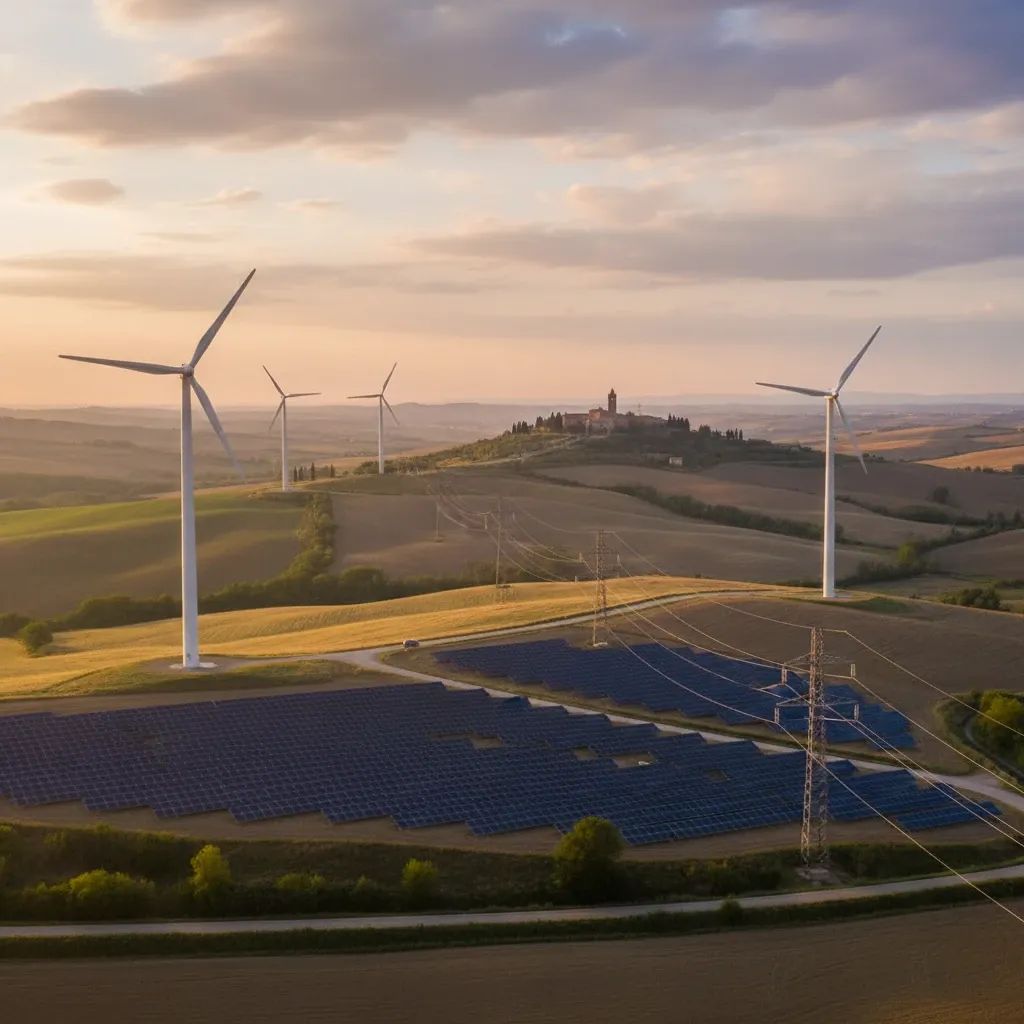
The Italian Ministry of Agriculture, Food Sovereignty and Forestry has quintupled funding for a national solar energy program aimed at agricultural businesses, pushing the budget from an initial €600M to over €3.15 billion—a move that will allow roughly 30,000 farms across Italy to install renewable energy systems and reduce exposure to volatile international energy markets.
Why This Matters
• Energy independence: When fully operational, the program will cover approximately 33% of the agricultural sector's electricity needs, based on 2024 consumption data.
• Direct cost relief: Farms installing solar panels through the initiative will be insulated from the price swings that have plagued the sector since the energy crisis began.
• PNRR alignment: The expansion slots into Italy's broader €23 billion renewable energy framework, which targets an additional 37.15 GW of clean capacity by 2030.
Undersecretary of State at the Agriculture Ministry Patrizio Giacomo La Pietra disclosed the figures during the launch of "Rinnovabile è Agricoltura," a project by Cia-Agricoltori Italiani in Rome. The announcement signals a dramatic acceleration of Italy's "Parco Agrisolare" initiative, originally conceived under the National Recovery and Resilience Plan (PNRR) to modernize agricultural infrastructure without consuming additional farmland.
How the Program Works
The expanded scheme channels funds through the Gestore dei Servizi Energetici (GSE), which administers digital applications for rooftop photovoltaic installations on farm buildings. Applications are submitted entirely online through the GSE portal, with documentation available in Italian and English. Eligible recipients include individual and corporate farmers, agricultural cooperatives, agro-industrial enterprises, and Renewable Energy Communities (CER), a new legal entity formalized in January 2026 under Law 4/2026.
For foreign residents and EU citizens operating farms in Italy, eligibility hinges on business registration with the Italian tax authorities and proof of agricultural land ownership or long-term leasing agreements. Non-EU foreign nationals must verify legal residency status before applying.
Grants cover up to 80% of eligible costs in many cases, including not only panel installation but also complementary upgrades such as asbestos removal, thermal roof insulation, and ventilation or cooling systems. The program prohibits ground-mounted installations on productive agricultural land—a restriction introduced by Decree-Law 175/2025 to prevent competition between food production and energy generation.
Applications for the 2026 tranche opened between March 10 and April 9, with projects selected on a first-come, first-served basis within regional quotas. Required documentation typically includes proof of agricultural business status, land ownership or lease agreements, and technical specifications for the installation. The Ministry's target capacity stands at 375,000 kW of new generation, distributed across Italy's farming regions.
What This Means for Farm Operators
The practical impact hinges on three variables: farm size, current electricity consumption, and roof space availability. A mid-sized dairy operation in Emilia-Romagna, for instance, consuming 50,000 kWh annually, could install a 50 kW rooftop array with costs substantially reduced through the subsidy—with typical payback periods ranging from five to seven years through avoided grid purchases and surplus energy sales.
Farms that secured agrisolare funding have reported significant insulation from rising electricity expenses, according to data from Althesys, an energy consultancy. By contrast, operations relying entirely on grid power saw bills climb substantially over recent periods, driven by geopolitical turbulence and fuel price volatility.
Beyond cost savings, the program offers strategic insulation. Italy imports approximately 95% of its natural gas, leaving agricultural businesses—especially greenhouse growers, poultry farms, and dairy processors—vulnerable to supply disruptions. Self-generated solar power shifts this exposure from international markets to domestic, predictable sources.
The Agrivoltaic Frontier
Parallel to the rooftop initiative, Italy is advancing a separate €1.1 billion agrivoltaic program, also financed by the PNRR, which integrates elevated solar panels with active crop cultivation. Unlike traditional ground-mounted arrays, agrivoltaic systems position panels 3 to 5 meters above the soil, allowing tractors and harvesters to operate underneath while crops benefit from partial shading.
A tender allocated 1.5 GW of agrivoltaic capacity, with projects required to demonstrate that agricultural productivity remains at least 70% of baseline yields. Early trials have shown promising results, with participating farms reporting productivity benefits from reduced heat stress in appropriate conditions.
However, uptake remains uneven. Bureaucratic bottlenecks have been identified as a chief obstacle, with authorization procedures for agrivoltaic installations stretching significantly longer than those for rooftop systems in some regions.
Regulatory Shifts and Legal Clarity
The January 2026 conversion of Decree-Law 175/2025 into Law 4/2026 marked a turning point for renewable energy in agriculture. The statute introduced Italy's first formal definition of agrivoltaico, distinguishing it from conventional photovoltaic installations and establishing criteria for dual-use land management.
The law also maps "suitable areas" for renewable projects, prioritizing brownfield sites, industrial zones, and unused public land while blocking new ground-mounted solar farms on prime agricultural soil. Exceptions remain for PNRR-funded projects and installations in designated non-agricultural zones.
Cia-Agricoltori Italiani has responded with "EnerCia," a national-level Renewable Energy Community designed to pool energy production from member farms and simplify access to grid incentives. The model draws on successful cooperative frameworks used in other European nations, where farmers collectively own generation assets and negotiate power purchase agreements.
European Context and Comparative Performance
Italy's push mirrors similar efforts across the European Union, though implementation varies. Other major agricultural economies are also scaling renewable energy investments as part of broader climate commitments, with emphasis on protecting productive farmland while transitioning to clean energy.
Germany's renewable energy framework, backed by substantial subsidies, targets high renewable electricity penetration by 2030. However, different European countries face distinct tax and regulatory considerations when implementing solar programs on agricultural land—a complexity Italy has addressed through its restrictions on ground-mounted systems.
Practical Barriers and Open Questions
Despite quintupled funding, challenges persist. Only a fraction of Italian farms currently generate renewable energy as a complementary activity—a figure that has likely improved but remains below potential capacity.
Bureaucratic complexity tops the list of complaints. Authorization requires coordination among municipal, regional, and national agencies, with environmental impact assessments mandatory for larger projects. Grid connection delays compound the issue: Italy's distribution network, managed by regional operators, struggles to absorb new capacity in rural areas where infrastructure was designed for consumption, not generation.
Initial capital requirements also deter participation. Although grants cover up to 80%, co-financing the remaining 20% still demands liquidity that smaller family farms often lack. Banks have begun offering "green loans" with reduced interest rates, but penetration remains shallow in southern regions where credit access is tighter.
Finally, the 33% coverage target, while substantial, leaves two-thirds of agricultural electricity demand unaddressed. Farms with limited roof space, such as open-field operations or livestock ranches, may see minimal benefit unless agrivoltaic authorization accelerates.
Long-Term Implications
If executed to plan, the expanded program positions Italy's agricultural sector as a significant contributor to national decarbonization. The targeted 375,000 kW of new rooftop capacity, combined with 1.5 GW of agrivoltaic installations, represents a meaningful portion of the country's 2030 renewable energy goals.
For individual operators, the calculus is straightforward: farms that invest now will lock in energy costs for 25 years—the typical lifespan of photovoltaic panels—while competitors relying on grid power remain exposed to market volatility. In a sector where margins are constrained, that stability translates directly to operational resilience.
The Ministry's next challenge will be execution velocity. With application windows measured in weeks and regional quotas capped, the risk is that the €3.15 billion flows primarily to large, well-capitalized operations with dedicated administrative staff, leaving smaller family farms—the backbone of Italian agriculture—on the sidelines.
Whether the program fulfills its promise of energy independence or merely subsidizes those already positioned to invest will depend on how quickly bureaucratic frictions ease and how equitably funds distribute across Italy's fragmented agricultural landscape. For now, the commitment is clear: the government has placed a substantial bet that renewable energy can stabilize farm economics while advancing climate goals.


