
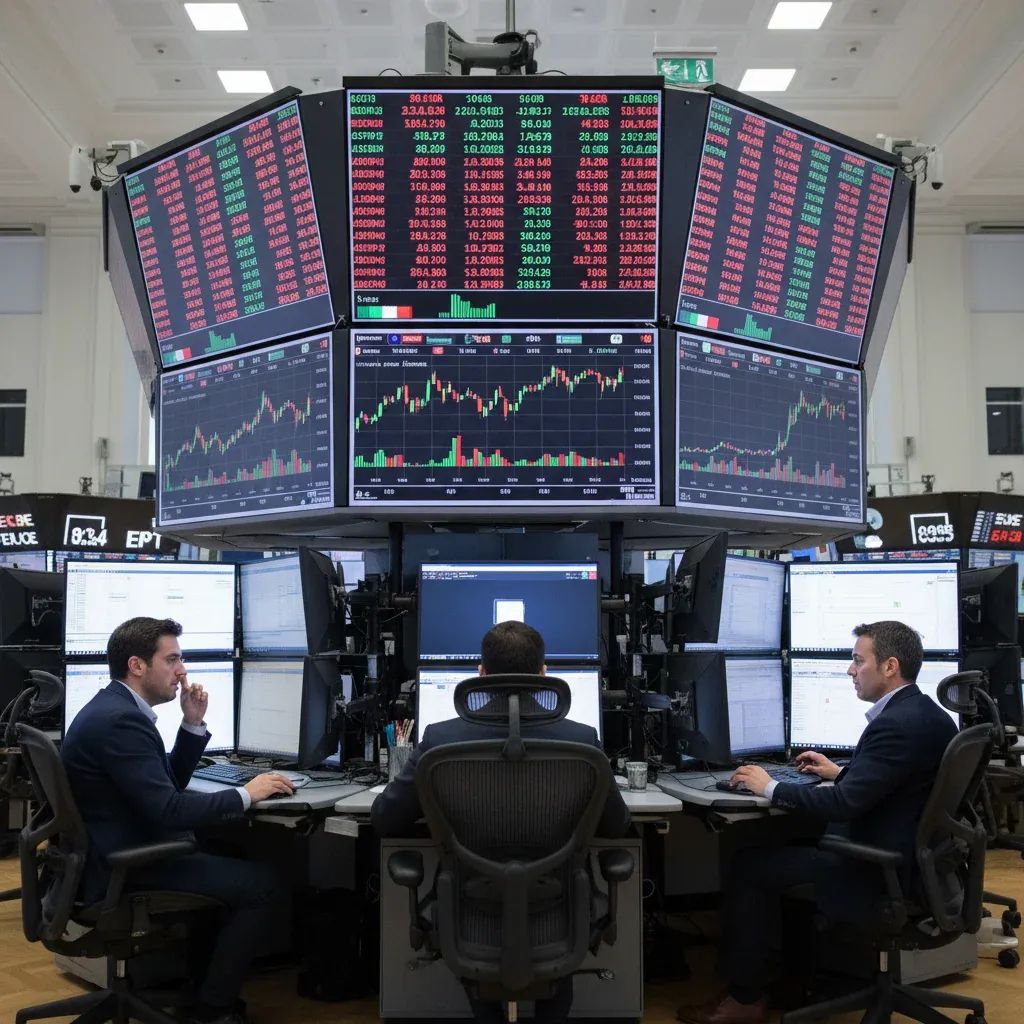
Italy's Milan stock exchange closed in positive territory, with the Ftse Mib index rising 0.5% to 49,825 points—a defensive performance during a session marked by renewed geopolitical anxiety over U.S.-Iran tensions near the Strait of Hormuz. The gain extends a remarkable year for Italian equities, which have now delivered a 24.5% return since January and briefly touched an all-time peak above 50,000 points earlier this month.
Why This Matters
• Defense stocks surged: Leonardo climbed 4.7% and Avio jumped 4.6%, reflecting investor appetite for geopolitical hedges.
• Banking consolidation continues: Monte dei Paschi rose 1.1% and Mediobanca gained 1.5% as merger talks swirl.
• Energy corridor risk: The Strait of Hormuz carries one-fifth of global oil and LNG supply—any closure would spike Brent crude past $150 per barrel.
Defense Titans Lead the Charge
The Italy defense sector emerged as the session's clear winner, with Leonardo and Avio posting gains above 4% each. STMicroelectronics added nearly 3%, while shipbuilder Fincantieri rose 2.6%. The rally mirrors a broader European trend favoring defense contractors as mixed signals out of Washington and Tehran revive concern over maritime security in the Persian Gulf.
Leonardo's surge comes despite a 22% decline from its March peak. The Rome-based aerospace and defense group reported a 31% year-on-year jump in orders during the first quarter, alongside revenue growth of 6.9%. Morgan Stanley recently lifted its 12-month price target to €82 from €71, citing NATO-driven demand and confidence in the firm's earnings trajectory. Analysts note that elevated defense spending across the European Union continues to underpin valuations, even as profit-taking has tempered earlier enthusiasm.
Avio, which manufactures propulsion systems and rocket engines, has benefited from both defense contracts and a resurgence in European space ambitions. The company's order book remains robust, and investor interest has intensified as Italy's government pledges to meet NATO's 2% GDP defense spending threshold.
Ferrari climbed 1.8% following the unveiling of its first all-electric model, the Luce, signaling the luxury carmaker's pivot toward electrification. The gain helped offset broader weakness in the automotive sector: Stellantis fell nearly 1%, weighed down by inventory concerns and slowing demand in key export markets.
Banking Sector Buzz Amid Merger Whispers
Italy's banking stocks traded mixed as speculation intensified around potential consolidation. Monte dei Paschi di Siena (MPS) advanced 1.1%, while Mediobanca rose 1.5%. Banco BPM barely moved, adding just 0.04%, as all three institutions declined to comment on press reports suggesting exploratory talks for a future merger.
A deal between MPS and Mediobanca has already been approved, with the incorporation of Mediobanca into MPS scheduled to take effect by the end of 2026. The merger involves a share exchange ratio of 2.45 MPS shares per Mediobanca share. The combined entity aims to consolidate corporate and investment banking operations, as well as high-net-worth private banking services, under a wholly owned "new" Mediobanca structure. MPS chief executive Luigi Lovaglio has described the move as essential for achieving scale and revenue diversification, targeting a combined group value of €50 billion.
Meanwhile, a second phase of consolidation appears to be taking shape. Industry sources report that Banco BPM is in advanced discussions to join forces with MPS, a union that would create Italy's third-largest banking group with roughly €450 billion in assets, 15% of domestic loans, 13% of deposits, and close to 2,900 branches. Banco BPM is reportedly engaging Goldman Sachs as an advisor, joining Citi and Lazard on the transaction team.
The potential tie-up faces several hurdles. Crédit Agricole, which holds a 22.8% stake in Banco BPM, would see its interest diluted to approximately 6.5% in the merged entity. Compensation discussions may involve the sale of around 300 branches—valued near €4.6 billion—to the French bank. Geographic overlaps in Tuscany, Lombardy, Liguria, and Veneto raise antitrust concerns, and the insurance portfolio remains contentious: MPS's agreement with AXA for life insurance expires in 2027, while Banco BPM operates its own life division.
What This Means for Investors
For Italy-based investors and portfolio managers, the resilience of the Ftse Mib index underscores the market's ability to absorb external shocks while capitalizing on domestic structural shifts. The year-to-date gain of 24.5% has outpaced most major European benchmarks, driven by a banking sector that benefits from positive interest rates and a defense industry enjoying multi-year NATO commitments.
However, volatility remains a constant companion. The Strait of Hormuz, a 21-mile-wide chokepoint for global energy flows, represents a systemic risk. Any disruption—whether from naval incidents, mining operations, or outright closure—would send crude oil and liquefied natural gas prices soaring, triggering inflationary pressures across Italy's import-dependent economy. Transportation costs, consumer goods, and manufacturing inputs would all rise, potentially forcing the European Central Bank to choose between inflation control and growth support.
Equity investors should monitor defense and energy names closely. While Leonardo, Avio, and Fincantieri offer geopolitical upside, their valuations have already priced in substantial optimism. Conversely, energy-intensive sectors such as chemicals, automotive, and logistics face margin compression if oil climbs above $100 per barrel.
Broader Market Context
On the losing side, Fineco Bank slid 2.2%, Unipol dropped 2.1%, cement maker Buzzi fell 1.2%, and Stellantis declined 1%. The sell-off in Fineco reflects profit-taking after a strong run, while Unipol faces headwinds from competitive pricing in the insurance sector.
The BTP-Bund spread—a key barometer of Italian sovereign risk—widened slightly to 74 basis points, with the 10-year Italian government bond yield holding steady at 3.73%. This stability suggests bond investors remain comfortable with Italy's fiscal trajectory, despite ongoing debates in Brussels over deficit targets and structural reforms.
The Ftse Mib's intraday path was uneven. The index dipped to around 49,400 points shortly after the opening bell before climbing back above 49,800 by mid-afternoon. The recovery was powered by luxury goods, industrials, and energy names, all of which attracted buying interest as traders weighed the balance between geopolitical risk and domestic earnings momentum.
Outlook and Caveats
Market participants should prepare for continued choppiness. The U.S.-Iran standoff carries tail risk that could upend the current equilibrium. If shipping lanes are contested or oil infrastructure is targeted, global equity markets would likely experience sharp declines—with emerging markets and energy-importing economies taking the hardest hits. Italy, which relies heavily on energy imports, would face an immediate inflation shock, complicating the ECB's policy calculus.
At the same time, the banking consolidation story offers a counterbalance. A successful MPS-Mediobanca integration, followed by a Banco BPM tie-up, would streamline Italy's fragmented banking landscape, reduce costs, and improve capital allocation. Investors with a multi-year horizon may find opportunities in these restructuring plays, provided antitrust clearances and stakeholder negotiations proceed smoothly.
For now, the Ftse Mib's 0.5% gain reflects a market that is neither euphoric nor fearful—simply watchful. The next few sessions will reveal whether Italy's equity rally can extend its remarkable run or whether external shocks finally force a correction.


