
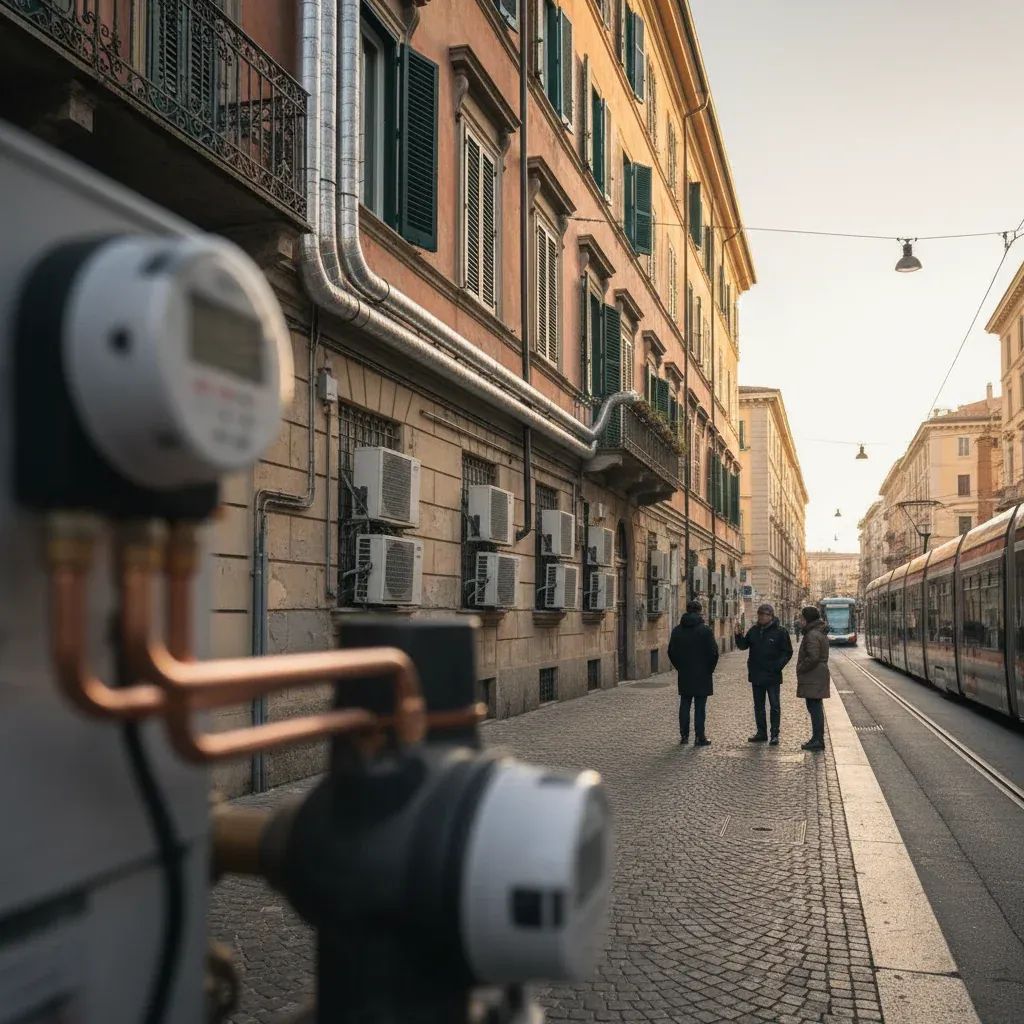
Europe's benchmark natural gas contract is holding above €47 per megawatt-hour at the Title Transfer Facility (TTF) exchange in Amsterdam, a price level that directly impacts utility bills, industrial costs, and inflation across the continent—including Italy. June futures climbed 0.69% to €47.30/MWh in early trading, before settling at €47.11/MWh with a modest 0.3% gain, reflecting persistent global supply anxiety tied to the ongoing closure of the Strait of Hormuz and fierce competition for liquefied natural gas (LNG) cargoes in Asia.
Why This Matters
• Household budgets: Italian consumers are paying roughly €0.53 per standard cubic meter for gas—well above historical norms and a significant strain on monthly energy bills.
• Inflation pressure: The Italy National Institute of Statistics estimates that elevated gas prices are contributing roughly 0.5 percentage points to the country's inflation rate, now running above 3%.
• Supply risk: Europe's gas storage sits at just 36.7% capacity—eight percentage points below year-ago levels—raising concerns about next winter's security of supply.
• Hormuz effect: With nearly 20% of global LNG passing through the Strait of Hormuz, the waterway's disruption since late February is tightening availability and pushing Asian spot prices up by 49% year-on-year, forcing European buyers to compete harder for alternative cargoes.
Geopolitical Bottleneck Drives Premium
The Strait of Hormuz, which connects the Persian Gulf to the Indian Ocean, remains effectively closed to commercial tanker traffic amid ongoing conflict in Iran. That narrow passage normally carries more than 90% of Qatar's LNG exports—Qatar being one of the world's largest suppliers—plus roughly one-fifth of seaborne oil. Insurers and shipping companies have suspended sailings through the chokepoint, rerouting vessels or halting loadings altogether.
As a result, Asian spot LNG prices for July delivery rose to approximately $18.81 per million British thermal units (MMBtu) at the Japan-Korea Marker in late May. European importers, who already depend on American LNG for 58% of their seaborne supply, now face stiffer competition from Chinese, Indian, and South Korean buyers scrambling to secure cargoes from Atlantic Basin exporters. That bidding war is keeping European gas prices elevated even as the continent heads into the low-demand summer season.
Italy's Exposure and Industrial Impact
Italy remains one of the most vulnerable economies in Europe to natural-gas price swings. The country generates a significant share of its electricity from gas-fired plants and relies on imports to meet nearly all domestic demand. The Italy Regulatory Authority for Energy, Networks and Environment (ARERA) pegs the current reference price for residential customers at around €0.529/Smc at the Virtual Trading Point (Punto di Scambio Virtuale – PSV), the Italian gas hub, which tracks TTF movements closely.
For manufacturers—especially in energy-intensive sectors such as ceramics, glass, chemicals, and steel—the sustained €47/MWh range translates into higher production costs that either squeeze margins or get passed along to customers. Small and medium enterprises, which form the backbone of Italy's industrial landscape, have limited hedging capacity and absorb spot-market volatility more directly than multinational corporations.
Meanwhile, the fertilizer industry, which relies on natural gas as both feedstock and fuel, is seeing parallel pressures: roughly one-third of global seaborne fertilizer trade also transits Hormuz. That dual squeeze threatens both input costs for Italian agriculture and downstream food prices.
Storage Shortfall Looms Before Next Winter
European Union gas inventories stood at 35.8% of capacity on May 13, 2026, well below the five-year average of 48.8% for that date. By May 28, 2026, the figure had crept up to 36.7% across the EU, but still lagged the previous year by eight percentage points. Under EU Regulation 2017/1938, member states are expected to reach 90% storage by November 1 each year to ensure winter resilience.
Italy's Ministry of Ecological Transition has emphasized the need to accelerate injection rates over the summer, but restocking is expensive when spot prices hover near €47/MWh. A cold snap in early 2026 depleted reserves faster than normal, and the window to refill before autumn is narrowing. Analysts at Bank of America estimate that if Hormuz remains closed through year-end, Europe could face a net gas deficit of 27 billion cubic meters relative to 2025 volumes—a shortfall that would force deeper inventory draws next winter and potentially drive TTF above €60/MWh by year-end, according to Trading Economics forecasts.
Forecast Divergence: Short-Term Volatility, Long-Term Easing
Market outlooks for the remainder of 2026 split sharply depending on assumptions about Middle East diplomacy and infrastructure. Goldman Sachs has revised its second-quarter TTF forecast upward to €45/MWh—from an initial €36/MWh—citing the Hormuz disruption. If the strait reopens by June, as some optimistic scenarios suggest, prices could stabilize in a €45–€55 range through summer, supported by lower cooling-season demand in Europe and rising renewable generation.
By contrast, a protracted closure into the fourth quarter could push European gas toward €80/MWh, according to stress scenarios from the Oxford Institute for Energy Studies. That institute models a worst-case loss of roughly 87 billion cubic meters of LNG export capacity compared with pre-crisis baselines, enough to double European import costs to approximately $28/MMBtu over six months—and as high as $54.90/MMBtu if combined with shifts in U.S. export policy.
For 2027, Bank of America anticipates a return to surplus conditions, with TTF potentially easing back to €30/MWh as new liquefaction capacity in the United States, Qatar, and Mozambique comes online and Asian buyers pivot harder towards renewables and nuclear power. Several Asian governments—including China, India, South Korea, and Vietnam—are already re-evaluating gas as a transition fuel, favoring domestic coal, Russian pipeline imports, and accelerated solar and wind deployment to insulate themselves from LNG price spikes.
What This Means for Residents
For households: Expect minimal relief on utility bills through the summer. ARERA typically updates regulated tariffs quarterly; the July–September period will reflect current elevated wholesale prices. A typical Italian family consuming 1,400 cubic meters per year could see annual gas costs remain roughly €200 higher per year compared to 2024 levels, even if prices moderate slightly in low-demand months.
For investors: Energy-sector equities—particularly midstream infrastructure, regasification terminals, and renewable developers—stand to benefit from sustained policy focus on supply diversification. Italy's National Recovery and Resilience Plan allocates funding for additional LNG import capacity and grid interconnections, projects that gain urgency as pipeline-gas dependence falls.
For business owners: Locking in fixed-price contracts for the next heating season may prove wise if TTF drifts lower over summer; waiting risks exposure to a potential autumn rally. Energy audits and efficiency upgrades qualify for tax credits under the Italy Ecological Transition Ministry's industrial decarbonization schemes, offering a hedge against volatile fuel costs.
Regional Ripple Effects and Policy Response
The European Commission has urged member states to coordinate winter-preparedness measures, including voluntary demand-reduction targets and cross-border solidarity mechanisms. Italy's interconnections with Algeria via the TransMed pipeline and with Libya via GreenStream provide some buffer, but both routes have faced maintenance issues and political risk in recent years.
Norwegian pipeline flows, which account for a large share of European baseload supply, have been steady but cannot compensate for a sustained LNG shortfall. An unplanned outage at Norway's Asgard field in mid-May briefly spiked TTF above €49/MWh before repairs restored output.
At the same time, a record-breaking heat wave across southern Europe in late May is driving up electricity demand for air conditioning, increasing gas burn in power plants and tightening the supply-demand balance even during what is normally a shoulder season. Climate volatility adds another layer of uncertainty to inventory planning and price forecasting.
Long-Term Structural Shift
Beyond the immediate Hormuz crisis, Europe's gas market is undergoing a structural transformation. The loss of Russian pipeline volumes since 2022 has been offset by a combination of Norwegian pipeline gas, expanded LNG imports—chiefly from the United States—and aggressive energy-efficiency campaigns. Italy has reduced overall gas consumption by roughly 10% since 2021 through industrial fuel-switching, building retrofits, and mild winters.
Yet the country's gas infrastructure remains central to the energy system. The Italy Gas Storage Operator (Stogit) manages underground facilities with a combined working capacity exceeding 18 billion cubic meters, representing a strategic asset for national and regional security. Policymakers are weighing whether to mandate higher storage obligations or subsidize injection costs during periods of extreme price volatility.
In the longer horizon—looking toward 2030 and beyond—renewables deployment, nuclear re-evaluation, and hydrogen pilot projects are expected to erode gas's share of the energy mix. Until then, Italian consumers, businesses, and policymakers will navigate a market shaped as much by geopolitical developments in the Persian Gulf region as by domestic weather and regulatory choices.
Bottom line: The €47/MWh level is not catastrophic by 2022 peak standards, but it is uncomfortably high for an economy still recovering from pandemic shocks and grappling with elevated inflation. How long prices stay elevated—and whether they spike again next winter—depends largely on geopolitical developments in the Persian Gulf region.


