
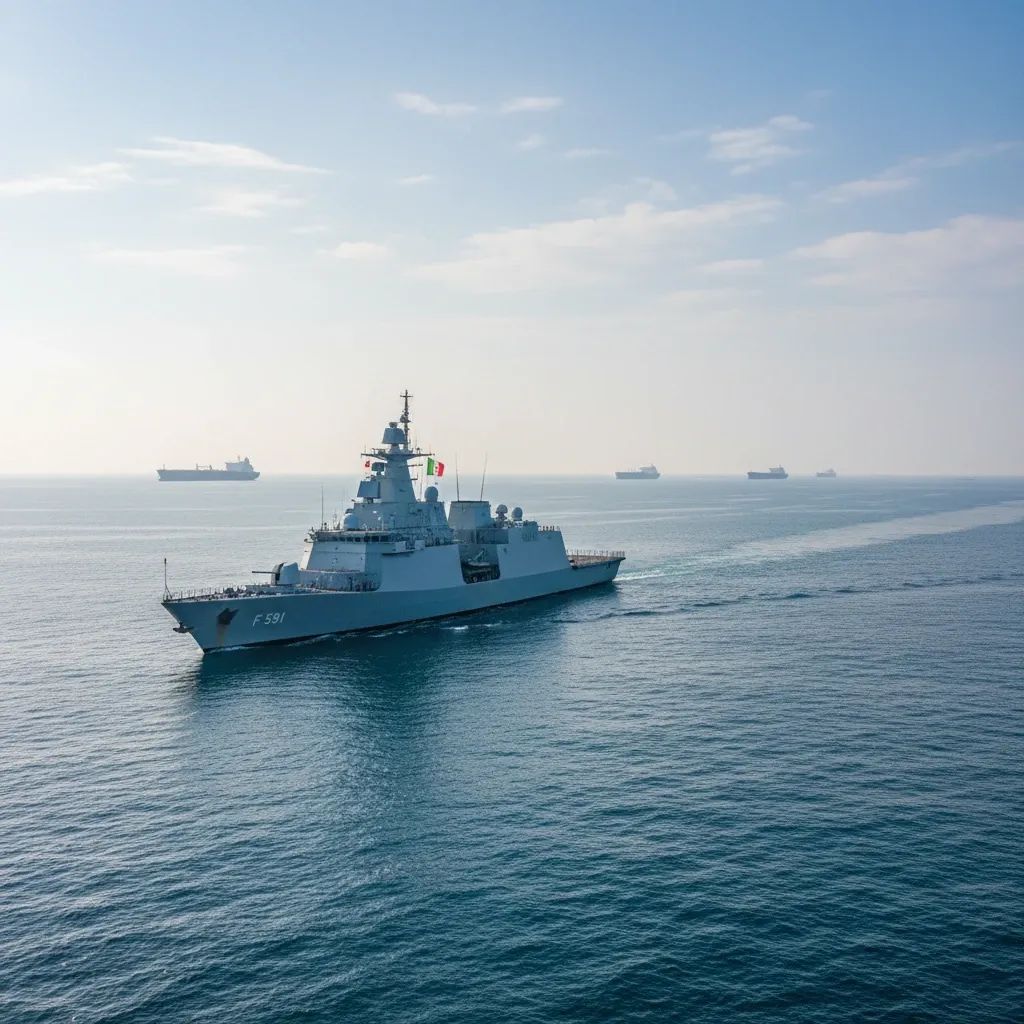
The Italian government is preparing to deploy specialized naval vessels to the Strait of Hormuz, contingent upon parliamentary approval—a move that will mark Italy's latest contribution to a rapidly forming European-led maritime security coalition. The commitment, announced by Prime Minister Giorgia Meloni at a summit in Paris on April 17, 2026, positions Italy's advanced mine-clearing capabilities as a cornerstone of the multinational effort to maintain freedom of navigation through one of the world's most critical shipping chokepoints. This is a potential deployment designed to prevent future disruptions, following Iran's current temporary reopening of the strait under a 10-day ceasefire.
Why This Matters
• Parliamentary vote required: Any Italian naval deployment hinges on approval from the Italian Parliament, per constitutional requirements—a debate now fracturing the political landscape. Parliament must formally authorize the mission, with voting procedures to be determined by the legislative calendar, likely within weeks.
• Mine-clearing expertise: Italy's 12 amagnectic minesweepers are among Europe's finest, designed to neutralize magnetic-influence mines that Iran has reportedly deployed in the strait.
• Energy security implications: The Strait of Hormuz handles roughly 20% of global oil transit; approximately 40% of Italy's energy imports transit through this chokepoint. A prolonged closure could spike fuel costs, disrupt supply chains, and inflate consumer prices across Italy.
• Timeline and conditions: Deployment will begin only after hostilities between Iran and the United States have definitively ceased and a durable ceasefire is in place. The current 10-day truce is temporary; a permanent agreement is essential for mission launch.
The Summit: A European Power Play
France and the United Kingdom convened approximately 50 countries and international organizations at the Élysée Palace on April 17, 2026, assembling what diplomats have dubbed a European maritime coalition. Among the attendees were Germany's Friedrich Merz, UK Prime Minister Keir Starmer, and Meloni, alongside observers from China and India. Even Ukrainian President Volodymyr Zelensky joined by video link.
The summit's architects, French President Emmanuel Macron and Starmer, framed the operation as strictly defensive: mine clearance, convoy escort, and surveillance to guarantee freedom of navigation once Iran's temporary reopening becomes permanent. Starmer confirmed that more than a dozen nations have pledged military assets, with detailed force composition to be finalized at a military planning session in London in the coming days.
Meloni's statement was measured but firm: "Europe is ready to do its part in the framework of international security, together with our partners." She emphasized that Italy's participation would require coordination with "all regional and international actors" and would proceed only under a defensive posture once hostilities have ended.
Germany, too, pledged its military resources. Merz added a caveat that many in Rome share: the mission needs a "solid legal foundation, for example, in the form of a UN Security Council resolution."
Yet the gathering's dynamics were upended by a characteristic Donald Trump broadside. As the European leaders held their press conference, the U.S. President posted on Truth Social: "Now that the situation in the Strait of Hormuz is resolved, I received a call from NATO asking if we needed help. I told them to stay out of it, unless they just want to fill their ships with oil. They were useless when we needed them: a paper tiger."
The remark underscored the transatlantic rift driving Europe's decision to act independently—a strategic recalibration with profound implications for Italian defense planning.
What This Means for Italy
Italy's potential deployment carries both symbolic and tangible weight. The Italian Navy operates 12 Lerici- and Gaeta-class mine countermeasure vessels (MCM), built with fiberglass hulls that render them non-magnetic—a critical feature when operating in waters seeded with magnetic-influence mines. These vessels deploy high-resolution 3D sonar and autonomous underwater drones to identify and neutralize ordnance at depth.
This expertise is not theoretical. Italy has deployed similar capabilities in Operation Aspides (Red Sea and northwestern Indian Ocean) and Operation Mare Sicuro (Mediterranean), accumulating decades of operational experience in volatile maritime corridors.
The financial burden is real. Italy's 2024 overseas military missions cost taxpayers €1.49 billion, up from €1.31 billion the previous year. The proposed Hormuz deployment, likely involving both minesweepers and frigates for convoy escort, could add an estimated €10–15 million monthly to that total, assuming a mission duration of several months. This additional spending would require parliamentary appropriation beyond Italy's existing overseas mission budget, meaning potential reallocation of defense resources or supplementary funding requests.
For Italian shipping companies, the stakes are existential. Confitarma, Italy's shipowners' association, has repeatedly urged the government to protect Italian-flagged vessels and seafarers. The Strait of Hormuz is a lifeline; any prolonged closure could spike fuel costs for consumers, disrupt supply chains, and inflate prices across Italy.
The Parliamentary Battle Ahead
Back in Rome, the political calculus is anything but straightforward. The center-right coalition—comprising Meloni's Fratelli d'Italia, Forza Italia, Lega, and Noi Moderati—largely supports the deployment, though internal messaging varies.
Forza Italia was swift to back the mission. Spokesman Raffaele Nevi framed it as an extension of Italy's existing commitments: "Ensuring the security of global commerce is consistent with what we already do at Hormuz and Suez." He echoed Meloni's insistence that deployment occur only after hostilities cease.
Noi Moderati leader Maurizio Lupi agreed, stressing the importance of a "European-led international framework."
The Lega, by contrast, has said nothing publicly. Party leader Matteo Salvini and senior lawmakers declined to comment. Internal sources suggest the silence signals tacit approval rather than dissent.
Opposition parties, however, are more fractured. The Movimento 5 Stelle (M5S) issued the sharpest rebuke: "No Italian military expedition is conceivable unless it occurs under the aegis of the United Nations, necessary to clearly separate ourselves from unilateral initiatives." The party questioned whether a UN mandate should be a prerequisite for parliamentary approval.
Alleanza Verdi e Sinistra (AVS) leaders Nicola Fratoianni and Angelo Bonelli echoed the call for a UN mandate and added a second condition: the ceasefire must be permanent, not the current 10-day truce.
The Partito Democratico (PD), the largest opposition force, has been conspicuously silent. The sole voice was Filippo Sensi, a reformist within the party, who said it is "vital to reopen the Strait of Hormuz" and that "Europe's role is fundamental—each should do its part."
The centrist opposition is more amenable. Italia Viva indicated support "if there is a shared international framework," while Più Europa leader Riccardo Magi backed a "European expedition." Azione's deputy secretary Ettore Rosato was unequivocal: "We will support all initiatives where Italy contributes to international stability within the rules."
The Geopolitical Puzzle
The Hormuz mission unfolds against a backdrop of shifting global alignments. Iran announced it has "temporarily reopened" the strait following the 10-day ceasefire, a move UN Secretary-General António Guterres called "a step in the right direction." Yet the U.S. embargo on Iran remains in force, and Trump's disdain for NATO cooperation suggests Europe must proceed with or without American blessing.
Germany's Merz floated the possibility of U.S. participation, saying it would be "desirable" for Americans to join. Meloni spoke of coordination with "regional and international actors," a formulation open to interpretation. France and the UK, however, have been explicit: the mission excludes direct involvement by conflict protagonists—namely, the United States and Iran.
The inclusion of China and India as observers and the participation of Gulf Arab states (Kuwait, Saudi Arabia, Qatar) reflect the strait's strategic importance beyond Europe. For Italy, this represents both an opportunity to project influence and a risk of entanglement in a wider geopolitical confrontation.
Precedents and Costs
Italy's naval deployments are not without precedent. Operation Mare Nostrum (2013) cost approximately €10.5 million monthly. Operation Aspides and EUNAVFOR MED Irini together carried a €9.8 million annual price tag in 2024. The most expensive mission, Mare Sicuro, ran to €104 million in 2023.
Since World War II, Italy has participated in 120 overseas missions, with 35 still active. The Hormuz deployment would extend that legacy—but also test Italy's ability to balance European solidarity, domestic political divisions, and fiscal prudence.
What Happens Next
Meloni has committed to seeking parliamentary authorization, a process that could take several weeks. Parliament will schedule formal debate and voting procedures to authorize the mission. Military planners will reconvene in London to finalize force composition, Rules of Engagement, and coordination protocols. Italy's specialized minesweepers are expected to play a leading role, complemented by frigates for convoy protection.
The mission's success hinges on three variables: a durable ceasefire (replacing the current temporary truce), broad international legitimacy (preferably a UN resolution), and clear delineation from unilateral action. For Italian residents, the outcome will ripple through fuel prices, shipping costs, and geopolitical stability—a reminder that distant naval operations carry immediate, tangible consequences.


