
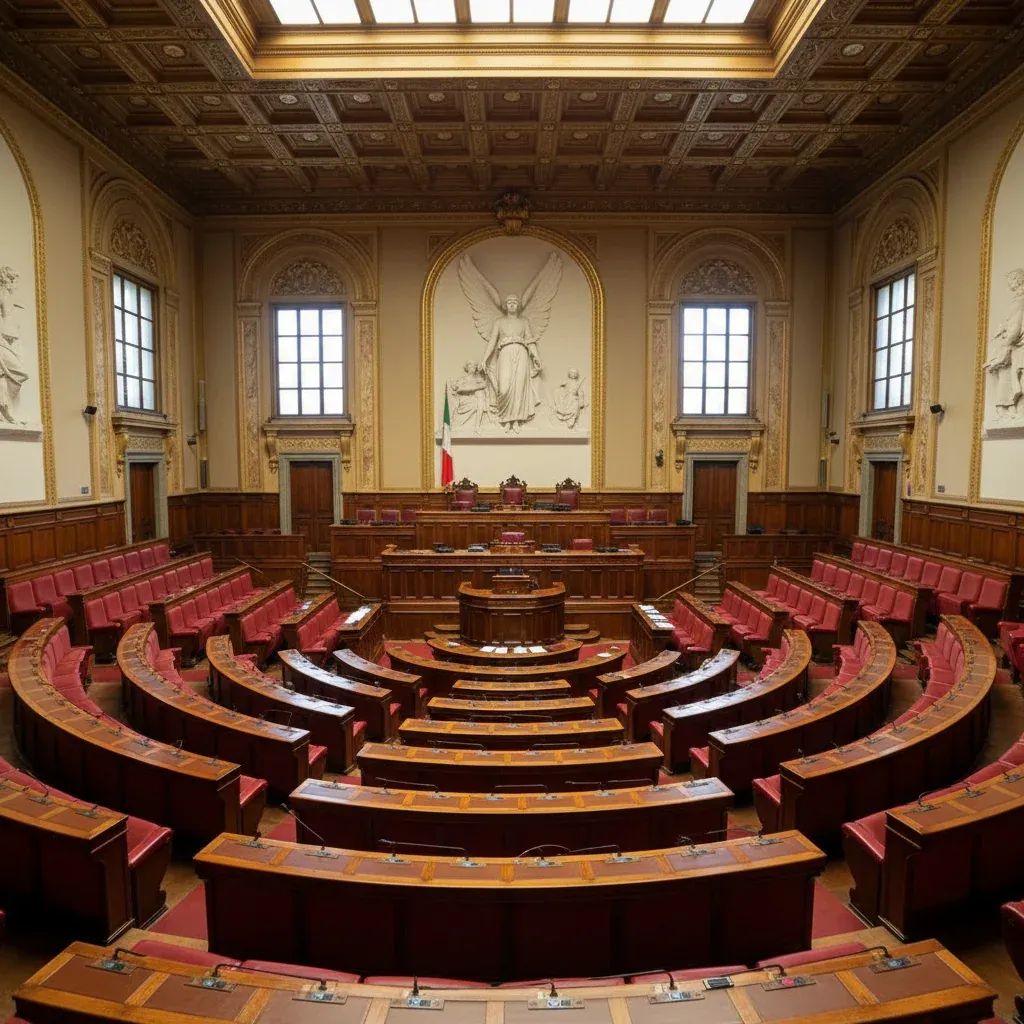
Italy's ruling coalition has reached a framework for overhauling the country's electoral rules—one that would exchange the current mixed majority-minority system for a proportional apparatus with a decisive bonus to whoever clears 40% of the national vote. According to coalition sources, the move aims to reduce fragmented coalition-building and strengthen government stability, though it carries the political cost of reducing voter agency in Parliament's final composition.
Why This Matters
• Your vote would no longer pick the MP: Under the proposal, candidates would be elected based on their position in a party-controlled list—with no preference voting allowing voters to select individuals they prefer within that list.
• The 40% threshold: Any coalition surpassing this threshold would automatically receive 70 additional Chamber seats and 35 Senate seats, transforming narrow pluralities into commanding majorities.
• Candidates for premier named in advance: Party coalitions would declare their chosen prime minister candidate in their official platform, not on the ballot itself—a shift toward quasi-presidential elements in Italy's parliamentary tradition.
• Timeline accelerating: Parliamentary review is expected within days; passage appears likely given Meloni's coalition commands both chambers.
What Italian Voters Could Experience Under the Proposed Rules
The proposed system—informally called the "Stabilicum" for its prioritization of government stabilità—would represent the most significant restructuring of Italy's electoral framework in a decade, according to government officials. The mechanics would work like this: coalitions that secure 40% or more of votes nationwide would lock in 70 extra seats at the Chamber of Deputies and 35 at the Senate before any other allocation occurs. This predetermined bonus would transform a plurality vote into a supermajority government. If no coalition reaches that threshold, but two coalitions finish between 35% and 40%, a second round would determine the winner.
The current system—the Rosatellum, in place since 2017—assigned roughly one-third of seats through single-member districts and two-thirds proportionally. The Stabilicum would abandon single-member districts entirely, collapsing everything into pure proportional distribution plus the majority bonus. For residents accustomed to voting for local MPs directly, this would mark a decisive shift toward party-centric representation.
The Preference Vote Question: A Coalition Divide
A flashpoint within the coalition involves whether voters would retain the power to rank candidates within party lists. Fratelli d'Italia (Brothers of Italy), Meloni's own party, has advocated for preserving preference voting as a democratic safeguard; the League (Lega) and Forza Italia have resisted, arguing that internal preference battles could fracture coalition discipline once government begins.
The current proposal: preference voting would be eliminated. Parties would deploy closed lists, meaning that party leadership alone determines candidate order. A voter who supports the Democratic Party (PD) within a coalition would no longer influence which PD candidates enter Parliament—the party would decide. This system last appeared in Italy during the Porcellum era (2005–2014), which drew accusations that it insulated politicians from grassroots scrutiny and concentrated power inside party headquarters. The Constitutional Court partially struck down the Porcellum in 2014, citing concerns about excessive distortion of voter intent.
What this would mean on the ground: A resident in Milan or Naples would participate in coalition selection, but not candidate selection. The accountability mechanism that once ran from voter to individual MP could be severed.
Italy's Electoral Reform Pattern
Italy has rewritten its election law multiple times in recent decades—reflecting a recurring tension: proportional systems guarantee representation but produce unstable, fractious governments; majoritarian systems create strong executives but alienate minority voters.
Historically, Italy has experimented with various approaches. Electoral reform experts note that systems providing substantial seat bonuses have periodically raised constitutional concerns, particularly regarding whether seat allocations fairly reflect voter intent. The Constitutional Court has repeatedly held that disproportionate seat allocations require justification and safeguards.
The Stabilicum attempts to anchor its bonus to a 40% threshold—high enough that most elections would still require the bonus to yield a majority, yet low enough that in Italy's fragmented landscape, it would likely trigger frequently. In the 2022 general election, the winning coalition captured 43.8% of votes; the Stabilicum's 40% bar would likely favor any future coalition competitive enough to lead.
How the 40% Threshold Would Reorder Italian Politics
Setting the bar at 40% would create incentives toward discipline and alliance-building before election day. A coalition polling at 39% would face pressure: it would receive no bonus, possibly triggering a runoff, or it would enter Parliament with proportional representation—without a working majority. This would incentivize the merger of smaller parties into larger blocs pre-election, reducing voter choice among micro-parties but also creating incentives for broad coalitions that may become unstable after taking power.
The runoff mechanism—applying only if two coalitions finish between 35% and 40%—would be theoretically a safety valve but practically rare. Italian electoral history suggests that once patterns crystallize, one coalition typically runs ahead.
Where the Premier Candidate Appears—And Where It Doesn't
One procedural element in the proposal: voters would encounter the name of each coalition's designated prime minister candidate in official platform documents (submitted to the Ministry of Interior) but not on the ballot itself. This sidesteps a constitutional question that complicated the 2015 Italicum law, which attempted to print premier candidates directly on voting slips. The Constitutional Court questioned whether doing so aligned with Article 92 of the Constitution, which reserves PM selection to parliamentary process.
The Stabilicum's approach would be a compromise: quasi-presidential in character (voters would know which leader each coalition backs) but constitutionally structured (they would not formally vote for the PM). It would give elections a leadership-focused aspect without moving into presidential mechanics.
Opposition Response and Potential Constitutional Review
The Democratic Party, Five Star Movement, and smaller left-aligned parties have opposed the Stabilicum, arguing it represents a partisan rewrite designed to entrench current electoral advantages. Opposition figures contend that reforming electoral rules before elections expected in 2027—when current polling patterns are visible—raises democratic concerns. Leaders of the PD and Five Star have declined Meloni's offers of dialogue, viewing the reform as unilateral imposition.
Meloni's government has stated it intends to proceed with or without opposition support. With majorities in both chambers, passage appears likely absent extraordinary procedural delay.
However, legal experts suggest the Constitutional Court may review the proposal. The same body that halted the Porcellum's bonus mechanics in 2014 and struck provisions of the Italicum in 2015 could examine whether the Stabilicum satisfies Article 48 of the Constitution, which guarantees equal suffrage and protects the principle that voter intent should be reflected in parliamentary composition. A bonus of 70 seats in a 400-member chamber for crossing 40% is mathematically significant—raising questions about whether the distortion is justified by governability concerns.
Coalition Tensions Over Preference Voting
Internally, Fratelli d'Italia has pushed for allowing voters to mark preferences within lists, contending that doing so enhances democratic legitimacy. Lega and Forza Italia, by contrast, worry that preference campaigns inside the coalition could pit party members against each other and destabilize working relationships once government takes office. The Lega, in particular, reportedly fears that internal candidate competition could weaken its negotiating position within a coalition Cabinet.
The current proposal eliminates preferences, favoring the Lega and Forza Italia position—signaling that coalition unity could be ranked above voter agency in selecting representatives.
Thresholds and Seat Distribution
Individual parties would still need to clear a 3% national threshold to enter Parliament; coalitions would face a 10% bar. These figures would remain unchanged from the Rosatellum. However, because the majority bonus would apply to coalitions rather than parties, smaller coalition members would see their seat counts affected. A junior coalition partner with 8% of the national vote would historically receive roughly 8% of 630 total Chamber seats (about 50). Under the Stabilicum, after the coalition's 70-seat bonus is allocated, that partner's proportional share of remaining seats would decline.
Parliament's Timeline and Next Election Window
The bill would be formally introduced in the Chamber of Deputies in coming days, with the government expected to fast-track debate. Opposition parties would likely employ procedural resistance—amendments, delays, possible filibustering—but lack the votes to prevent passage. If approved in both chambers and not blocked by Constitutional Court review, the law could govern the next general election, likely scheduled for 2027.
What Residents Should Anticipate
Under the Stabilicum proposal, the coming election would become a choice among pre-made coalitions and their declared leaders—a quasi-presidential ballot structured within parliamentary language. Individual candidate quality, local track records, and grassroots support would matter less. Party positioning within coalition lists determines outcomes. The result could be a government with a commanding parliamentary majority but one that represents less than 40% of the electorate more forcefully than ever before. That tension—efficiency versus representation—would define Italian political life if this law is finalized and survives any Constitutional Court review.
For now, the government moves forward, the Chamber and Senate are set to debate, and the Constitutional Court may have a final say. The Stabilicum's fate rests partly on law, partly on politics, and partly on whether Italy's highest judicial authority views the electoral transformation as a democratic choice or a democratic concern.


