
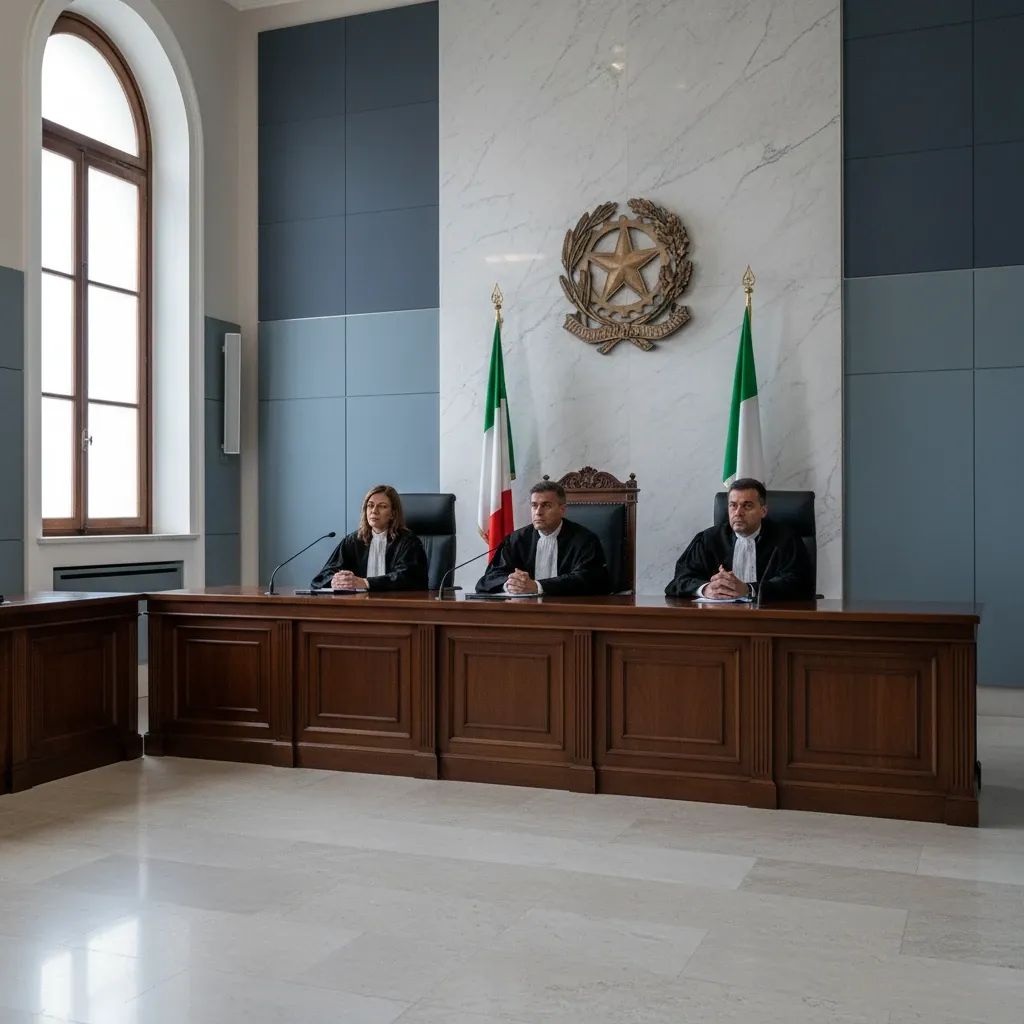
Italy faces a definitive choice this weekend on whether to fundamentally restructure how prosecutors and judges operate within its constitutional system. Voting takes place Sunday 22 and Monday 23 March 2026, with no quorum requirement—meaning whatever emerges from the ballot boxes becomes law, regardless of turnout. The referendum presents competing visions of how judicial independence is best protected: through unified institutional self-governance or through structural separation and external oversight.
Why This Matters
• The turnout paradox flips traditional referendum dynamics: Unlike past votes, lower participation now favors "No" while high turnout helps "Sì"—making campaign mobilization the decisive factor, not voter apathy. Early surveys show near-identical support (50.4% for "Sì", 49.6% for "No" among likely voters), with roughly 40% remaining undecided.
• Governance gets restructured, not judicial speed: The reform splits the CSM into separate councils and creates a new High Disciplinary Court—but does nothing to reduce case backlogs or accelerate the 5-10 year trial timelines that plague Italian courts.
• Career separation becomes permanent and constitutional: New magistrates will immediately enter distinct professional tracks with no ability to transfer. Existing judges and prosecutors complete their careers under current rules, but the unified magistracy disappears generationally.
• Disability voting access simplifies participation: Italy's Interior Ministry confirmed this week that citizens can present the EU Disability Card at polling stations rather than producing medical documentation—a practical expansion of voting rights taking effect immediately across all elections.
The Government's Case: Structural Independence
Prime Minister Giorgia Meloni descended into her most direct campaigning Friday evening, appearing on the podcast "Pulp" with rapper Fedez and YouTuber Mr. Marra. For nearly an hour, she confronted the political framing head-on. "The opposition manufactured a narrative that this is a referendum against me," she stated. "Their campaign slogan is literally 'go vote to send Meloni home.' But that logic is backwards. If you vote 'No' purely to remove me from power, you end up keeping both me in office AND a broken justice system. That's not a good bargain."
Foreign Minister Antonio Tajani, leader of Forza Italia, crystallized the technical argument Friday. "When an Italian citizen sees a judge, they should perceive someone standing above suspicion. A judge who attended university with the prosecutor, who joins the same professional associations, perhaps even socializes with his family—how can that judge maintain genuine independence? Even with perfect intentions, the familiarity creates reasonable doubt about impartiality."
The government's logic contains coherence: current law permits judges and prosecutors to transfer between functions—meaning an official can spend a decade as a judge, accumulating relationships and institutional knowledge, then shift to prosecution. Though rare in practice (roughly 2-3% annually), the possibility creates structural incentive misalignment. Separating careers would eliminate this conflict, the reasoning goes, making the judiciary less vulnerable to perceptions of bias.
Italy's center-right coalition—Fratelli d'Italia, Lega, Forza Italia, and Noi Moderati—presents a united front. They argue the current unified magistracy enables what they call "factional behavior": prosecutors and judges operating within informal networks that prioritize institutional loyalty over impartial case assessment.
Where the Judiciary Draws Its Line
The National Association of Magistrates (ANM), representing roughly 8,000 practicing judges and prosecutors, issued a near-unanimous opposition statement that carries institutional weight because it originates from within the system itself—not from lawyers, academics, or opposition politicians, but from the professionals who would operate under these new rules.
The ANM's resistance centers on institutional autonomy. By splitting the Consiglio Superiore della Magistratura (CSM) into two separate councils, they argue, the reform hollows out the judiciary's collective voice and capacity to resist executive pressure. Once prosecutors operate under their own governance structure, insulated from judges' institutional protections, successive governments can more easily reshape prosecutorial priorities through ministerial influence. This concern is not theoretical: Austria, France, and Germany all feature prosecutors operating under greater executive authority than Italy currently maintains—and the outcomes prove mixed.
Magistrates also invoke a historical concern: the 1948 Constitution itself emerged from anti-Fascist framers specifically to insulate courts from political weaponization. Prosecutors operating under government hierarchy or separate from judges loses the protective cocoon that Italy's constitutional settlement intentionally created. "We're being asked to abandon the inherited model precisely because it works against politicians," one senior magistrate circulated among judicial groups. "Now that a right-wing government wants reform, we're supposed to believe this is about efficiency rather than control."
A secondary ANM anxiety focuses on prosecutorial mission creep. Separated from the unified magistracy, prosecutors lose the institutional restraint exercised through shared professional councils. They risk becoming government attorneys—functionaries tasked with securing convictions rather than pursuing truth impartially. "Justice that is strong with the weak and weak with the strong," the ANM warned in internal documents circulating among magistrates this week. The fear is particular and concrete: once prosecutors stand apart structurally, they become exposed to political instruction or selective deployment in prosecuting government critics while protecting allies.
When Symbols Override Substance
Senate President Ignazio La Russa crystallized the case for "Sì" by invoking a specific court decision he characterized as emblematic of judicial overreach. An Australian woman's children were removed from her custody and placed in foster care following a court order. "The court accused the mother of committing the 'crime of hope' because she said 'I hope this ends soon,'" La Russa recounted on RAI's flagship news program Friday. "She was cited in the ordinance for expressing hope. This is the evidence that magistrates operate without accountability, requiring structural reform to restrain them."
The case became a touchstone for "Yes" voters—a concrete horror story illustrating abstract concerns about judicial autonomy. Whether the original judgment was correctly decided matters less than its symbolic power: it represents to center-right voters the perception that courts operate unchecked, immune from consequences for evidently wrong decisions.
Arianna Meloni, her sister and head of Fratelli d'Italia's political secretariat, anchored the government's final rally Friday in Rome's Palazzo dei Congressi. Her speech centered on family and political origin story. "We began political activism immediately after 1992—right after judges Falcone and Borsellino were assassinated for defending justice," she told a packed hall of party veterans and younger activists. "People now ask: how can we possibly oppose the magistracy? We don't. This reform proves our commitment by strengthening judicial autonomy and independence. It removes politics from governance of the courts—not by politicizing prosecutors, but by clarifying their distinct constitutional role."
The crowd applauded moderately until Antonio Di Pietro, the legendary anti-mafia prosecutor who pursued corruption through the 1990s and became synonymous with prosecutorial independence, took the microphone. "It's time to rewrite the false narratives the anti-mafia establishment has propagated," Di Pietro said. His endorsement of "Sì" carried symbolic weight that technical arguments alone could not muster.
Undersecretary Alfredo Mantovano, addressing wavering voters, deployed the most direct warning: "If you vote 'No' thinking it removes the government, you're fooling yourself twice over. The government stays in place, and you forfeit the reform you implicitly support."
The Opposition's Constitutional Concern
Former Justice Minister Andrea Orlando of the Democratic Party invoked the gravest language available. "What hangs in balance isn't procedural refinement. It's the constitutional framework built over eighty years," he said Friday in a video released across social media. "They claim the goal is speeding trials and strengthening defense rights. The opposite occurs. Subordinating the judiciary to executive power doesn't improve justice—it politicizes it."
The left's case hinges on constitutional principle. Italy's 1948 Constitution, written in deliberate reaction to Fascism, established a unified, self-governing judiciary explicitly to insulate courts from political interference. Separating magistrates necessarily subordinates prosecutors to somewhere in the power structure—either formally within the executive (following Germany's model) or effectively under political influence (reflecting France's experience). Either trajectory, they argue, weakens what the Constitution intends: a neutral arbiter standing between state power and individual rights.
Additionally, they note the reform addresses none of Italy's actual justice dysfunction: trials lasting 5-10 years, case backlogs numbering in the hundreds of thousands, prisons operating above capacity. The reform reorganizes governance; it adds no judges, streamlines no procedures. So prosecutors separated from judges still move at glacial pace. The opposition reads this omission as proof the reform's true motivation is political rather than functional.
Italy's CGIL (largest labor federation) and civil society organizing under the banner "Società Civile per il No" echo this framing. Town halls in major cities, social media channels accumulating hundreds of thousands of followers, all deliver a unified message: defend the Constitution, protect judicial independence, vote "No."
The European Comparison Complicates Everything
Twenty-two of twenty-seven EU member states feature separated careers for judges and prosecutors. Only Italy and Greece maintain the unified model. Yet this statistical weight tells deceptively little about outcomes.
Germany's prosecutors work under justice ministry authority and receive binding instructions from state-level officials—a model critics say would horrify Meloni's opponents if implemented in Rome. France's prosecutors depend hierarchically on Paris's Justice Ministry, enabling what some studies characterize as selective prosecution patterns tied to political interest. Spain allows prosecutors and judges to transfer between roles in early career. Portugal split its magistracy into three separate self-governing councils.
Each arrangement reflects constitutional culture, historical trauma, and institutional path-dependency specific to place. Austria, despite having separated careers, still permits prosecutors significant autonomy in deciding whether to prosecute; the principle of mandatory prosecution prevents political selectivity despite hierarchy. Belgium maintains formal separation but de facto integration through shared professional culture and career mobility. No European model is universally lauded as superior; each involves trade-offs between autonomy and accountability, independence and responsiveness.
The Meloni government argues Italy should abandon its inherited model and converge with European norms. The left counters that different constitutional histories require different governance structures; transplanting German arrangements to Rome without German constitutional protections risks subordinating the judiciary to executive will without offsetting safeguards.
How Polls Shifted in Final Days
YouTrend's Supermedia for Sky (released March 7) showed "Sì" at 50.4% and "No" at 49.6% among those planning to vote, with estimated turnout around 42%. The Only Numbers Institute (released March 5) detected "Sì" at 50.5% and "No" at 49.5%, but found only 38% of Italians intended to participate. An earlier YouTrend analysis (27 February) suggested "No" would advantage in low-turnout scenarios while "Sì" would gain if participation spiked.
The divergence matters because lower participation historically favors "No"—voters who mobilize for referendums despite low salience tend to be public employees, unionists, and civil society activists skeptical of the Meloni government. Higher participation conversely shifts toward "Sì" as center-right voters mobilize behind their government's project.
Because this referendum carries no quorum requirement—the result stands at any turnout level—the contest becomes pure mobilization. The side that persuades its base to actually cast a ballot wins. That dynamic inverts standard referendum calculus, where lower participation often kills reform through apathy.
What Victory Actually Changes
If "Sì" prevails, Italy joins European mainstream within months, though implementation spans years. Existing magistrates complete careers under current unified system. New recruits enter separate paths. Dual CSMs establish governing procedures. The High Disciplinary Court convenes and assumes prosecutorial-misconduct oversight. None of this dramatically transforms how trials function immediately. The feared catastrophe—prosecutors as government lawyers—depends on subsequent legislation and cultural shifts that may never occur.
For residents, expats, and investors, the practical impact focuses on confidence in judicial institutions. A judiciary perceived as independent and fair lubricates contract enforcement, property rights protection, and recourse against arbitrary state action—all factors influencing investment and life decisions. If the reform passes and transition unfolds smoothly, confidence in courts might incrementally improve. If implementation becomes politicized, or if prosecutors subsequently operate under executive pressure, judicial integrity may deteriorate.
A more immediate and concrete change involves voting access. The Interior Ministry's new guidance permits citizens with disabilities to present the EU Disability Card rather than scrambling for medical documentation at polling stations. Additionally, poll workers received guidance to physically assist voters with intellectual disabilities who enter booths alone but struggle to refold ballots—a procedural correction addressing past incidents where technically imperfect ballots were invalidated despite voter intent being clear.
Historical Echoes and Lessons
Italians have voted on judicial system reform three times in republican history. In 1987, two justice-focused referendum questions passed overwhelmingly—80%+ margins with 65% turnout—seeking to hold magistrates accountable for errors and limit parliamentary immunity. Yet subsequent legislation (the 1988 Vassalli Law) narrowed the reforms' impact so substantially that practical effect remained marginal. Most magistrates were never held financially liable for judicial mistakes; immunity persisted in diluted form.
In 2022, five justice referendums promoted by the Lega and Radical Party achieved voter support exceeding 60% for each measure—but turnout collapsed to 20.4%, the lowest in Italian referendum history. Without quorum requirement, none passed. Result: gridlock. Voters wanted change; the system couldn't register that wish because too few participated.
The 2026 referendum operates under different rules—no quorum needed—flipping the strategic calculation. Lower participation now aids the side that mobilizes better, currently favoring "No" given ANM institutional resistance and civil society organizing. Government machinery, once fully engaged, is formidable though. Center-right parties control vast networks, media platforms, and campaign infrastructure. The final 48 hours will determine whether those resources overcome voter fatigue and institutional skepticism.
The Existential Question
Italy will decide whether to restructure its post-Fascist constitutional settlement treating judges and prosecutors as a unified magistracy insulated from political capture, or to export prosecutorial independence into a separate governance structure. Political leaders across the spectrum frame the choice as fundamental to national governance. Neither camp has demonstrated proof that their preferred model makes trials faster, fairer, or more trustworthy. This reflects deeper disagreement about whether independence is best protected through unified institutional self-governance, or whether it requires structural separation and external oversight.


