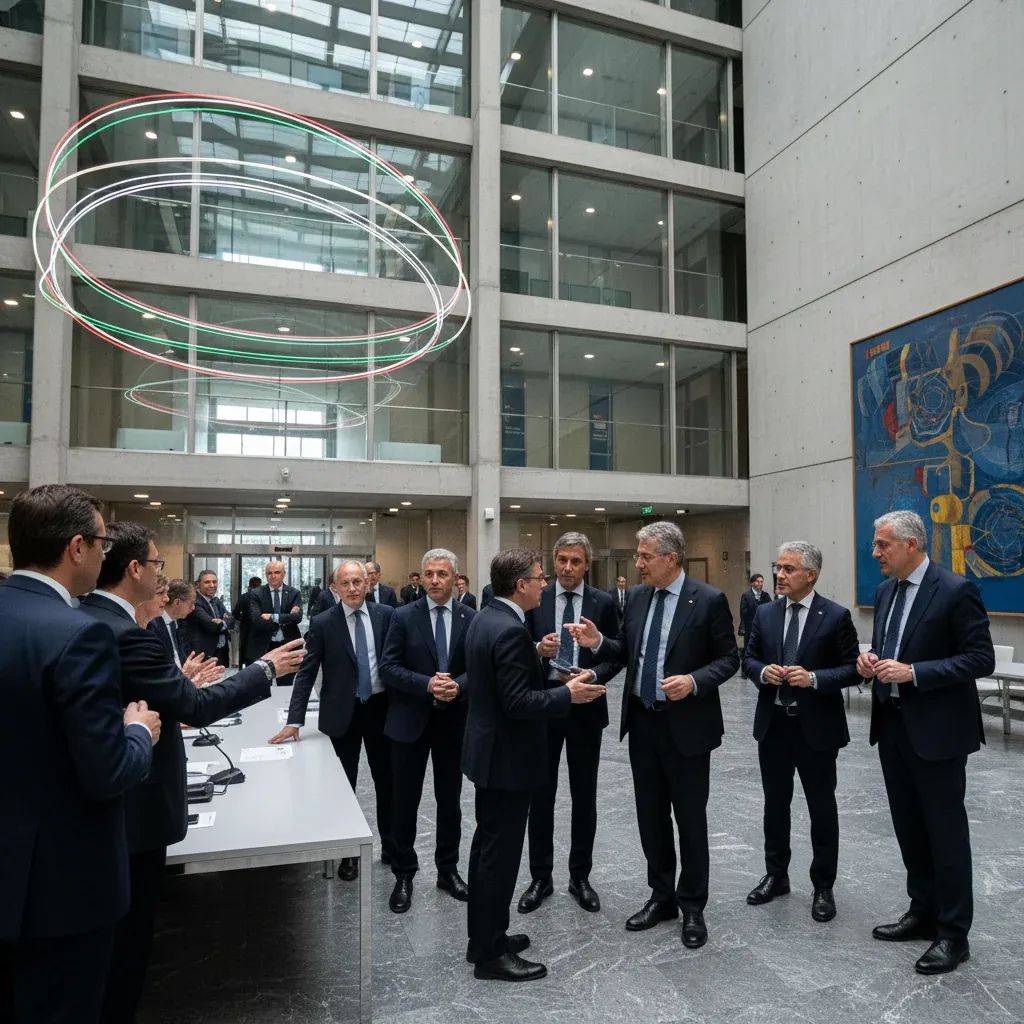
Italy's public broadcaster RAI is facing mounting pressure from Brussels as it navigates a high-stakes standoff with veteran investigative journalist Sigfrido Ranucci, whose potential removal from the flagship investigative program Report has triggered a debate over editorial independence and political interference in Italy's state-run media. The controversy carries particular weight given that Ranucci survived a homemade explosive device detonated outside his Pomezia home in October 2025, making this clash about far more than corporate maneuvering.
The Italy-based national broadcaster is reportedly preparing to offer Ranucci, who has helmed Report for years, an alternative position within the organization — a move the journalist has publicly rejected as politically motivated. Meanwhile, the European Commission has confirmed it will "continue to monitor" the situation after receiving a formal complaint from Italy's governing party Fratelli d'Italia, which questioned whether Report violated European Media Freedom Act standards on impartiality and balance.
Why This Matters
• Editorial independence test: The Commission's intervention puts RAI's compliance with EU media freedom laws under scrutiny — specifically the requirement that public broadcasters operate free from political interference.
• Internal succession battle: Report's editorial team has issued an ultimatum against any external successor, warning such a move would be viewed as "hostile" and tantamount to editorial "normalization."
• Legal clock ticking: RAI management is racing to propose a role aligned with Ranucci's current rank (vice-director ad personam for investigative programming) to avoid a potential lawsuit for job demotion. Under Italian labor law, "demansionamento" (reassignment to a lower-ranking position) is illegal and exposes employers to significant liability.
• Broader press freedom concerns: International watchdogs have flagged Italy in 2026 reports for systemic political meddling in public media, budget cuts, and attacks on journalists — with Ranucci's October 2025 bombing cited as evidence of the risks faced by reporters.
The Journalist Who Won't Step Aside
Ranucci, who survived the bombing attack at his home, has adopted a defiant stance. Speaking to journalists during a book tour stop in Favignana, he framed the battle as one of political will: "We are waiting for a decision that has a clear political matrix, but I resist to the end."
His strategy is straightforward — force RAI to make the first move. "I should decide to step aside, but I won't because that's what they want," he told the program In Onda. "If their conscience is clear, let them move me." With sardonic humor, he quoted the late Italian singer Franco Califano: "As he wrote on his tomb: I do not rule out my return... even from the dead."
The 35-year RAI veteran, who started as an assistant and rose to lead what he describes as "the most awarded investigative program in the company's history," has maintained a packed public schedule — appearances in Cerveteri, Favignana, Agrigento, and Florinas in Sardinia — where he has drawn crowds exceeding 1,000 people, according to his social media posts.
What RAI Is Weighing
Behind closed doors, RAI CEO Giampaolo Rossi, legal affairs director Francesco Spadafora, and human resources chief Felice Ventura have been mapping out exit scenarios. The broadcaster's predicament: Ranucci holds the title of vice-director in addition to being Report's head writer, meaning any reassignment must match that seniority or risk a costly demansioning lawsuit.
Two newsrooms are on the shortlist — TG3 (Italy's third public TV news channel) and RaiNews (the 24-hour news network), both of which Ranucci has worked for earlier in his career. According to well-placed sources, TG3 director Pierluca Terzulli personally advocated for leaving Ranucci in his current role, while stating he would accommodate him if management decided otherwise.
Simultaneously, RAI is hunting for an internal successor to front Report when it returns to air in November 2026. Names circulating in media circles include Giorgio Mottola, Giulio Valesini, and Giulia Innocenzi — all seasoned members of the investigative unit. Former Report colleagues Sabrina Giannini and Riccardo Iacona (now helming Presadiretta, launching September 13) appear less likely, as do external figures like Massimo Giletti, Federico Ruffo, or Peter Gomez, who are committed to other programs.
One scenario gaining traction: a rotating format where individual reporters present their own investigations without a fixed anchor — though this remains unconfirmed.
Impact on Expats & Media Watchers
For foreigners living in Italy, this case is a litmus test of how the country's media environment is evolving under the current government. The European Media Freedom Act, which came into force across the EU, mandates that public service media must be "editorially and functionally independent" and provide "impartial" coverage reflecting diverse viewpoints.
If RAI proceeds with Ranucci's reassignment over his objections, it could set a precedent for how Italy's state broadcaster handles journalistic autonomy — particularly when investigative reporting targets government figures or policies. Brussels' involvement signals that member states' domestic media practices are no longer insulated from EU oversight, especially when cross-border media freedom standards are at stake.
For those following Italian news in English, it also underscores why understanding the mechanics of RAI — which is funded by a mandatory annual TV license fee paid by residents — is essential. Unlike private media, RAI's editorial choices directly implicate public accountability and the rule of law.
The Lavitola Affair: Bombs, Interrogations, and Spin Doctors
The backdrop to this corporate chess match is a criminal investigation that reads like a thriller. Valter Lavitola, a businessman with shadowy political connections, was arrested in August 2026 and confessed to commissioning an intimidation operation against Ranucci. However, Lavitola claimed he envisioned "four or five demonstrative gunshots" against a wall — not a bomb.
His stated motive? To boost Ranucci's public profile and accelerate the journalist's alleged plans to enter politics, or to increase his security detail. Rome's investigating judge dismissed this as "implausible and unsupported by evidence," maintaining Lavitola's pretrial detention.
On August 27, two of the four alleged executors — Pellegrino D'Avino and Antonio Passariello — were scheduled for interrogation. Their lawyers said both men claimed they dealt only with Gomes Clesio Tavares, Lavitola's fixer now reportedly in Africa, and insisted they never intended harm. Tavares himself told the TG1 news program he is confident he will be cleared and has never met Ranucci.
Lavitola is scheduled to make spontaneous declarations before the Rome Review Court on September 7. Prosecutors allege he financed opinion polling on Ranucci's electability and sought to position himself as the journalist's political advisor — claims Ranucci has denied, authorizing his attorney to file defamation charges against anyone insinuating the attack was staged.
Brussels Weighs In — And Watches
The involvement of the European Commission adds a transnational dimension. A Commission spokesperson confirmed receipt of the Fratelli d'Italia letter and pledged to "provide a response in due time," noting that the EMFA "requires Member States to ensure that public service media providers are editorially and functionally independent."
International press freedom organizations have flagged Italy in 2026 reports for a "deterioration" in media freedom, citing systematic political interference in public broadcasting, budget cuts, structural reforms, and attacks on journalists. Groups like Liberties and Reporters Without Borders argue the Commission's annual Rule of Law reports tend to "normalize threats" against journalists and underplay the decline in press freedoms.
Federico Mollicone, chair of Italy's parliamentary Culture Committee and a member of Fratelli d'Italia, welcomed the EU's attention, joking that Ranucci now sees himself as the "Che Guevara of Campo Ascolano." Mollicone also praised media outlets controlled by Antonio Angelucci, a right-wing publisher and member of parliament, for publishing "2,800 articles" on Ranucci in recent months — a figure Ranucci himself sarcastically acknowledged on social media.
Report's Newsroom: United Against Outside Control
The journalists who produce Report have drawn their own red line. In a letter to Paolo Corsini, RAI's director of investigative programming, the team declared that "any hypothesis of an external conductor and head writer" would be judged as "hostile and aimed at normalization and commissariamento [takeover] of the program."
They argue the newsroom already possesses the necessary talent and warned that appointing an outsider would be interpreted as an attempt to muzzle one of "the last bastions of freedom and informational independence in the public service."
However, internal fractures reportedly exist. A document explicitly backing Ranucci's continued leadership allegedly failed to gain full consensus, though a version was still sent to Corsini, who is scheduled to meet the Report team on September 2.
What Comes Next
RAI could announce its decision as early as today, though sources suggest the timing remains fluid. The broadcaster faces a complex calculus: maintain credibility as an independent public institution, satisfy political stakeholders, avoid legal exposure, and preserve the franchise value of Report — one of its most internationally recognized brands.
For Ranucci, the calculus is simpler. He has made clear he will not voluntarily relinquish the role he has built over decades, leaving RAI to shoulder the responsibility — and the optics — of removing him. Whether the standoff ends in a negotiated transition, a courtroom battle, or a surprise compromise will shape not only one journalist's career but also the trajectory of investigative journalism in Italy's public sphere at a time when Brussels is watching more closely than ever.