
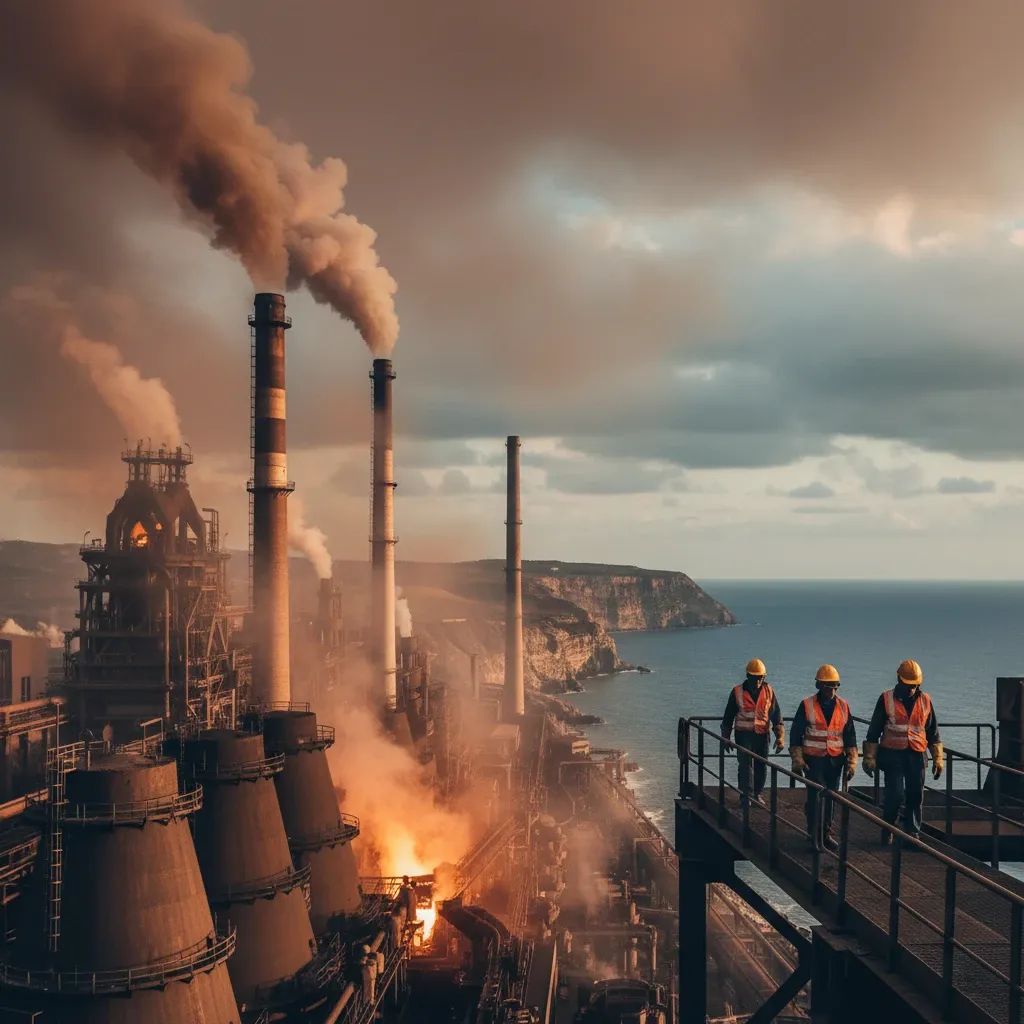
Taranto Steel Crisis Deepens: Supplier Companies Poised to File Mass Layoffs
Employer associations representing the supply chain of the Acciaierie d'Italia plant in Taranto—formerly Ilva—have announced they will formally request authorization for collective redundancies affecting an estimated 3,000 workers, a move that signals the collapse of one of Italy's largest industrial ecosystems and poses a systemic threat to the national manufacturing sector.
The decision, reached during an emergency meeting of the "Permanent Roundtable for Taranto" convened recently, reflects what Confindustria, Confapi, Aigi, Confartigianato, and Federmanager describe as a crisis "without precedent." The roundtable was established in response to the Milan Court of Appeal's order to shut down the plant's hot-end operations within 90 days, triggering an immediate domino effect across Italy's steel supply chain.
What This Means for Residents and Workers—Act Now
For Taranto and its hinterland, the next weeks will be decisive. Immediate actions for affected workers:
• Monitor employer announcements regarding redundancy procedures and timelines
• Check eligibility for wage-support schemes (cassa integrazione) through your employer or union
• Contact unions (Fim, Fiom, Uilm) for retraining opportunities linked to reindustrialization projects
• Track updates from the Puglia Region and Invitalia regarding the €730 M in approved development contracts expected to generate 6,500 new jobs over time
The employer associations have made clear that collective redundancy filings will proceed unless "news arrives capable of marking a viable path and suitable to guarantee the health-work combination." This language signals an ultimatum: absent concrete government commitments—legal relief, investment guarantees, or a credible buyer—the supply chain will begin formal workforce reductions.
Why This Matters
• Employment shock: Up to 3,000 workers in supplier firms face imminent layoffs, with total exposure—direct employees, contractors, and related services—potentially reaching 20,000 people across Italy.
• Production halt: The closure of the hot-end zone will starve the cold-rolling facilities of feedstock, forcing a sequential shutdown of the entire Taranto complex.
• National contagion: Industry groups warn the crisis will not remain localized but will ripple through "a significant portion of the country," destabilizing Italy's strategic steel sector.
• Timeline: Companies state "there is no more time to lose," demanding urgent government intervention or concrete recovery signals within days.
The Court Order That Triggered Collapse
The crisis stems from a recent ruling by the Milan Court of Appeal, which ordered the hot-end area—the heart of primary steel production—shuttered within three months due to persistent environmental and health violations. The decree affects the blast furnaces that produce molten steel, the raw material for downstream processing.
Several supplier companies, including Semat and Anmar, have already suspended operations. Employer groups emphasize that the closure will first eliminate all jobs tied to the hot zone, then cascade into the cold-rolling segment, which cannot function without a domestic supply of semi-finished steel.
The associations' joint statement describes the closure as a force that "inevitably will lead to a direct surplus of all personnel employed in that area and subsequently another portion of resources deployed in the cold area." The cold segment, they warn, will be "the next to halt for lack of steel feedstock."
Government Response and Industrial Options Under Review
The Ministry of Enterprise and Made in Italy (Mimit) has convened technical working groups to explore emergency measures. Options under consideration include a possible appeal to the Court of Cassation to suspend the decree's effects and the development of a national extraordinary plan for Taranto that balances environmental remediation with industrial continuity.
In parallel, a consortium of Italian steelmakers—including Arvedi, Marcegaglia, Feralpi, Duferco, Beltrame, and Lucchini—has expressed conditional interest in acquiring portions of Acciaierie d'Italia, specifically the cold-rolling assets not covered by the court's shutdown order. Federacciai, the national steel association, has mandated its president Antonio Gozzi to file a formal expression of interest, contingent on state support for environmental cleanup and workforce restructuring.
The consortium's proposal centers on preserving the plant's downstream capacity—rolling mills and finishing lines—while leaving the hot-end decommissioning and workforce redundancies to public management. This model aligns with broader European Union decarbonization strategies, which prioritize electric arc furnaces and direct-reduced iron (DRI) over traditional blast furnaces.
The Italian government has already allocated over €20 M through the Puglia Region to support supply-chain firms maintaining operations, and has identified 170 hectares within the ex-Ilva perimeter (140 already remediated), plus 450 hectares of port authority land and 350 hectares of decommissioned military sites for alternative industrial investment. Some 17 reindustrialization projects, totaling over €2 B in private capital, have been presented to the "Tavolo Taranto," spanning sectors from advanced manufacturing to green energy.
Union Mobilization and Social Protection Demands
National metalworkers' unions Fim, Fiom, and Uilm have declared permanent nationwide mobilization, calling for a "shared pathway with the government" to transform the Taranto complex into a facility that meets environmental standards without abandoning steel production or employment.
Their platform includes:
• A decarbonization roadmap integrated into an extraordinary industrial plan, not a managed decline.
• A comprehensive social plan with extraordinary safety nets for direct employees, subcontractors, and the entire supply chain.
• Retraining and active labor policies to redeploy workers into new industrial activities emerging from the reindustrialization projects.
Unions underscore that a "mini-Ilva" strategy—downsizing production and shedding thousands of jobs—would inflict "devastating consequences on the national industrial system" and fail to resolve the underlying environmental and health issues that have plagued the site for decades.
The Broader Economic and Social Stakes
Taranto's steel crisis carries implications far beyond southern Italy. The plant once produced 8-10 M metric tons of steel annually, making it Europe's largest integrated steel mill. Its contraction threatens Italy's position as the EU leader in electric-arc-furnace steel production (accounting for 80% of national output) and its reputation for relatively low-emission steelmaking (100-200 kg CO₂ per ton versus 1,800-2,000 kg for traditional blast furnaces).
Italy has already spent approximately €4 B on the Ilva dossier since 2012, covering bridge loans, wage guarantees, commissioner fees, and remediation studies. A definitive closure would entail additional costs: unemployment benefits for 10,000 direct employees, settlement of €10 B in debts, and an estimated €4-5 B for comprehensive site remediation.
Employer associations have warned that absent a credible recovery plan, Taranto faces "industrial desertification"—a fate reminiscent of Bagnoli, the former steel town near Naples that still awaits full redevelopment three decades after its plant closed.
European Context: Lessons from Other Steel Shutdowns
Across Europe, legacy steel regions are navigating similar challenges. ArcelorMittal has announced workforce reductions at plants in Dunkerque (France), Eisenhüttenstadt (Germany), and the Asturias (Spain), while ThyssenKrupp is cutting 11,000 jobs by 2030.
The European Commission's Steel Action Plan emphasizes six priorities: secure, affordable energy; stronger trade defenses (including new "melted and poured" rules to trace steel origin); circular economy incentives; decarbonization funding (€150 M from the Research Fund for Coal and Steel, €600 M from Horizon Europe); and active labor policies to protect the 2.6 M direct and indirect jobs the sector supports EU-wide.
Germany, Sweden, and France are leading the shift to "green steel," with 12, 4, and 3 projects respectively to build electric arc furnaces and hydrogen-based direct-reduced-iron facilities. Italy's challenge is to apply these lessons in Taranto while managing the social and economic fallout of transitioning away from blast-furnace technology.
Economic Ripples Across the Region
Residents should prepare for broader economic impacts: reduced consumer spending, pressure on municipal finances, and heightened demand for social services. National policymakers face a test of whether Italy can manage an industrial transition without repeating the mistakes of past deindustrialization episodes, which left communities stranded for decades.


