
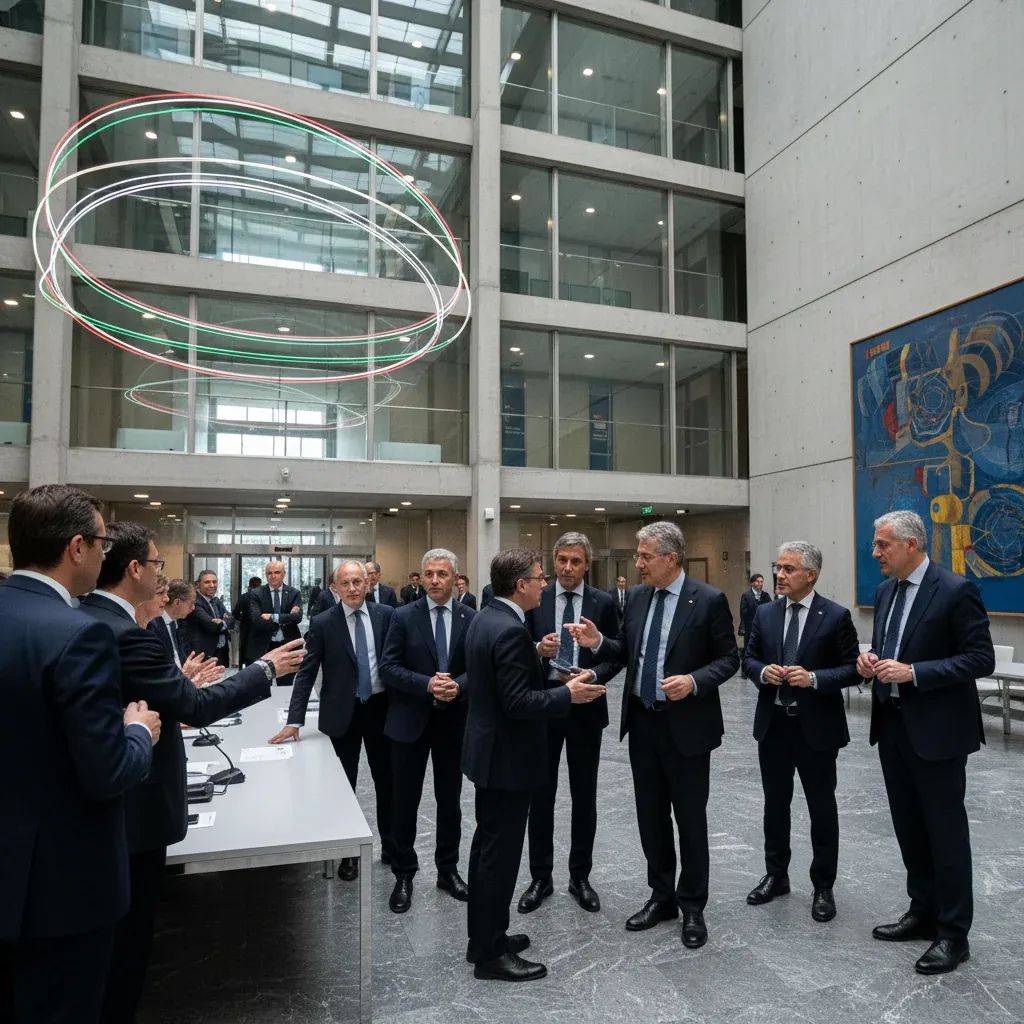
Italy's football federation has withdrawn support for FIFA President Gianni Infantino's re-election bid, aligning with UEFA in a continental shift against the leadership style of the man who has governed global football since 2016. The move, announced by FIGC President Giovanni Malagò, signals deepening fractures within football's international governing structure ahead of the March 2027 presidential election in Rabat, Morocco.
Why This Matters
• Italy joins Nordic countries in pulling support for Infantino following a controversial privatization proposal
• UEFA has withdrawn its boycott threat after receiving FIFA assurances the privatization plan is permanently shelved
• European federations are pushing for rotational FIFA presidency and independent governance review
• The election is scheduled for March 18, 2027, with candidates needing to register by November 18, 2026
What Italy's Opposition Means for Governance Reform
The FIGC's decision reflects what Malagò described as a commitment to "merit, solidarity, sustainability, and fan-centricity"—principles the federation believes have been undermined by Infantino's recent initiatives. The withdrawal wasn't a solitary gesture; Italy coordinated the timing and messaging with UEFA leadership, according to sources within the federation's Rome headquarters on via Allegri.
The catalyst was the FIFA Forward Enterprise (FFE) proposal unveiled in late July, which would have allowed private investors to purchase minority stakes in a new commercial subsidiary managing World Cup rights. FIFA valued the FFE at roughly $20B, seeking $4.2B in external capital—representing approximately a 21% minority stake—to fund development programs across its 211 member associations. Critics interpreted the plan as commodifying football's crown jewel tournament, prioritizing profit maximization over sporting integrity.
Within days, UEFA, the Asian Football Confederation, and CONCACAF condemned the proposal for its lack of consultation and transparency. The backlash forced Infantino to shelve the plan just 72 hours after its announcement, but the damage to his political standing proved lasting.
The European Alternative: Rotating Leadership and Structural Reform
UEFA's opposition extends beyond the FFE debacle to broader questions about concentrated power at FIFA's apex. European federations are advocating for a rotational presidency model that would cycle leadership among continental confederations, preventing any single individual from consolidating authority across multiple terms.
Claudius Schafer, president of the European Leagues association, told The Athletic that Infantino has "no future at FIFA" given his "increasingly centralized and personalized" approach. Richard Masters, chief executive of England's Premier League, echoed that assessment, calling for fresh leadership when the FA withdrew its support for the incumbent.
UEFA's governance framework, adopted in December 2023, established standards across five domains: democracy, transparency, integrity, control mechanisms, and internal procedures. The confederation argues this model should serve as a template for FIFA itself, which has struggled with accountability questions throughout Infantino's tenure.
The European Parliament has formally endorsed UEFA's vision, emphasizing values such as open competition, sporting merit, and inclusive stakeholder participation—a pointed contrast to FIFA's top-down management style.
Fragile Opposition: Support Collapses in Some Regions
Despite European unity, Infantino retains substantial backing globally. The Caribbean Football Union publicly supported him during an August meeting in the Dominican Republic, where he framed his agenda as narrowing the gap between football's elite powers and developing nations.
"Some, unfortunately, don't need or want others to grow," Infantino said, according to Spanish outlet Marca. "But we must reduce this gap between the very large countries and everyone else." He emphasized that "big players should keep growing" while FIFA finds investment for all federations—rhetoric that resonates in regions where expanded World Cup slots and increased financial distributions have been welcomed.
Former footballers including Fabio Cannavaro, the 2006 World Cup-winning captain now coaching Uzbekistan, penned letters defending Infantino's decade in office. "Not recognizing that football has improved in the last 10 years would be intellectually dishonest," Cannavaro wrote, joined by signatories Christian Vieri, Marco Materazzi, Javier Zanetti, and Roberto Carlos. Their intervention countered a separate appeal from French defender Mikael Silvestre demanding leadership change.
The split illustrates Infantino's selective but powerful support base, particularly in Africa, Asia, and parts of the Americas, where FIFA's expanded tournaments and financial programs have generated goodwill.
Italy's Internal Split: League vs. Federation
The FIGC announcement caught Serie A President Ezio Simonelli off guard, highlighting coordination failures within Italy's football structure. "I would have taken a bit more time," Simonelli commented. "I expected a collegial choice. I was informed, I don't know about the other components."
Malagò, who serves alongside Infantino on the International Olympic Committee, insisted the decision was "political, not personal." With Italy co-hosting Euro 2032 alongside Turkey, maintaining alignment with UEFA carries practical benefits beyond ideological consistency. The tournament hosting requires deep coordination with UEFA on stadium standards, security protocols, and tournament operations—making FIGC's UEFA alignment strategically necessary. The working relationship between FIGC and UEFA's Nyon headquarters depends on institutional harmony, particularly as tournament planning accelerates.
Boycott Withdrawn, Elections Ahead
The Guardian reported that FIFA sent private written assurances to UEFA confirming the FFE proposal would never be revived. In response, UEFA dropped threats to boycott FIFA competitions, allowing European teams to participate in the Women's Under-20 World Cup opening September 5 in Poland. Italy, England, France, and Spain will all compete.
"Playing at home will give us an advantage," Poland coach Marcin Kasprowicz told FIFA's official site, confirming the crisis had been de-escalated.
Yet the political opposition remains. Italy and other European federations will not vote for Infantino in March, but the fragmented opposition has yet to coalesce around an alternative candidate. Victor Montagliani, president of CONCACAF and a FIFA vice-president, is considered the leading challenger, though he hasn't formally declared. Aleksander Ceferin, UEFA's president, ruled himself out. Other names floated include Salman Bin Ibrahim Al Khalifa of the Asian confederation, Lise Klaveness of Norway's federation, and Nasser Al-Khelaifi, though the PSG president denies interest.
The candidacy deadline is November 18, 2026, leaving the anti-Infantino bloc approximately three months to field a viable alternative.
What This Means for Italy's Football Diplomacy
For Italy, the stance reflects strategic positioning within European football governance. Malagò's parallel roles—FIGC president, Italian Olympic Committee president, and IOC member—require balancing domestic priorities with international relationships. The decision to side with UEFA over Infantino prioritizes regional alliances and tournament hosting obligations.
The controversy also exposes tensions between Italy's club competitions and its national federation. Serie A, with its international commercial partnerships and revenue pressures, might benefit from FIFA's more market-oriented approach, while FIGC's institutional identity remains tied to UEFA's regulatory structure.
Whether Infantino secures a fourth term or faces an upset depends on whether his critics can unify behind a single candidate before the November deadline. For now, Italy has made its position clear: the next FIFA president should embrace collective governance, not centralized control.


