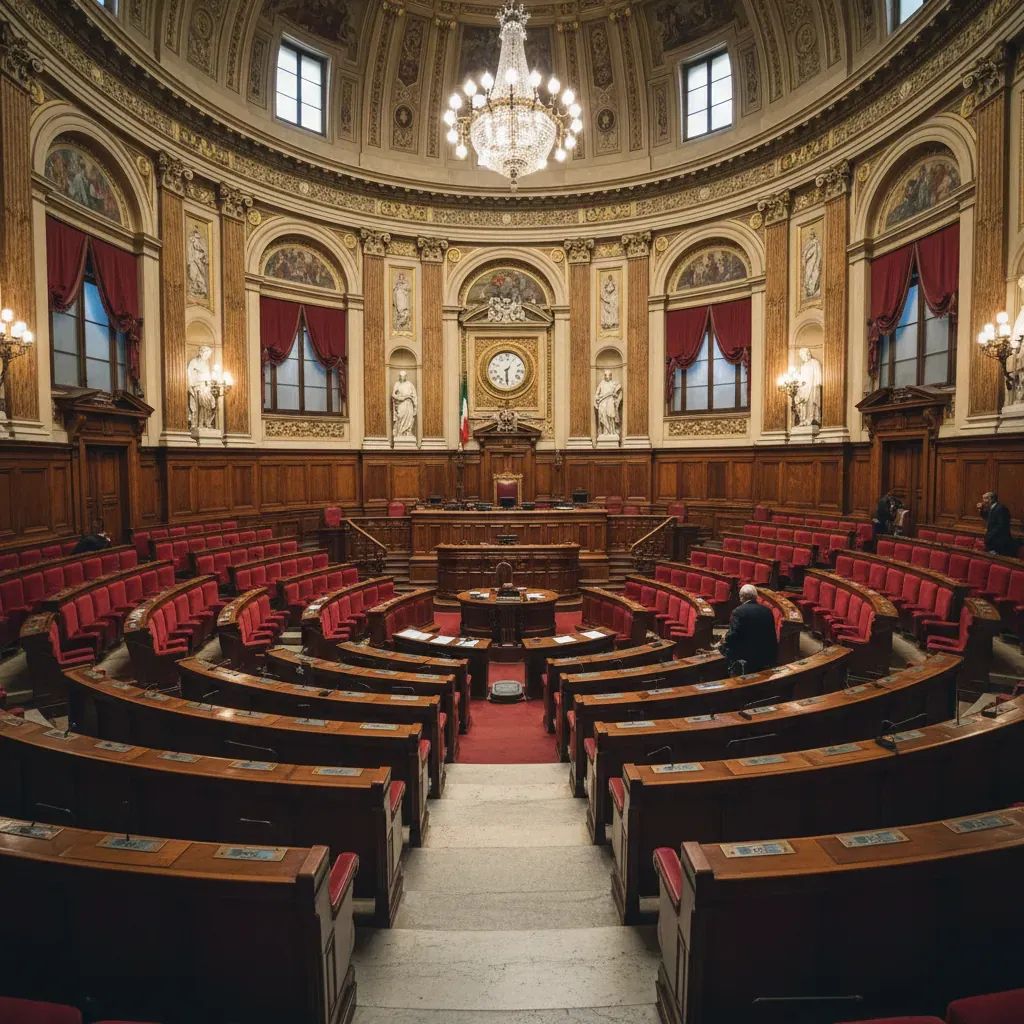
Italy's Forza Italia has signaled it will compromise on a contentious electoral reform issue, prioritizing government stability over internal party disputes about how voters select their representatives. The announcement, delivered by Deputy Prime Minister Antonio Tajani, comes as Parliament prepares to debate the so-called "Stabilicum" electoral law this Tuesday, with amendments due Monday. These parliamentary votes are scheduled for July 14, 2025, with the amendment deadline set for July 13—meaning the coalition must resolve divisions fast.
Why This Matters
• Parliamentary voting begins July 14, 2025, with the amendment deadline set for July 13—meaning the coalition must resolve divisions fast.
• Italy's center-right is seeking "civic" candidates in Rome and Milan to broaden appeal beyond traditional party bases, potentially reshaping urban politics.
• The preference vote debate pits direct voter choice against party control, with constitutional concerns over blocked candidate lists unresolved.
The immediate political challenge centers on whether Italian voters will regain the ability to pick individual candidates within party slates—a mechanism called "preferenze" that Fratelli d'Italia supports but which both Lega and Forza Italia view with caution. Tajani, speaking to Corriere della Sera, framed preferences as "a detail within something much more important," insisting Parliament rather than the executive will decide and expressing confidence "a solution will be found."
The Electoral Reform at Stake
The Italian Chamber of Deputies is examining a proportional representation system with a national majority bonus. Under the draft text, any coalition securing at least 42% of votes would receive an additional 70 seats in the Chamber and 35 in the Senate, designed to guarantee stable majorities and prevent the revolving-door governments that have plagued Italy for decades.
The proposal introduces short blocked candidate lists in multi-member districts, where voters choose a party symbol rather than individual names, and requires the coalition's prime ministerial candidate to appear on ballots. Critics warn this structure may violate constitutional principles, particularly regarding regional representation in the Senate. Italy's Constitutional Court has previously invalidated electoral laws in 2013 and 2017, forcing emergency reforms—raising the possibility it could intervene again if it deems these provisions unconstitutional.
Fratelli d'Italia, led by Prime Minister Giorgia Meloni, wants to reintroduce preference voting—allowing citizens to write in one or more candidate names—to strengthen territorial roots and reduce central party control. Yet both coalition partners remain skeptical. Lega's chamber leader Riccardo Molinari argued Italians rejected preferences in a 1990s referendum, while Forza Italia worries the mechanism could destabilize internal power balances and exacerbate north-south representational imbalances.
A cross-party group of female lawmakers has opposed preferences on the grounds they disadvantage women, who often lack the personal networks, financial resources, and name recognition that benefit male candidates under preference systems. Technical negotiators from the coalition—dubbed "sherpa" (technical negotiators who work behind the scenes)—are racing to draft compromise amendments before Monday's cutoff, with the possibility of a public floor vote that would expose rifts not only in the majority but also within opposition ranks.
What This Means for Residents
If the Stabilicum passes as drafted, Italian voters would see a fundamentally different ballot structure at the next national election. The majority bonus mechanism aims to deliver clearer governing mandates, reducing the risk of hung parliaments and protracted coalition negotiations that have historically delayed policy implementation and spooked markets.
However, blocked lists mean voters lose the ability to choose specific representatives unless preferences are restored via amendment. For citizens in southern regions or smaller municipalities, this could dilute local accountability, as party headquarters in Rome would effectively handpick many lawmakers.
One immediate consensus the coalition did reach addresses a longstanding pain point: out-of-area voting for students and workers. Currently, Italian citizens must return to their municipality of residence to vote, creating logistical challenges for the estimated millions of university students and internal migrants. Under the reform, residents who study or work outside their hometowns will be able to cast ballots in their domicile municipality, a change many have long demanded.
Rome and Milan: The Civic Candidate Strategy
Parallel to the national electoral law debate, Italy's center-right is grappling with candidate selection for upcoming municipal elections. Rome votes in 2026 (timing to be finalized), Milan in spring 2027, and Tajani's Forza Italia is pushing hard for non-political, "civic" figures to head both campaigns.
"Absolutely yes," Tajani said when asked if civic candidates were necessary in Rome and Milan. "The center-right, challenging incumbent administrations, must expand its boundaries. We don't need a candidate who merely boosts votes for their own list, but someone who enables winning alliances with other parties."
In Milan, where the center-left has held city hall for years, Forza Italia has floated economist Carlo Cottarelli as a potential candidate, a choice reportedly welcomed by Carlo Calenda's Azione party. Cottarelli himself acknowledged he would consider a concrete proposal but called it "unlikely" absent an official offer, stressing any decision would depend on the political project and program rather than prestige. His past as a Partito Democratico senator complicates matters for Lega, which is skeptical of crossover figures.
The Lega held "primaries without candidates" in June to gauge grassroots sentiment, with leader Matteo Salvini considered a favorite among the base. Other names circulating include MEP Silvia Sardone, former Forza Italia figure Pietro Tatarella, Noi Moderati leader Maurizio Lupi (backed by Senate President Ignazio La Russa), and culture assessor Francesca Caruso from Fratelli d'Italia.
In Rome, the process is less advanced. Lazio Regional President Francesco Rocca suggested in June that a candidate could emerge after summer or by year-end, with early discussions focused on platforms rather than personalities. Fratelli d'Italia internally favors a political candidate, wary of technocratic or civic outsiders after past disappointments. Fabio Rampelli of FdI has been mentioned, though some in Forza Italia view him as too polarizing. Another possibility is Roberta Angelilli, vice president of the Lazio region.
Calenda himself was floated in some quarters as a potential center-right candidate for Rome, an idea he flatly denied. Yet Maurizio Gasparri of Forza Italia suggested Calenda could be a "realistic option" if the coalition aimed to broaden its perimeter.
Governability vs. Voter Control
Tajani's framing—"the electoral law is necessary because it delivers governability and stability"—captures the center-right's core argument. Italy's post-war history of frequent government collapses has long fueled calls for majoritarian or bonus systems that produce durable executives. Yet critics counter that stability purchased at the cost of voter agency and proportional representation risks legitimacy crises, especially if the constitutional court strikes down key provisions.
The preference vote question embodies this tension. Allowing voters to select individual candidates strengthens accountability and reduces the gatekeeping power of party secretaries, but it can also favor entrenched local elites, amplify clientelism, and—according to female lawmakers—entrench gender imbalances. The compromise Tajani envisions will need to satisfy both democratic participation concerns and coalition unity, a tall order with less than 48 hours until the amendment deadline.
For Italy's residents, the coming week will clarify not only how they elect national representatives but also whether Rome and Milan—two of Europe's largest cities—will be contested by traditional party politicians or by civic figures capable of bridging ideological divides. The outcome in both arenas will shape governance, policy implementation, and the day-to-day functioning of Italian democracy for years to come.