
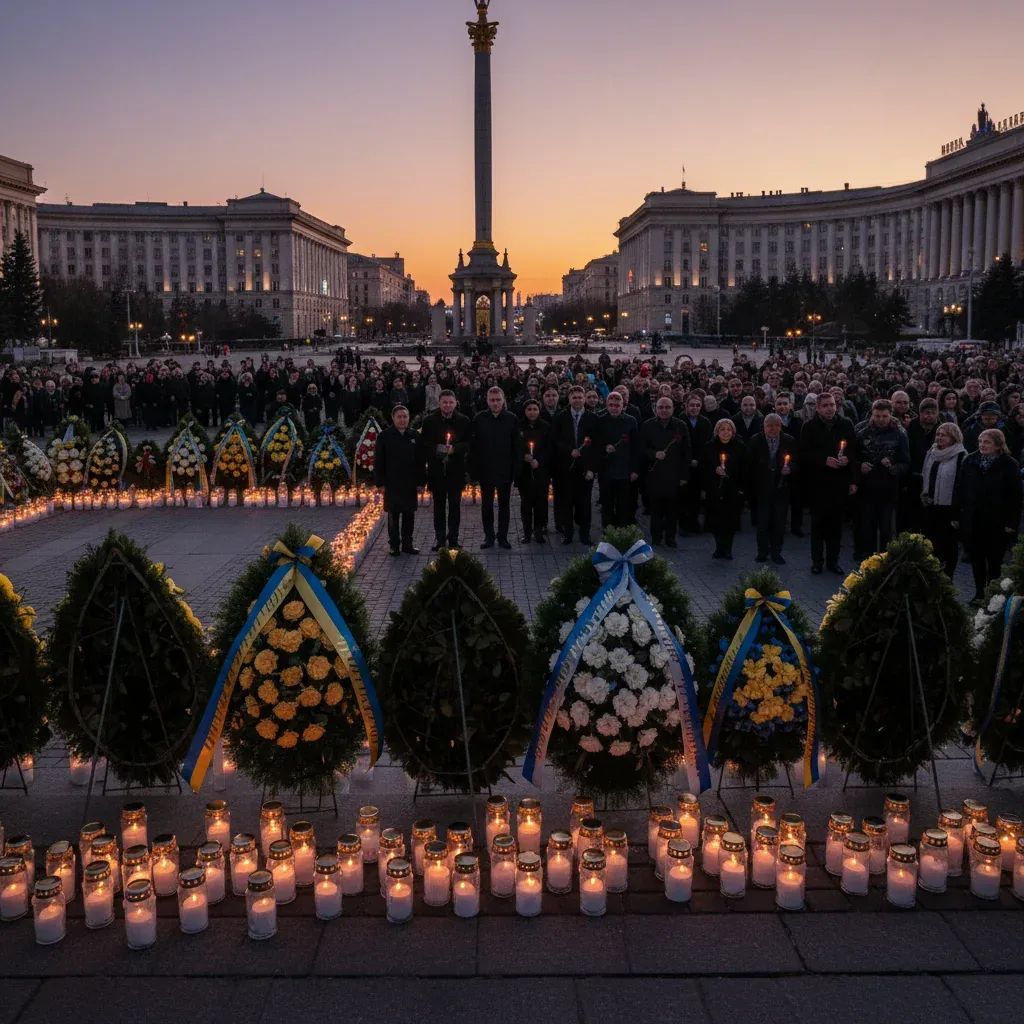
Italy's Azione party leader Carlo Calenda has publicly condemned what he described as a glaring diplomatic absence: not a single representative from Italy's largest opposition parties nor even one Foreign Ministry undersecretary traveled to Kyiv during the solemn fourth anniversary of Russia's invasion of Ukraine. Speaking from the Ukrainian capital, where he attended commemorations at Maidan Square, Calenda called the no-show a "moral failure" and suggested that diminishing Italian government support for Ukraine is becoming unmistakable.
Why This Matters
• Diplomatic signal: Calenda's criticism highlights tensions within Italy's political landscape over continued military and financial aid to Ukraine, with implications for EU unity.
• Vatican mediation: Pope Leone XIV and the Holy See remain among the few actors maintaining open channels with both Moscow and Kyiv, a role the Russian ambassador to the Vatican publicly praised.
• Sanctions stalemate: Hungary's veto has blocked the EU's 20th sanctions package against Russia, undermining Brussels' attempt to mark the anniversary with concrete action.
• Debate at home: The controversy feeds into a broader Italian conversation about balancing security commitments, energy costs, and domestic priorities as the war grinds into its fifth year.
What This Means for Italian Residents
For Italians, this dispute carries real consequences. Italy has been a significant contributor to EU and NATO support packages for Ukraine, including financial aid, weapons systems, and humanitarian assistance. Any reduction in commitment could shift the burden onto other EU members—or weaken the bloc's overall posture at a moment when diplomatic fatigue is setting in across Europe.
The energy dimension is particularly relevant: while Italy does not directly depend on the Druzhba pipeline at the center of current EU disputes, the broader conflict over EU energy solidarity affects negotiations on alternative supply routes that do impact Italian consumers and industry. Hungary's veto of sanctions over pipeline repairs demonstrates how energy becomes intertwined with geopolitical leverage—a vulnerability Italy must navigate carefully.
Italy's diplomatic stance also determines its voice in future settlement negotiations. With France and Germany traditionally dominating EU foreign policy, Rome's reluctance to send high-level representation to Kyiv could diminish Italy's influence in any peace process.
Calenda's Solo Mission to Kyiv
Calenda arrived in Kyiv on February 22, marking his fourth visit to Ukraine since the war began. He was joined by fellow Azione MPs Ettore Rosato, Federica Onori, and Francesca Scarpato. The delegation met with Ukraine's Deputy Foreign Minister, Deputy Prime Minister for Culture, and Minister of Sport and Youth Policies, and conducted interviews with Ukrainian state media.
The timing was deliberate: their presence coincided with memorial ceremonies for those killed in the conflict, held at Maidan Square on the exact fourth anniversary of Russia's full-scale invasion. Calenda reported experiencing an attack upon arrival and noted that much of the capital remained without electricity due to sustained Russian strikes on energy infrastructure.
But it was the absence of his Italian political counterparts that dominated his public remarks. "It is surreal that there is no representative from the other opposition parties here, and not even an undersecretary from the government," Calenda said. "It was a moral duty for Giuseppe Conte, Matteo Renzi, or Elly Schlein to be here."
He singled out the Italian Ministry of Foreign Affairs, which employs four undersecretaries, for failing to send anyone. "The Ukrainians are fighting for us, too," Calenda argued, framing the trip as both a symbolic and strategic necessity for a country that has committed billions in aid to Ukraine.
Government Response and Opposition Reaction
Giuseppe Conte, leader of the Five Star Movement, reportedly defended his absence by stating he did not want to appear "partisan between Kyiv and Gaza"—a rationale Calenda openly dismissed as inadequate.
Meanwhile, Giovanbattista Fazzolari, Undersecretary to the Presidency of the Council, responded to the criticism by reaffirming that Italy would continue military and other forms of aid to Ukraine throughout 2026. The Italian Embassy in Oslo issued a similar statement emphasizing Italy's and the European Union's commitment to achieving a "just and lasting peace" for Ukraine.
Yet Calenda contends that actions speak louder than words. He pointed to what he perceives as a "clear signal" in recent months of waning government enthusiasm for the Ukrainian cause, a charge that resonates in a country where public opinion on the war remains divided and energy prices continue to sting household budgets.
The Vatican's Parallel Track
While Italian politicians engage in this dispute, the Vatican has emerged as one of the few institutions maintaining credible dialogue with both Moscow and Kyiv. Pope Leone XIV, the first American pontiff and successor to Pope Francis since May 2025, has continued the Holy See's intensive mediation efforts.
At his Angelus address on February 23, Pope Leone lamented the "dramatic situation" and called for an "urgent" peace. "Peace cannot be postponed," he said. "It is an urgent necessity that must find space in hearts and translate into responsible decisions."
The Vatican's diplomatic apparatus, led by Secretary of State Cardinal Pietro Parolin, has coordinated humanitarian missions, including the repatriation of Ukrainian children deported to Russia and the exchange of prisoner lists. Cardinal Matteo Zuppi, president of the Italian Bishops' Conference and the Pope's special envoy, has traveled to Kyiv, Moscow, Washington, and Beijing in search of common ground.
Ivan Soltanovsky, the Russian ambassador to the Holy See, praised the Vatican's approach in a statement marking the anniversary. "We attribute great value to the work of the Holy See, which continues to keep open spaces of listening and trust when many others seek only confrontation," he said. He credited Zuppi's two visits to Moscow with facilitating "positive outcomes in humanitarian negotiations."
Soltanovsky also issued a warning: "A simple ceasefire is not enough. If the causes of the conflict are not resolved, the risk is a fragile truce that prepares an even bloodier phase." He accused Kyiv of worsening conditions for Russian-speaking populations in Ukraine, particularly in education, language, and religious freedom—a charge Ukraine and Western governments reject as propaganda.
President Volodymyr Zelensky has met Pope Leone three times, most recently in December 2025, and has extended an open invitation for the pontiff to visit Kyiv, which would constitute a powerful symbolic endorsement of Ukraine's cause.
EU Sanctions Hit a Wall
The diplomatic dysfunction extends to Brussels. Kaja Kallas, the EU's High Representative for Foreign Affairs, confirmed on the eve of the anniversary that the 20th sanctions package against Russia would not advance due to Hungary's veto.
The package, proposed by the European Commission, included a total ban on maritime services for Russian crude oil, new export restrictions on rubber, tractors, and cybersecurity services, and import bans on metals, chemicals, and critical minerals. For the first time, it also featured an "anti-circumvention tool" designed to close loopholes exploited by third-country intermediaries.
Viktor Orbán's government has conditioned its approval on the restoration of the Druzhba pipeline, which supplies crude oil to Hungary and Slovakia. Damaged by a Russian drone attack in Ukrainian territory on January 27, the pipeline remains only partially operational. Budapest accuses Kyiv of failing to expedite repairs, while Ukraine argues that Russian strikes—not Ukrainian negligence—are to blame.
The impasse underscores the fragility of EU consensus on Russia policy as the war drags on. Orbán has cultivated ties with Moscow and repeatedly criticized sanctions as counterproductive, positioning himself as a brake on what he considers Brussels' overreach. For Italy and other member states, the standoff complicates efforts to maintain a united front and threatens to erode the credibility of EU sanctions as a tool of coercion.
The Human and Economic Toll
Four years into the conflict, the human cost is staggering. An estimated 1.8 million Russian and Ukrainian soldiers are dead, wounded, or missing, according to aggregated estimates. The UN reports more than 14,000 civilian deaths. Russia now controls nearly 20% of Ukrainian territory, including Crimea and most of Luhansk, along with large parts of Donetsk, Zaporizhzhia, and Kherson.
In 2025 alone, Russian forces gained just 0.8% of Ukrainian territory at a cost of 416,570 casualties, illustrating the grinding, attrition-based nature of the war. On the night of February 20-21, Ukraine struck an industrial site near Votkinsk, which Kyiv claims produces Iskander ballistic missiles, intercontinental ballistic missiles, submarine-launched missiles, and Kinzhal hypersonic missiles. The attack wounded 11; Moscow has not commented.
Russia, too, is beginning to feel the strain. Its economy has been fundamentally transformed by the war, with hundreds of thousands dead or maimed.
Diplomatic Openings and Accusations
On the diplomatic front, Steve Witkoff, the U.S. special envoy, expressed confidence that a meeting between Zelensky and Putin could take place to address territorial disputes and security guarantees. Zelensky has said a trilateral meeting with the United States and Russia is "probable within 10 days," though he insists European participation is essential.
The UN General Assembly passed a resolution, sponsored by Ukraine, calling for a "lasting peace," with 107 votes in favor. Notably, the United States abstained, a signal some analysts interpret as reflecting shifting American priorities under evolving leadership.
Russia, meanwhile, has accused the United Kingdom and France of planning to supply Ukraine with nuclear weapons, alleging the transfer would be disguised as indigenous Ukrainian development. Moscow maintains that Ukraine cannot defeat Russia with conventional arms alone, and it views Western nuclear assistance as an unacceptable escalation.
Broader Implications for Italy
For residents of Italy, the anniversaries, accusations, and diplomatic absences all point to a broader question: What role will Italy play in the next phase of the war?
The country has historically balanced transatlantic loyalty with pragmatic ties to Russia, particularly in energy and trade. The war has forced a recalibration, but the Calenda controversy suggests that Italy's political class remains divided and uncertain about how far to commit.
With the EU struggling to maintain unity, the Vatican offering one of the few credible mediation tracks, and the United States signaling potential shifts in policy, Italy's diplomatic stance in the coming months could shape not only its own security and economic interests but also the trajectory of European engagement in the conflict.
For now, the absence of Italian officials in Kyiv has become a symbol—whether justified or not—of a country unsure of its convictions at a moment when clarity, according to critics like Calenda, is a moral imperative.


