
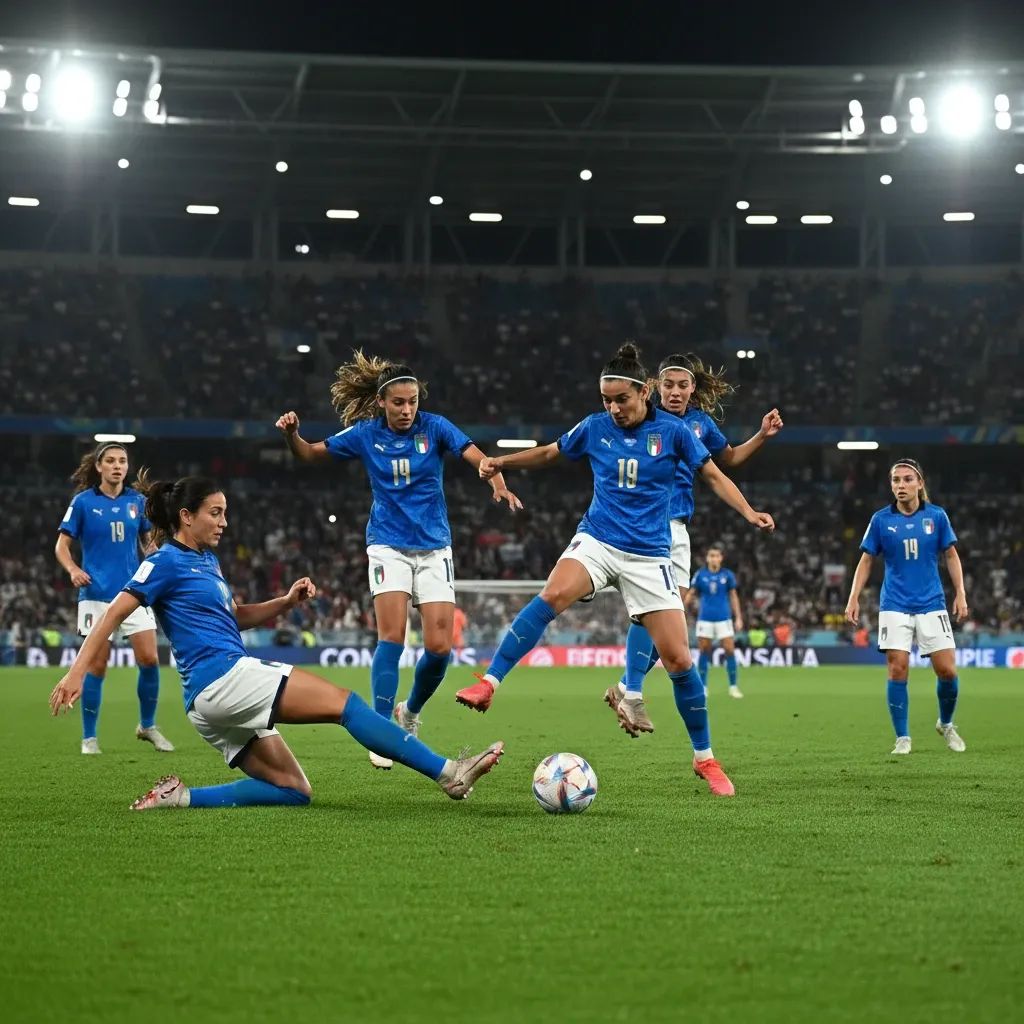
Two Games, One Lifeline: Italy's Women's Football Team Faces World Cup Elimination-or-Advancement Scenario in June
Coach Andrea Soncin has summoned 29 footballers to the Italy national training facility at Tirrenia for what amounts to a knockout-stage rehearsal. The Azzurre will camp there from May 31 through June 7, preparing for two fixtures that will essentially determine whether Italy reaches the 2027 World Cup in Brazil or enters a precarious playoff gauntlet. The stakes could hardly be clearer: the team sits third in qualifying Group A1, trailing Denmark (8 points) and Sweden (7 points), while holding just 5 points from four matches.
Why This Matters to Italian Residents
• Direct qualification is slipping away: Italy must win both remaining games—against Serbia in Pisa on June 5 and in Sweden on June 9—while hoping Denmark stumbles. Anything less means a two-legged playoff in October and December with no certainty of reaching Brazil.
• The campaign's turning point arrives: Months of preparation and friendly matches culminate in 96 hours of football that will define whether this generation reaches a World Cup or falls short.
• Domestic football gets a showcase: Serie A Femminile clubs—particularly Juventus, Roma, and Lazio—have supplied most of the squad, reflecting the health of Italy's women's league and the opportunities it creates for international competition.
The Squad: Core Returnees and Key Reinforcements
Soncin's 29-player call-up includes 12 players unavailable during April's training session, signaling a deliberate recalibration ahead of the critical period. Key returnees include Elisa Bartoli (Inter), the defender whose spring absence left a void in the backline; midfield anchor Manuela Giugliano (Roma); and forward-line veterans Barbara Bonansea (Juventus) and Cristiana Girelli (Juventus), both of whom have carried Italy's attacking ambitions through previous tournaments.
The goalkeeper rotation includes Laura Giuliani (Milan), whose consistent performances have anchored Italy's defensive architecture throughout qualifying. The broader squad draws primarily from Serie A Femminile clubs, with significant contingents from Juventus, Roma, and Lazio, supplemented by players competing internationally—including Arianna Caruso at Bayern Munich, Lisa Boattin in the NWSL, and Margot Shore at Olympique Marseille.
What Happened Before: The Path to This Moment
Italy entered the 2026 qualifying cycle with legitimate aspirations. The team had reached the knockout phase of Euro 2022 and competed in Australia at the 2023 World Cup, where it exited in the group stage after a narrow loss to Sweden. When qualifiers began in March 2026, the Azzurre expected to challenge for top spot in Group A1, a relatively balanced collection featuring Denmark, Sweden, and Serbia.
The opening match shattered that optimism. On March 3 in Reggio Calabria, Italy lost to Sweden 0-1, a defeat orchestrated by Johanna Angeldahl's 22nd-minute finish. Soncin's team dominated possession and created multiple opportunities—including striking the post—but lacked the clinical edge to convert territorial advantage into goals. The coach subsequently acknowledged "excessive frenzy" in the first half, identifying a pattern of over-eagerness that would resurface.
Italy recovered slightly with a March 7 home draw against Denmark (1-1), then enjoyed a confidence-boosting April 14 victory over Serbia in Leskovac (6-0). That performance demonstrated aggressive pressing, quick transitions, and effective finishing. However, a goalless return fixture at home against Denmark on April 18 illustrated the team's vulnerability against disciplined, compact opponents. The Danes absorbed pressure and restricted Italy to peripheral chances, leaving Soncin's squad frustrated and mathematically precarious.
The qualifying mathematics transformed overnight. Denmark's unbeaten record vaulted the Danes to 8 points. Sweden's single win and three draws yielded 7 points. Italy, by contrast, accumulated just 5 points from the same four matches. The group's final round approaches with Denmark and Sweden positioned to claim the top two spots, while Italy faces near-elimination if it does not execute flawlessly.
The Serbia Variable: Opportunity or Trap?
On the surface, the June 5 fixture at Pisa's Arena Garibaldi appears to offer straightforward advantage. Italy demolished Serbia 6-0 in April and holds a dominant historical record against them. Serbia, anchored to last place with 1 point and no wins, has demonstrated limited capacity to compete at this qualifying level.
Yet complacency would invite disaster. The four-day turnaround before traveling to Göteborg means that squad rotation, fixture congestion, and mental fatigue could conspire against Italy. Should the Azzurre win by a narrow margin rather than decisively, they board a flight to Sweden already requiring perfection. The psychological burden of needing an away victory against a historically superior opponent, on short rest, after managing a supposedly routine domestic challenge, cannot be underestimated.
Soncin's challenge involves treating the Serbia match with appropriate seriousness while preserving tactical flexibility and player freshness for the Sweden test. The coaching staff will likely field a starting XI closest to full strength, establish early dominance, then gradually introduce rotation—allowing senior players to rest for the continental confrontation.
Sweden: The Final Test
The Göteborg encounter on June 9 at 7 p.m. local time represents the decisive moment. Sweden has been Italy's most consistent rival in women's football. Across 26 lifetime meetings, the Scandinavians have won 17 times, drawn 5, and lost just 4. At the 2023 World Cup in Australia, Sweden defeated Italy 5-0 in a performance that demonstrated a gap between the nations. The March 2026 reverse-fixture loss in Calabria adhered to that pattern: Italy controlled possession and generated chances, yet failed to breach Sweden's compact defensive structure.
Soncin must address this tactical challenge through intensive preparation. The Tirrenia camp will focus on set-piece routines, transition speed to convert possession into penetrative attacks, and precise interior passing angles to break down Swedish pressure. The coaching staff will also emphasize emotional discipline—avoiding the desperation that can accompany playing an opponent knowing that defeat ends qualification hopes.
The Club Connection: Serie A Femminile's Global Reach
Italy's roster reflects the internationalization of Serie A Femminile. While Juventus supplies a core contingent, other domestic clubs contribute meaningfully. Roma, Lazio, Inter, Milan, Fiorentina, and Napoli each provide players. Yet the squad's international dimensions matter equally. Players competing at Bayern Munich, in the NWSL, and in European top flights maintain contact with multiple footballing cultures and competitive environments—an advantage when facing diverse opponents.
The Playoff Alternative: A Path No One Wants
Failure to top Group A1 consigns Italy to a playoff framework running October through December. The structure involves two-legged ties with higher-ranked nations receiving home advantage in the second match. The format introduces additional variables—travel fatigue, fixture congestion—that complicate qualification prospects.
For a team ranked 14th globally by FIFA, missing a World Cup would constitute a setback to national football development. Italy's participation in Australia in 2023 and the Euro 2022 knockout stage demonstrated that the infrastructure, coaching, and player development pathways support high-level international competition. A sudden playoff failure would disrupt momentum and raise questions about the sustainability of women's football investment in Italy.
The Final Week of Preparation
The Tirrenia training facility, situated on the Tyrrhenian coast south of Livorno, has served as Italy's national football headquarters for decades. For eight days, Soncin's staff will conduct video analysis, position-specific drilling, small-sided games, and tactical simulations designed to prepare the squad for two distinct challenges.
Against Serbia, Italy will practice aggressive pressing, offensive positioning, and clinical finishing. Against Sweden, the emphasis shifts to possession retention, positional discipline, set-piece routines, and pressing immediately after losing possession in dangerous areas. The physical and mental preparation must account for the emotional weight accompanying elimination-scenario football.
By June 7, when the squad departs Tirrenia for Pisa, every principle will have been reinforced, every corner kick choreographed, every substitute prepared for potential deployment. The remainder depends on execution, resilience, and the willingness of players to perform under maximal pressure. For Italy's women's football, the subsequent fortnight will define the next four-year cycle.


