
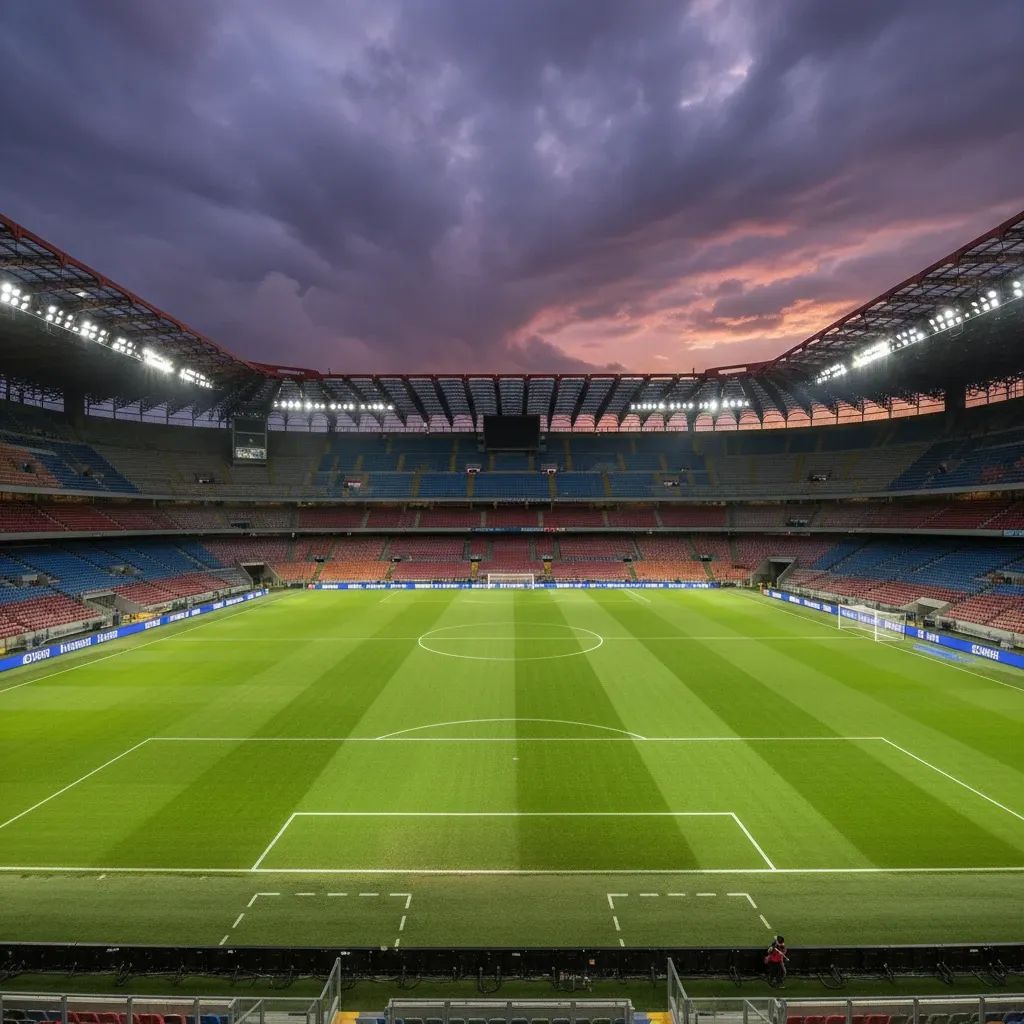
Como is now a Champions League club, and the Italian lakeside city is scrambling to process what that means. After spending decades in football obscurity, the small northern club has locked itself into continental competition for the first time since its founding—a feat that required just seven years of systematic recruitment and a manager willing to trust process over quick fixes. The celebration, however, carries an expiration date. By early June, Real Madrid will almost certainly reclaim Nico Paz, Como's creative heartbeat, via a buy-back clause that represents both the blessing and curse of assembling undervalued talent in modern football.
Why This Matters
• Como enters the 2026-27 Champions League as Italy's fourth representative, joining Inter Milan, Napoli, and Roma in the continental competition after English and Spanish allocation increases eliminated Italy's fifth-place slot for this cycle.
• Nico Paz's exit to Real Madrid (deadline May 30 or June 1) will strip Como of its most creative force immediately after qualification, forcing reconstruction before European debut.
• Cesc Fabregas remains under contract through 2028 with minority ownership, yet Premier League clubs are actively monitoring his availability, threatening management continuity.
• Como's lean wage structure (€47M, 11th in Serie A) makes its squad a poaching target for wealthy European clubs, despite €127M invested in recruitment this season—figures representing significant investment in Italian football terms, where smaller clubs typically operate with far leaner budgets than their Premier League counterparts.
The Impossible Trajectory
Lake Como's natural beauty has long attracted the affluent and the artistic. Its football club until recently attracted neither attention nor success. The transformation under Cesc Fabregas borders on the implausible when examined against Italian football's institutional inertia.
When the Spanish manager arrived at Como, he inherited a club still processing relegation trauma from Serie B. Rather than impose classical Italian defensive structures, Fabregas identified a philosophical approach almost contrary to the peninsula's footballing tradition: allow young players psychological permission to develop without immediate tactical punishment. The results proved almost mathematically consistent with this philosophy.
Martin Baturina, a 23-year-old midfielder, spent the campaign's opening months on the margins before finding coherence around mid-January. His contribution then transformed: eight goals and four assists across the final stretch provided precisely the attacking injection Como required for the decisive sprint. Anastasios Douvikas, the club's principal striker, followed a parallel trajectory—beginning as a secondary option before accumulating 17 total goals and 14 in league play, finishing tied for the Serie A scoring crown alongside Donyell Malen.
The defensive architecture proved equally methodical and less celebrated. Jean Butez, acquired as a depth option between the posts, evolved into the league's statistically most reliable goalkeeper. His combination of distribution, handling, and positioning became Como's emotional and technical foundation. Central defenders Jacobo Ramon and Christian Kempf operated with such disciplined spatial awareness that Como yielded fewer goals than any Serie A rival. This wasn't aggressive pressing or high-octane tactics. It was intelligent positioning replicated across 38 matches—a defensive record that reflected collective discipline and genuine preparation rather than theatrical intensity.
The manager synthesized these disparate elements into something resembling coherence. After Como clinched fourth place, Fabregas addressed his squad with candor: "This is the finest group I will ever manage. You will be remembered forever." Later that evening, two open-top buses carried the squad through Como's arteries—Viale Cavallotti, Viale Varese, Viale del Mercato, and ultimately Piazza Cavour—where supporters waved white-and-blue flags and ignited celebratory flares. The city, a municipality of roughly 85,000 residents on the lake's southwestern shore, experienced something it had not known for decades: sporting prominence.
The Paz Reckoning Arrives This Month
No single player represents Como's paradox more completely than Nico Paz. The 21-year-old Argentine arrives from a respected footballing lineage yet maintains deliberate public modesty—a personality shaped by elite development pathways yet humble in presentation. On the pitch, he speaks a completely different language. When Paz receives possession in transitional spaces, Como's entire attacking geometry realigns.
He arrived from Real Madrid in summer 2024 under a €6M arrangement that functioned as a loan-to-buy structure, meaning the Spanish club retained financial and administrative leverage. Como eventually made the transfer permanent, but Madrid protected itself through what amounts to a ladder of escalating options. Real Madrid can reactivate the Argentine for a reported €9-10M before May 30 or June 1 of this year; delay until 2027, and the fee becomes €11M.
Spanish media reports suggest that Jose Mourinho, Real Madrid's incoming manager, has identified Paz's return as a priority objective. The timing proves hardly coincidental—Paz qualifies for Champions League just as his parent club prepares to integrate him into a competitive European framework. Fabregas has stopped short of publicly opposing the likely transfer, instead acknowledging its inevitability with transparent emotion: "Obviously Mourinho has won everything, but I hope he plays Champions League with me. He's like a son to me. There's still time—we'll see everything eventually. I'm very calm about what we're doing here and with whom."
The manager has privately indicated that Paz will either remain with Como or return to Madrid—no alternative club will be entertained, effectively blocking Inter Milan and other Serie A competitors from consideration. This categorical stance means Paz's fate depends entirely on Madrid's administrative timeline rather than Como's preferences. His departure would hollow the team's creative engine precisely when European competition demands maximum technical sophistication.
European Interest Intensifies
Domestic success creates an immediate paradox in European football. The moment a provincial club proves its competence, wealthier continental rivals conduct thorough personnel audits. Como now experiences this phenomenon acutely.
Jacobo Ramon, the 21-year-old Spanish defender whose composed ball-playing has anchored the reconstruction, has attracted Chelsea's interest, with Real Madrid simultaneously uncertain whether to exercise their own buy-back clause on the young center-back. Jean Butez, now 30 years old, has drawn inquiries from "clubs abroad"—diplomatic phrasing that encompasses Premier League outfits seeking goalkeeper solutions. Depth contributors like Jesus Rodriguez and Anastasios Douvikas, whose combined output proved decisive throughout the campaign, could become bargaining chips if Como underperforms next season.
The vulnerability stems from Como's deliberate financial model. While the Indonesian ownership invested €127M in new signings during the 2025-26 cycle—among Serie A's highest outlays—the aggregate wage bill ranks only 11th in the division at €47M. This efficiency suggests a squad constructed on potential and value rather than established reputation. European scouts recognize immediately: Como assembled talent inexpensively, developed it systematically, and that talent has now proven itself at the continental threshold. For Premier League clubs, Spanish giants, or ambitious ownership groups, Como functions as an unpaid recruitment farm.
Fabregas and the Arsenal Question
The manager occupies an increasingly complex position as Como's visible success intensifies attention from rival organizations. Fabregas holds a minority shareholding in Como and exercises near-total control over sporting decisions—an unusually concentrated power structure for someone early in his managerial arc. His contract runs through 2028, representing genuine stability on paper.
Yet he has never concealed his eventual destination: the Premier League, specifically the clubs that defined his playing career. At 39, Fabregas combines qualities that generate inquiries from ambitious ownership structures: proven tactical sophistication, former elite-level athlete credentials, and a demonstrated capacity for elevating underperforming projects. He represents precisely the type of figure that ambitious clubs pursue when traditional managerial markets prove saturated.
Como's president Mirwan Suwarso has addressed the probability with refreshing candor: "We would be foolish not to anticipate that one day he might pursue Arsenal, Barcelona, or Chelsea. If he continues succeeding, it's natural he pursues grander objectives. But he will choose his successor." This phrasing acknowledges an exit timeline without admitting immediate defeat—a diplomatic recognition that Como represents a stepping stone rather than a permanent destination.
Recent coverage linked Fabregas to Chelsea's vacant managerial position, but he dismissed such speculation, calling the rumors "unimportant" and reaffirming commitment to Como's inaugural Champions League campaign. Such statements carry sincerity while remaining conditional. Should Arsenal or Chelsea present formal offers with genuine infrastructure for sustained success, Fabregas's calculation would shift. For now, he appears committed to delivering European credibility before pursuing higher-profile opportunities.
What Champions League Means for the City and Region
Como, a municipality of approximately 85,000 residents on the Lago di Como's southwestern shore, has historically anchored identity in tourism and light manufacturing rather than athletic achievement. Champions League qualification represents a genuine cultural inflection point for the city and its surrounding region.
Immediate effects will manifest in matchday economics. European fixture schedules demand increased hotel occupancy, restaurant revenue, and ancillary spending from visiting supporters and media delegations. International broadcast attention accompanying the club's continental debut may generate ancillary investment interest toward Como's hospitality infrastructure. The psychological dimension matters equally—residents accustomed to mid-table domesticity now inhabit a city with continental sporting standing.
Operational disruptions will intensify proportionally. Road closures during European competition weeks will become routine. Residents should expect increased traffic restrictions during matchdays and advance planning for local travel, particularly around the stadium district. Ticket demand will vastly exceed available capacity, creating frustration among supporters unable to secure access to Champions League matches. Accommodation pricing will spike during European nights, potentially excluding local residents from hospitality experiences within their own city.
The deeper structural risk remains: if Paz departs and Fabregas eventually decamps to England, Como faces genuine regression risk. The project depends fundamentally on retaining its architects and creative talent. The club's capacity to reinvest transfer revenue while maintaining competitive standards will determine whether 2026 represents a singular achievement or the genesis of sustained European presence.
For now, the lakeside city savors the moment. Beneath the celebratory atmosphere, however, the familiar mechanics of European football operate relentlessly: success attracts competitive interest from wealthier rivals.


