
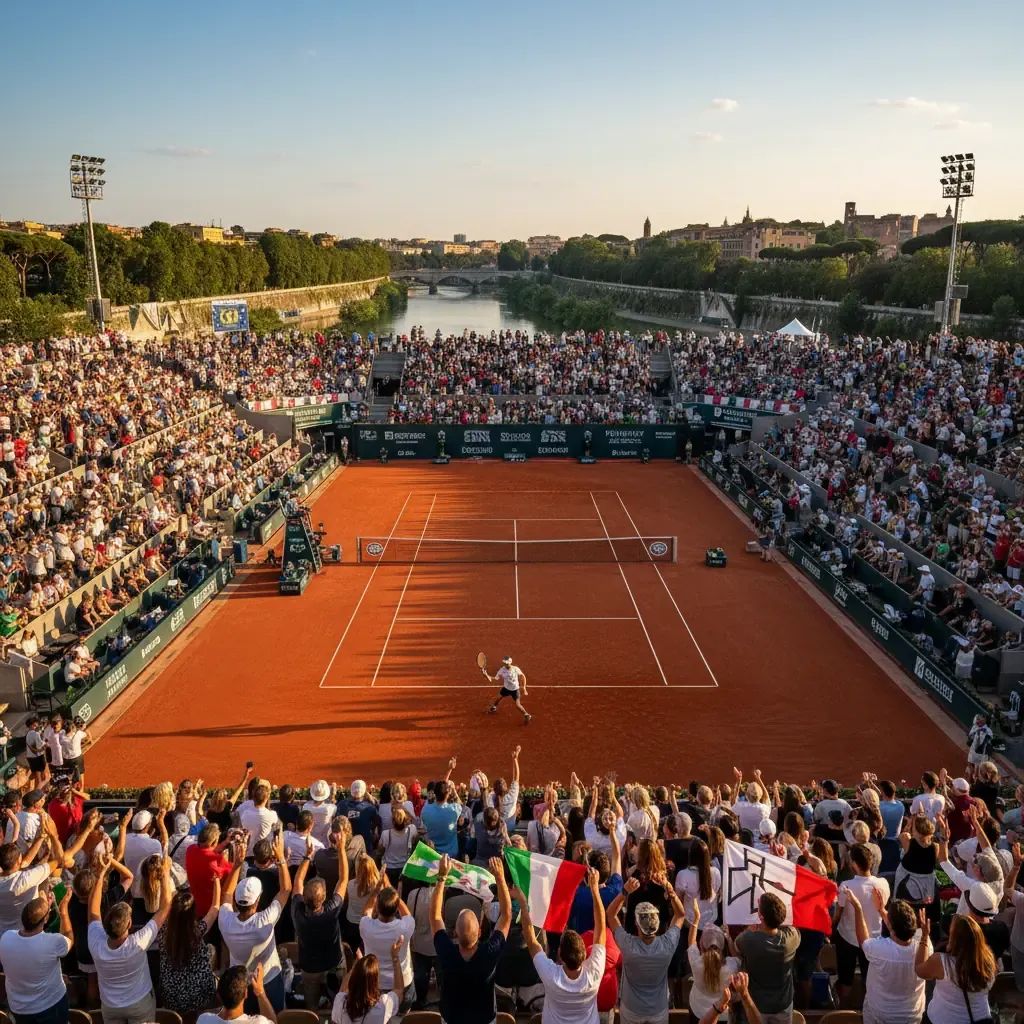
The Italian capital is set to host one of the world's four major padel championships starting this Saturday, a tournament that organizers hope will cement Rome's status as a global hub for the sport—and inject millions of euros into the local economy.
The BNL Italy Major Premier Padel will transform the Foro Italico into an 11-court padel arena from May 31 through June 7, bringing 49 of the top 50 male players and the entire female top 50 to compete for over €1 M in prize money and 2,000 ranking points. Free qualifying rounds kick off Sunday and Monday before the main draw begins Tuesday, with finals scheduled for June 7 at 6:30 p.m.
Why This Matters:
• Economic boost: Past editions drew 33,000+ spectators, with projections of 50,000+ this year—comparable to the tourism footprint of Rome's marathon events, which generate €50-75 M in economic activity.
• Padel boom: Italy now ranks second worldwide in padel infrastructure with 10,060 courts across 3,795 clubs, and the capital alone counts nearly 250,000 players.
• Global showcase: The event is one of only four padel majors internationally, alongside tournaments in Doha, Paris, and Mexico City.
• Accessibility: Admission to early rounds is free; quarterfinals onward stream exclusively on Red Bull TV.
From Zero to Major in Four Years
The Italy Major exists because of a 2022 ambition voiced by Angelo Binaghi, president of the Italian Tennis and Padel Federation (FITP), to Luigi Carraro, head of the International Padel Federation (FIP): "I want to create the Grand Slam of padel."
Carraro, speaking at Monday's press conference, emphasized the speed of execution. "We invented it from scratch," he said. "Without Binaghi and Diego Nepi Molineris—CEO of Sport e Salute, the government-owned sports infrastructure agency—this would never have become a concrete project."
The tournament debuted in 2022 and is now in its fifth edition. Sport e Salute and the FITP erected the 11 temporary courts in what Nepi called "record time," a logistical feat showcasing institutional collaboration between national sports agencies, the federation, and Rome's municipal government.
Nepi framed the event as part of a broader strategy. "After the spectacle of the tennis Internazionali, Rome is once again turning the spotlight on major sport with one of the most prestigious stops on the world padel circuit," he said. "This is a virtuous model of collaboration that strengthens Rome's role as an international capital for major sporting events."
A Sport Growing Faster Than Any Other
Carraro presented padel's explosive global trajectory: 175 countries now play the sport, and the FIP website logged 4.5 M visitors in recent months. "Padel today has the highest growth trend in the world," he said, noting that the Premier Padel circuit stages 25 tournaments annually. In 2026, the tour added London and Johannesburg as new host cities, reflecting the sport's shift from a Spanish-speaking niche to a global phenomenon.
The player nationality breakdown tells that story: while Spain and Argentina still dominate the top rankings, emerging padel powers include Singapore, India, and the United States, according to Carraro.
What This Means for Rome Residents
For those living in the Italian capital, the tournament offers both spectacle and economic ripple effects. The Foro Italico, a UNESCO-protected complex built under Fascism and renovated for the 1960 Olympics, will host crowds expected to exceed 50,000 over the week—up 10% from last year's 33,000.
Local businesses tied to padel are already seeing the benefit. The Lazio region, which includes Rome, leads Italy with 2,014 padel courts spread across 605 clubs—20.1% of the national total. Rome itself ranks as the third city worldwide for padel infrastructure, behind only Madrid and Barcelona.
This density drives a parallel economy: court rentals generated 68% of padel sector revenue in 2023, while equipment sales (rackets alone brought in €190 M) and new facility construction (€165 M invested) round out an ecosystem worth roughly €1.5 B annually in Italy. The sport's organized movement has grown to 86,301 registered players and 2,164 certified coaches, with the FITP recording over 1.15 M total members by late 2025—an increase driven largely by padel.
For those hunting for a court reservation, the numbers explain the occasional weekend scarcity: nearly 800,000 regular players compete for time slots, with projections suggesting that figure will surpass 2 M by year-end.
Who to Watch: The Title Contenders
On the men's side, all eyes are on Arturo Coello (Spain) and Agustín Tapia (Argentina), the world's top-ranked pair with 21,109 points each. They won the Rome Major in 2023 and dominated the 2025 season as the undisputed No. 1s.
Defending champions Alejandro Galán (Spain) and Federico Chingotto (Argentina)—ranked third with 18,357 points—have won Rome twice (2024 and 2025) and enter the tournament in blistering form. A potential dark horse: Juan Lebrón (Spain, ranked 5th) and Leandro Augsburger (Argentina, 9th), who recently upset both top pairs at the P2 tournament in Brussels. Lebrón won the inaugural Rome Major in 2022 partnering Galán.
Among women, Gemma Triay Pons (Spain) and Delfina Brea Senesi (Argentina) hold the No. 1 ranking with 18,009 points each. They won Rome in 2025, and Triay also triumphed in 2023. Challengers include Paula Josemaría Martín (Spain, 3rd, 15,497 points), Beatriz González Fernández (Spain, 4th), and Ariana Sánchez Fallada (Spain, 5th).
The official entry list confirms 49 of the top 50 men will compete (only injured Pablo Cardona is absent) and the entire top 50 women's field.
Impact on Italy's Sport Economy
The Italy Major is the first of four majors on the 2026 calendar, giving it symbolic weight and scheduling advantage. Matches through the round of 16 will stream on the Premier Padel YouTube channel, with knockout rounds exclusive to Red Bull TV.
Nepi described padel as "one of the most significant sporting and social phenomena of our time," arguing it represents "a new galaxy of sport where talent, innovation, inclusion, and community reinforce each other." He suggested the sport's appeal lies less in athleticism than in accessibility—most courts are open to casual players, and the learning curve is forgiving compared to tennis.
The tournament's economic footprint mirrors patterns from Rome's other major sporting events. The Internazionali BNL d'Italia tennis championship generated an estimated €894.9 M in economic impact in 2025, creating 7,000 jobs and €179 M in labor income. Projections for 2026 put that figure above €1 B. Similarly, the Run Rome The Marathon produced a €50 M economic ripple in 2024, projected to reach €75 M in 2025.
International visitors drive much of that spending. Survey data from Rome's marathon shows 80% of participants come from abroad, stay three nights to a week, and spend between €500-€5,000 individually. A majority (90.1%) of respondents said Rome should intensify its event strategy to encourage longer, repeat visits.
A Sport Invented for Community
Nepi's framing of padel as "social phenomenon" reflects its structural advantages. Unlike tennis, where court time is often jealously guarded, padel thrives on doubles play and social leagues. The sport's growth in Italy has been overwhelmingly amateur-driven: of the 1.5 M players counted in 2024, only 60,000 competed in official tournaments, suggesting the vast majority play recreationally.
The infrastructure boom mirrors this dynamic. From 7,128 courts at the end of 2022, Italy added over 1,000 courts annually, crossing 10,000 courts in early 2025 and reaching 10,060 by February 2026. Notably, indoor courts now represent 45% of the total—critical for year-round play in northern Italy's colder months.
The FITP, created through the 2023 merger of the Italian Tennis Federation with the legacy Italian Paddle Federation (founded 1991), now oversees both sports under a single administrative umbrella, streamlining tournament licensing and coach certification.
Tickets and Access
Tickets are available via TicketOne for main draw sessions starting June 2. Qualifying rounds on May 31 and June 1 are free entry, offering a no-cost option for curious fans.
The Foro Italico's famous amphitheater atmosphere—honed over decades of hosting tennis majors—translates well to padel's glass-walled court setup, which allows spectators close sightlines and the ricocheting ball noise that defines the sport's aesthetic.
Carraro emphasized Rome's venue advantage. "This is a unique Major, the first of the season, played in a wonderful place: the Foro Italico," he said. The venue's marble statues, Fascist-era mosaics, and cypress-lined promenades provide a backdrop unmatched in the padel calendar.
For residents, the tournament represents both a spectacle and a validation of the sport's role in daily life across the city's thousands of courts. Whether padel sustains its breakneck growth or plateaus remains an open question—but for now, Rome is betting it will.


