
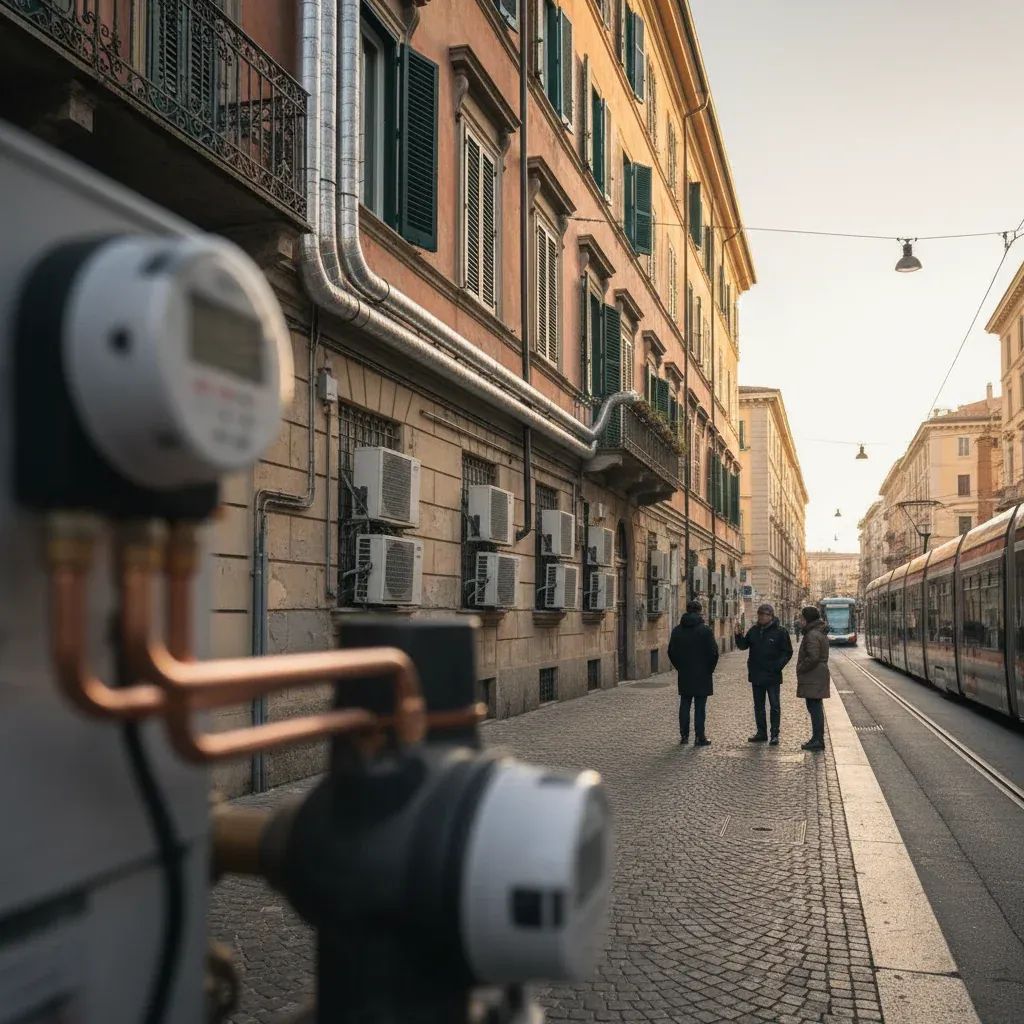
The Italian Ministry of Environment and Energy Security has authorized the release of nearly 10 million barrels from the nation's strategic petroleum reserves, a direct response to the worst supply disruption in global oil market history triggered by the ongoing Middle Eastern conflict that has virtually shuttered the Strait of Hormuz.
Why This Matters
• Fuel costs are climbing: Gasoline prices in Italy have already crossed €1.95 per liter, with further increases expected as Brent crude hovers around $100 per barrel.
• Strategic reserves remain adequate: Even after releasing 9,966,000 barrels (approximately 1.6 M tonnes of oil equivalent), Italy will maintain 90 days' worth of net petroleum imports, meeting EU obligations.
• This is part of a coordinated global response: The International Energy Agency has approved a historic release of 400 M barrels from member countries, with Italy contributing roughly 2.5% of that total.
• Energy security is under threat: The Strait of Hormuz has seen daily ship transits collapse by 97%, from 129 vessels in February to just 4 on March 9.
A Historic Supply Shock
The International Energy Agency has characterized the current crisis as the largest oil supply interruption in the history of global petroleum markets. Production from Gulf producers has plummeted by at least 8 M barrels per day, with an additional 2 M barrels per day of refined products and condensates blocked—totaling nearly 10% of worldwide demand.
The catalyst is the near-total paralysis of traffic through the Strait of Hormuz, the narrow waterway that ordinarily channels 20 M barrels of crude daily, representing about 25% of seaborne global oil trade. Since the military escalation involving the United States, Israel, and Iran that erupted on February 28, the strait has become a war zone. Iran's new Supreme Leader, Mojtaba Khamenei, has publicly endorsed keeping the strait closed as leverage against adversaries, and Tehran has threatened to destroy any vessel attempting passage with Gulf oil.
By March 9, transits had fallen to just four ships. On March 12, three vessels were struck while trying to cross. The International Bargaining Forum has designated the area as a war operations zone, entitling crews to refuse entry. War-risk insurance premiums have quadrupled, and bunker fuel costs have nearly doubled. Even a shadow fleet of vessels operating outside international norms struggles to maintain minimal flows.
Italy's Contribution to Market Stabilization
The Italian government's decision to tap its emergency stockpile is part of a coordinated release orchestrated by IEA member states to calm markets and contain price spikes. Italy will release precisely 9.966 M barrels, equivalent to about 1.605 M tonnes of oil equivalent (TOE).
As of today, Italy's strategic petroleum reserves stand at 11.9 M TOE, corresponding to 90 days of net petroleum product imports, comfortably within the threshold mandated by European Union regulations. This cushion allows Rome to participate in the IEA initiative without compromising domestic energy security in the near term.
The scale of the international effort reflects the gravity of the situation. At 400 M barrels, the IEA's coordinated release is the sixth such action in the agency's history and by far the largest. Yet energy analysts remain skeptical about its effectiveness given the magnitude of the disruption and the ongoing nature of the conflict.
What This Means for Residents and Businesses
For households and enterprises across Italy, the immediate consequence is higher energy costs. Brent crude prices, which lingered around $70 per barrel before the conflict, have surged past $100, with peaks even higher during moments of acute tension. At the pump, average gasoline prices have already exceeded €1.95 per liter, squeezing household budgets and raising the cost of goods transport.
Natural gas markets are feeling parallel pressure. European gas prices have climbed to €55.80 per megawatt-hour, a 74% increase, as traders price in broader energy insecurity. For Italian manufacturers and logistics firms, this translates into sharply elevated operating expenses. Sectors ranging from agriculture to heavy industry face the prospect of compressed margins or the need to pass costs downstream to consumers, stoking inflationary pressure.
Italy imported approximately 14.3 M tonnes of energy products from Gulf states in 2025, accounting for more than 13% of total national energy imports, all delivered by sea. With that pipeline now choked, the country must either rely on alternative suppliers—often at premium prices—or draw down reserves while hoping for a diplomatic breakthrough or military de-escalation.
The release of nearly 10 M barrels will offer marginal relief. While the volume is substantial for Italy, it represents less than a tenth of a single day's global consumption. The psychological effect may prove more valuable than the physical barrels: signaling government willingness to act can temper panic buying and speculative trading, at least temporarily.
Europe Scrambles for Solutions
The crisis has exposed Europe's persistent energy vulnerability despite years of effort to diversify supply chains following previous disruptions. The continent imports over 55% of its energy, and instability in the Gulf ripples immediately through European markets. The European Commission estimates that in the first 10 days of the conflict alone, European taxpayers have borne an additional €3 billion in fossil fuel import costs.
France has announced preparatory work for a "purely defensive" naval escort mission intended to protect tankers and container ships once the most intense phase of hostilities subsides. The International Maritime Organization convened an extraordinary Council session on March 18–19 to address maritime safety in the Gulf region, though concrete outcomes remain uncertain.
Several EU member states have activated their own strategic reserves in concert with Italy. The coordinated nature of the response reflects a recognition that unilateral actions by individual countries would be insufficient to stabilize a market as vast and interconnected as global petroleum.
The Road Ahead
Energy security experts caution that reserve releases, however large, are temporary measures. The fundamental problem—an ongoing military conflict disrupting a chokepoint through which a quarter of the world's seaborne oil flows—will persist until diplomatic or military resolution is achieved. Refilling strategic reserves once prices stabilize will itself impose costs on national budgets.
The crisis is also accelerating political conversations around energy independence and the green transition. Policymakers across Europe are revisiting timelines for renewable capacity expansion, grid interconnection projects, and demand-side efficiency measures. In Italy, where the Ministry of Environment and Energy Security has championed offshore wind development and solar deployment, the current shock may provide political cover for more aggressive investments.
For now, Italian consumers and businesses should brace for sustained higher energy costs throughout the spring and possibly into summer. The reserves being released can cushion the blow, but they cannot eliminate it. Whether this crisis becomes a catalyst for structural change or simply another painful episode in Italy's energy dependency will depend on decisions made in Rome, Brussels, and—most critically—in the Gulf itself.


