
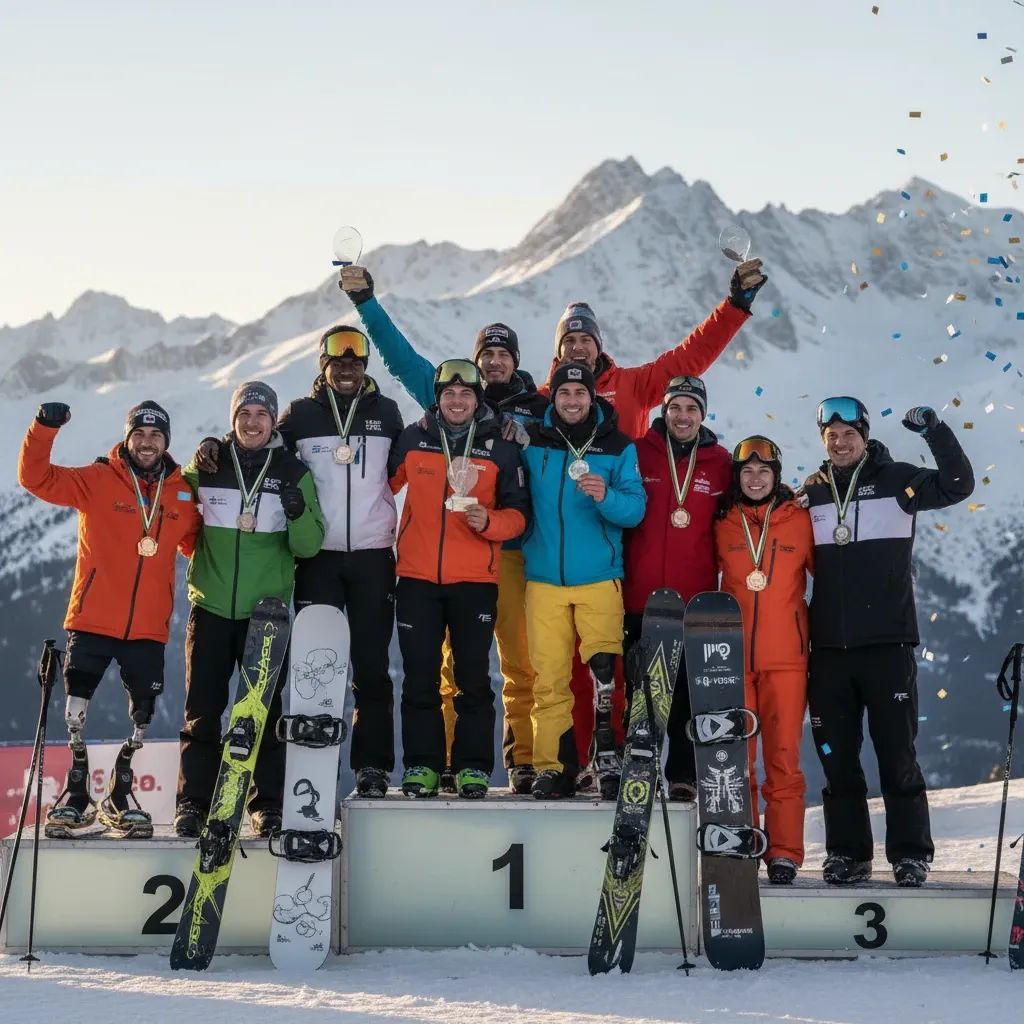
For residents living in Lombardy, Veneto, and Trentino-Alto Adige, the Milano Cortina 2026 Paralympics delivered something beyond medals: €900 million in accessibility infrastructure upgrades that are already reshaping daily mobility, plus an estimated €200 million in direct economic impact and 36,000 new job opportunities across the region.
Italy's Paralympic team has just wrapped up the most successful Winter Paralympics in the nation's history, capturing 16 medals at the Milano Cortina 2026 Games—a haul that places the country 4th in the global standings and firmly establishes it as an unexpected powerhouse in adaptive winter sports. The achievement is a milestone for Italian Paralympic sport, surpassing all previous records and eclipsing nations traditionally dominant on snow and ice.
What This Means for Residents: Infrastructure Now in Place
For Italians living in the affected regions, the Games' legacy is already tangible and accessible.
Specific accessibility improvements now in place or underway include:
• Ten renovated regional rail stations spanning Veneto and Trentino-Alto Adige: Ponte nelle Alpi, Belluno, Feltre, Longarone, Trento, Colico, Morbegno, Sondrio, Lecco, and Tirano
• Milan M1 and M2 metro line upgrades with improved wheelchair accessibility, accessible ticketing, and tactile navigation aids
• Wheelchair-accessible pathways in major public squares across Cortina, Milan, and regional towns
Most upgrades were completed before the Games began and are already serving daily commuters, with particular benefits for wheelchair users and travelers with mobility impairments across Lombardy and Veneto. Station operators report smooth integration of new systems with minimal disruption to regular service.
Tourism and employment surged. The Games drew over 400,000 spectators, with 70% of Italian visitors extending stays to explore nearby towns. The broader Olympic-Paralympic cycle is expected to generate 36,000 jobs (spanning tourism, hospitality, transportation, and event services—both temporary Games-related and sustained through increased year-round tourism), 18,000 volunteer positions, and between €500 million and €600 million in additional tax revenue. Hotel occupancy in Cortina, Livigno, and Bormio remained near capacity for weeks, and operators report sustained booking interest through the spring ski season.
Local businesses benefited from a multiplier effect: every euro spent on lift tickets generated more than €5 in ancillary tourism spending and over €8 in total regional economic activity, according to analysis by Banca Ifis.
Why This Matters: Beyond the Podium
• Legacy infrastructure: The €3 billion investment in accessible venues, rail stations, and urban spaces will reshape mobility for disabled residents long after the Games conclude.
• Economic windfall: The Paralympics alone generated an estimated €200 million in direct economic impact, part of a broader €5.3 billion Games-related boost to Lombardy, Veneto, and Trentino-Alto Adige.
• Cultural shift: With 87% of Italians surveyed viewing Paralympic values as essential to breaking down physical and social barriers, the event is accelerating national conversation around inclusion.
• Geopolitical tension: The return of Russian athletes competing under their national flag and anthem—banned since 2014—sparked diplomatic boycotts and protests, including from Ukraine and the European Commission.
Italy Dominates Alpine Disciplines, Stuns Experts
The Italian squad amassed 7 gold, 7 silver, and 2 bronze medals, with nearly all hardware coming from alpine skiing and snowboard events. The performance stunned analysts: Italy had never before cracked the top five in Winter Paralympic medal counts.
Chiara Mazzel, a 30-year-old skier from the Fassa Valley who lost most of her vision to glaucoma at age 18, became the breakout star. Guided by Nicola Cotti Cottini in speed events and Fabrizio Casal in technical races, Mazzel claimed 1 gold and 3 silver medals across Super-G, downhill, combined, and giant slalom. Her Super-G victory was the only defeat Austria's Veronika Aigner suffered across five events; Aigner otherwise swept the vision-impaired category with four golds and one silver. Austria's Johannes Aigner, Veronika's brother, added three golds and a bronze in the men's vision-impaired races, making the siblings a dominant force in Cortina.
Giacomo Bertagnolli, already a legend at 27, extended his Paralympic tally to 13 career medals—the most of any Italian winter Paralympian. Paired with guide Andrea Ravelli, Bertagnolli won 2 gold (combined, slalom), 2 silver (giant slalom, Super-G), and 1 bronze (downhill) in the vision-impaired category. His versatility and consistency underscored Italy's depth in adaptive alpine racing.
Snowboard Breakthrough and a Remarkable Comeback
Perhaps the most compelling narrative belonged to Emanuel Perathoner, a 39-year-old from South Tyrol. A five-time Olympian at Sochi and Pyeongchang before a catastrophic 2021 training crash forced a total knee replacement, Perathoner reinvented himself as a Paralympic snowboarder. He delivered double gold in snowboard cross and banked slalom—Italy's first-ever Paralympic medals in the discipline. Organizers selected him as flag bearer for the closing ceremony, recognizing both his athletic resurgence and symbolic value.
Other contributors included Jacopo Luchini and René De Silvestro (each with 1 gold), Federico Pelizzari, and cross-country skier Giuseppe Romele, whose bronze in the grueling 20km sitting race drew praise from Sports Minister Andrea Abodi for his "determination and resilience."
Diplomatic Firestorm Over Russian Participation: Italy's Balancing Act
The Games were marred by controversy when the International Paralympic Committee (IPC) voted in September 2025 to allow Russian and Belarusian athletes to compete with their national flags, anthems, and uniforms—a reversal of the neutral-athlete policy imposed after Russia's 2022 invasion of Ukraine and earlier doping scandals. Russia had not appeared under its own banner at a Paralympics since 2014.
For Italian residents watching their athletes compete, the situation reflected a complex tension: national pride in Italian success alongside government opposition to the IPC's decision. While Italy's delegation performed brilliantly on the slopes, the Italian government voiced "absolute opposition" to Russian participation, arguing that Russia's ongoing violation of the Olympic truce contradicted Paralympic ideals.
The decision triggered broader international backlash. Ukraine boycotted the opening ceremony and called the move "scandalous." The European Commission, alongside Canada, Germany, Poland, the Netherlands, and several Baltic and Nordic nations, also boycotted the opening ceremony. Polish broadcasters cut transmission during the Russian and Belarusian delegations' parade.
Russia fielded six athletes; Belarus, four. The Russian anthem played eight times during the Games, the first for Varvara Voronchikhina's skiing victory on March 9. Russia finished 3rd in the medal count with 12 total medals (fewer than Italy's 16), while Ukraine placed 7th with 19 medals—second only to China and the United States in total haul—but only three golds. All three Ukrainian golds came in a single morning, March 7, in biathlon, with Taras Rad, Serhii Kucheriavyi, and Oleksandra Kononova (who later received a warning for wearing "Stop War" earrings) dominating the shooting range.
To avoid diplomatic incidents, organizers replaced the traditional athlete flag-bearer parade at the Verona opening ceremony with volunteers, showing athletes only on video screens.
Record Attendance and Organizational Success
The para ice hockey final at Milan's Arena Santa Giulia set a new Paralympic attendance record: 11,500 tickets sold, with 10,795 spectators watching the United States defeat Canada 6-2. The previous record—roughly 9,000 for a preliminary USA-Italy match—had been set days earlier. China took bronze over the Czech Republic.
Italian fans, many supporting Canada, shared the stands with American and Canadian expatriates. Italian Paralympic fencer Bebe Vio, shown on the jumbotron, received a standing ovation. Andrea Varnier, CEO of Milano Cortina 2026, called the turnout "a powerful signal of enthusiasm and a marker of cultural change."
IPC President Andrew Parsons declared Milano Cortina "my favorite Paralympics since I became president in 2017," praising the sport quality and athlete focus despite the geopolitical tensions. Giovanni Malagò, president of the organizing committee, highlighted "record numbers" across ticketing, viewership, and medal performance. Marco Giunio De Sanctis, president of the Italian Paralympic Committee (CIP), said Italy had entered "the upper echelon of winter Paralympic sport," surpassing far more established nations.
Long-Term Cultural and Economic Ripple Effects
Beyond infrastructure and medals, the Games aim to shift public perception. The Team26 Volunteers Programme drew 130,000 applications for 18,000 roles, while the Educational Programme reached 2 million students nationwide, embedding Paralympic values in school curricula.
Sustainability measures included 100% renewable energy for all venues, a goal of 70% waste diversion through the "Follow the Flo" recycling campaign, and the reuse of 20,000 furniture items from the Paris 2024 Olympics.
Organizers and government officials emphasize that the most significant impact will unfold over years, as upgraded transport, enhanced civic awareness, and a stronger "Brand Italia" in adaptive sport continue to generate social and economic returns. For residents, the Paralympics have already redefined what accessible infrastructure and inclusive public life can look like—a legacy measured not just in medals, but in daily mobility, employment, and civic pride.
What's Next: Accessing Infrastructure and Adaptive Sports Opportunities
For residents using new accessibility infrastructure: All renovated rail stations and metro line upgrades are operational and available for immediate use. Trenitalia and ATM (Milan transport authority) have posted detailed accessibility guides on their websites, including tactile maps, audio navigation systems, and accessible ticket purchase options. Residents with mobility impairments can contact station operators directly for assistance.
For those interested in adaptive sports: The success of Milano Cortina has sparked increased interest in local Paralympic sport clubs and recreational programs across Veneto, Lombardy, and Trentino-Alto Adige. Regional sports councils are expanding adaptive skiing, snowboarding, and cross-country programs, with recruitment ongoing for both competitors and volunteers. The Italian Paralympic Committee (CIP) website lists clubs and programs by province.
For employment seekers: Many Games-related positions have evolved into sustained roles in tourism, hospitality, and local sports management. Tourism boards in Cortina, Livigno, and Bormio continue hiring for seasonal and year-round positions. Early estimates suggest the infrastructure investment alone will support 18,000 new jobs through 2027.
Global Standouts Beyond Italy
While Italy celebrated its breakthrough, other nations delivered memorable performances. Oksana Masters, a Ukrainian-born American with 23 career Paralympic medals across summer and winter sports, added 4 gold and 1 bronze in biathlon and cross-country skiing. Adopted from a Ukrainian orphanage after a childhood marked by disability and hardship, Masters has competed in rowing, handcycling, and now Nordic skiing, overcoming multiple surgeries and career-threatening injuries.
Austria's Aigner siblings and the United States' dominant hockey squad reinforced their countries' reputations, while China claimed ice hockey bronze and a strong overall medal haul. Ukraine's biathlon team, despite limited resources and the backdrop of war, proved formidable on the range, underscoring the resilience that defines Paralympic sport.
The Milano Cortina 2026 Paralympics concluded with a ceremony at Cortina's iconic 1956 Olympic venue, a nod to the town's storied winter sports history and a symbol of continuity between past and future Games.


