
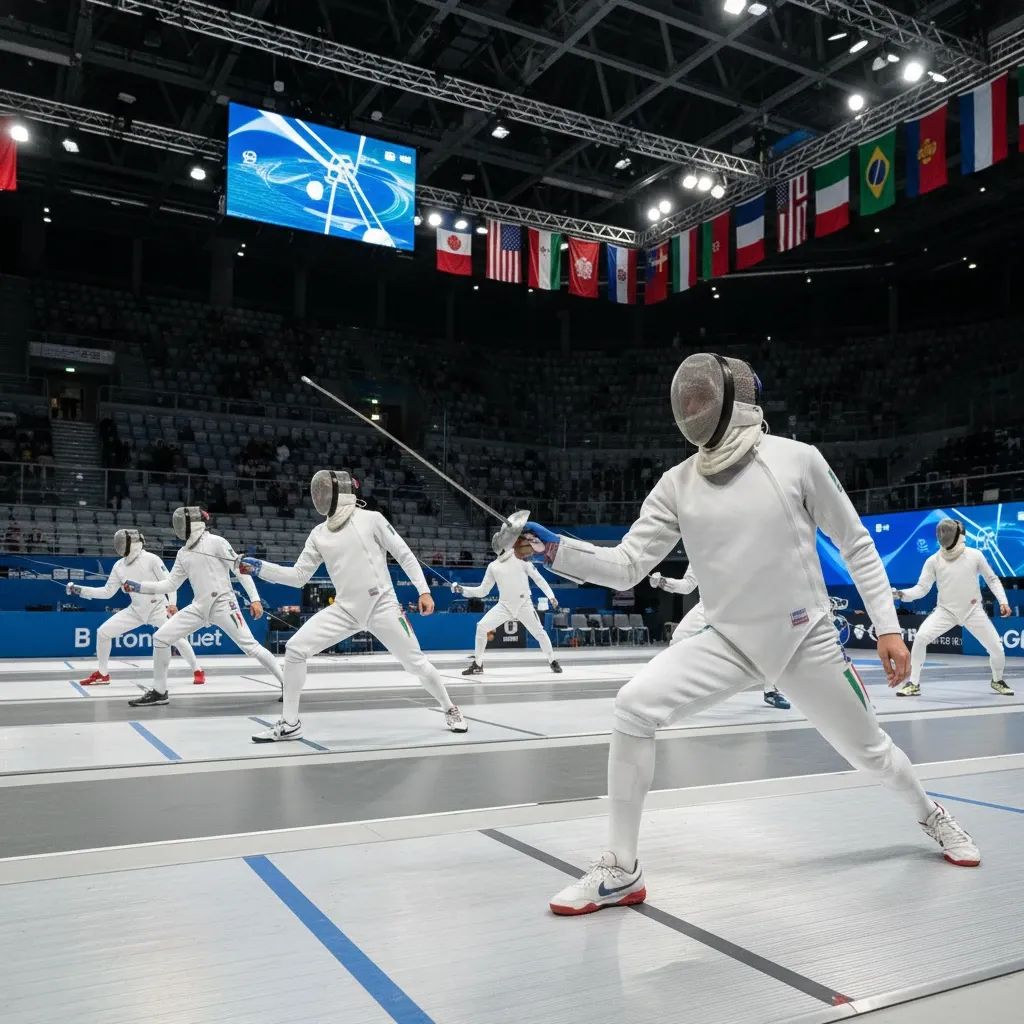
Italy's fencing federation is deploying a 24-athlete contingent to Lima this week as the international foil circuit resumes with a high-stakes Grand Prix event from March 20 to 22. The move underscores the nation's determination to maintain its global dominance in a sport where Italian fencers currently occupy 3 of the top 10 spots in men's rankings and 4 in women's rankings.
Why This Matters
• Elite-level points: Grand Prix events award boosted ranking points, making them critical for Olympic qualification pathways and seeding in future championships.
• Italian depth on display: The squad includes 12 men and 12 women, with Martina Favaretto (world No. 2) and Guillaume Bianchi (world No. 2) leading their respective divisions.
• Building on last year's success: At last year's Lima Grand Prix in March 2025, both Favaretto and Bianchi earned podium finishes—Favaretto with bronze and Bianchi with silver—that propelled them into contention for top rankings.
The Squad: Ranking Firepower and Strategic Depth
National coach Simone Vanni has assembled a roster that blends established champions with rising talent. On the men's side, Bianchi anchors a lineup that includes Filippo Macchi (world No. 6) and Tommaso Marini (world No. 8), both of whom have demonstrated consistency in the 2025-2026 season. The squad also features Giulio Lombardi (No. 18), Davide Filippi (No. 22), Tommaso Martini (No. 25), and veteran Alessio Foconi (No. 27), a former world champion who brings tactical experience to the piste.
Rounding out the men's delegation are Edoardo Luperi (No. 44), Damiano Di Veroli (No. 59), Lorenzo Nista (No. 75), Damiano Rosatelli (No. 76), and Giuseppe Franzoni (No. 167). The wide spread in rankings reflects Italy's strategic approach: accumulate points across multiple athletes to maximize team qualification scenarios.
The women's roster is equally formidable. Favaretto, who briefly held the world No. 1 ranking in March 2025 following her bronze in Lima, leads a contingent that includes Martina Batini (No. 3), fresh off her victory at the Torino Grand Prix on February 7, where she defeated Arianna Errigo (No. 8) in an all-Italian final. Also on the roster is Anna Cristino (No. 7), alongside Martina Sinigalia (No. 16), and Alice Volpi (No. 22). Errigo, a former Olympic medalist, remains a formidable competitor despite recent ranking shifts.
Deeper roster spots go to Elena Tangherlini (No. 27), Irene Bertini (No. 37), Carlotta Ferrari (No. 41), Aurora Grandis (No. 44), Margherita Lorenzi (No. 144), and Matilde Molinari (No. 203). This depth is not accidental: Italian fencing's generational succession strategy has been meticulously cultivated through youth programs, with the federation fielding large delegations at recent European and World Youth Championships.
What This Means for Italian Fencing's Global Position
The Lima Grand Prix arrives at a pivotal moment. Bianchi's triumph in Torino—where he defeated a field that included several Olympic medalists—demonstrated that Italy's men's foil program has recovered from a transitional period. But the global landscape has shifted. Asian fencers—particularly from Japan, South Korea, Hong Kong, and China—are no longer outliers. At the Paris 2024 Olympics, Hong Kong won gold in men's individual foil, while Japan and South Korea claimed medals in épée and sabre.
This "remixing of the medal table" has been driven partly by the diaspora of European coaches seeking opportunities abroad, and partly by aggressive investment in fencing infrastructure in non-traditional markets. Egypt and Tunisia have also emerged as contenders; Egypt's Mohamed El-Sayed won the nation's first Olympic fencing medal (bronze in épée) in Paris, and Tunisia's Farès Ferjani took silver in sabre.
Italy's response has been to double down on tactical versatility and squad depth. The federation's eight-event World Cup calendar for 2025-2026 includes five "classic" team competitions and three Grand Prix individual events, each offering amplified ranking points. The FIE (International Fencing Federation) has also rescheduled four postponed World Cup and Grand Prix events—men's and women's foil in Cairo (April 16-19), men's sabre in Padua (April 17-19), women's sabre in Athens (April 17-19), and épée in Budapest (April 17-19)—ensuring a compressed but equitable competition calendar.
The Lima Test: Momentum Versus Memory
Last year's Lima Grand Prix serves as both blueprint and cautionary tale. Favaretto's bronze propelled her to No. 1 in the world, albeit briefly, while Bianchi's silver confirmed his status as a medal contender in any field. The Grand Prix format—individual competitions only—places a premium on mental resilience and tactical improvisation, as there are no team events to fall back on.
Italy's coaching staff has emphasized acclimatization protocols and pacing strategies for the South American leg. The squad arrived in Lima several days early to adjust, a luxury not always afforded in the congested international calendar.
Impact on Italian Sports and the Broader Context
For Italian fencing fans and stakeholders, Lima represents more than a weekend of bouts. The sport is a strategic pillar of Italy's Olympic program, with fencing historically delivering a disproportionate share of medals relative to funding. Success in Lima translates to improved seeding for the Rio de Janeiro Youth and Cadet World Championships (April 1-9) and the Torino Grand Prix, which has become a marquee event on the FIE calendar.
Italian fans can follow the competition through live streaming on the FIE website and Italian sports broadcasters covering the key matches. Italian sports broadcasters and sponsors are closely watching the rankings chase. The top-ranked athletes secure appearance fees and endorsement deals that can exceed €100,000 annually for medal contenders. A strong Lima performance by Bianchi or Favaretto could also boost viewership for the April slate of rescheduled World Cups, offering commercial value to broadcasters and the federation alike.
Beyond the piste, Italy's fencing infrastructure—training centers, equipment manufacturers, and coaching academies—benefits from sustained global competitiveness. The sport employs hundreds of coaches, armourers, and support staff across Italy, many of whom rely on the federation's international success to justify public and private investment. Regional fencing clubs throughout the country use these national team successes to recruit young talent and secure local funding.
The Road Ahead
After Lima, the Italian squad will pivot to the Cairo World Cups and the critical Padova sabre event, where home advantage could prove decisive. But the immediate focus remains on accumulating points in Peru. With 24 athletes on the roster, Italy has hedged its bets: even if the top-ranked fencers falter, mid-tier athletes can still earn critical ranking points that shore up team qualification scenarios.
The FIE's strategic emphasis on accessibility and youth development also aligns with Italy's long-term planning. The federation has convened large youth delegations for the Tbilisi European Youth and Cadet Championships (February 20-27) and Rio Worlds, signaling a commitment to generational renewal. Emerging talents like Maria Elisa Fattori and Sofia Giordani in women's foil, and the four Reale siblings in sabre, represent the next wave.
For now, though, the spotlight is on Lima. If Italy can replicate or exceed its 2025 podium haul—one silver and one bronze—it will send a clear message: despite the global redistribution of talent, Italian fencing remains a force to reckon with on every continent.


