
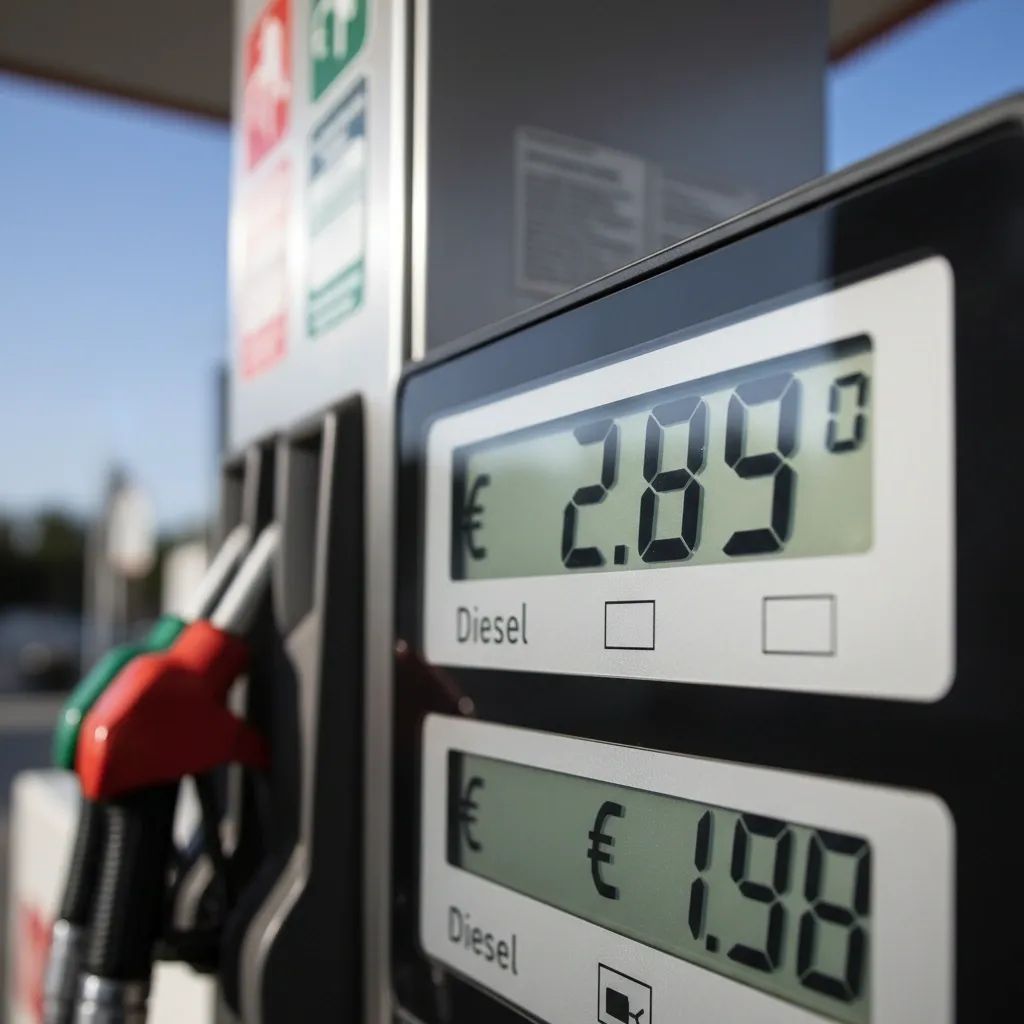
Salvini is bringing 14 fuel companies to the negotiation table tomorrow in a bid to arrest what the Italy Ministry of Infrastructure and Transport characterizes as unjustified price inflation. If voluntary relief doesn't materialize, Rome has signaled it will move toward a mandatory levy targeting energy-sector profits—a tactic that secured billions from banks in recent years and now has petroleum operators in its crosshairs.
Why This Matters
• Diesel has broken €2.09/liter nationally; refueling a typical 50-liter tank now costs motorists around €104 per week—equivalent to substantial portions of urban household budgets
• A windfall tax is credible; the government extracted €2+ billion from lenders through similar mechanisms and has legal EU cover to tax energy firms this year
• 14 operators convening Wednesday at Milan's Prefecture represent the entire supply chain, from majors like Eni and Q8 to independent "white pump" networks that serve smaller communities
• Outcome expected within days: Either negotiated price relief or draft fiscal measures fast-tracked to the Council of Ministers by week's end
What This Means For You: Timeline and Action Points
Residents should expect clarity by Thursday or Friday on whether companies have agreed to voluntary relief. If major branded networks (Eni stations, Q8, Tamoil, IP) announce price rollbacks or promotional campaigns within 48 hours of Wednesday's summit, relief is materializing. If prices remain flat or climb, the government will likely move to legislation.
Should you refuel now or wait? Monitor prices Thursday morning—if relief is imminent, waiting saves money. If talks stall, filling up before potential price increases make sense. Regional note: Northern Italy and major urban centers typically see price adjustments first; southern and rural areas often follow within 3–5 days, so residents in smaller communities may want to act after observing northern pump movements.
If a voucher expansion of the "Carta Dedicata a Te" program is implemented, eligible households (currently those below €15,000 ISEE threshold) would receive fuel-specific credits—likely announced within weeks and usable at pump networks nationwide.
The Situation on Italian Pumps
Drive past any filling station across Italy this week and the arithmetic feels punitive. The Italy Ministry of Business and Made in Italy logged benzina at €1.853 per liter and diesel at €2.087 per liter on March 17—marginal increases from the day before, but cumulative pressure that now dominates household spending conversations. Motorists filling up on autostrade (Italian toll highways) encounter even steeper prices: €1.94 for benzina and €2.15 for diesel at self-service pumps, with attended-pump service adding upward of 24 cents per liter.
What makes these figures politically radioactive is their disconnect from underlying market fundamentals. Brent crude—the oil benchmark that sets European prices—was trading near $94–95 per barrel in mid-March 2026. That's elevated historically, but nowhere near the March 2022 spike during geopolitical chaos that sent crude climbing sharply. The gap between crude movements and retail pump prices has become the focal point of government frustration and consumer anger alike.
Station operators caught in the middle are quick to defend themselves. The gestori (pump operators) earn between 3.5 and 5 cents per liter regardless of price swings—a fixed margin structure that leaves them squeezed when wholesale costs jump suddenly. They don't set prices; the oil majors do. When the Eni, Q8, Tamoil, or IP traders determine the daily rack price, independent station owners absorb the consequence and watch their thin margins erode further.
The real beneficiary of the 20-cent spread between self-service and attended pumps? The petroleum companies themselves, which control the promotional calendars and brand pricing strategies that drive consumer traffic.
How We Got Here: The Windfall Narrative
This isn't the government's first rodeo with energy excess. Between 2022 and 2023, when geopolitical chaos and supply shocks sent crude and natural gas spiraling across Europe, Italian energy firms posted historically outsized profits. Eni's financial statements tell the story starkly: the state-controlled giant earned €10.8 billion net profit in the first nine months of 2022—a 311% year-on-year jump. Full-year 2023 yielded an adjusted operating profit of €17.8 billion. Even as crude prices moderated in 2024, settling to €5.2 billion net profit (down 37% from 2023), the two-year windfall left analysts estimating €7 billion in cumulative sector-wide excess earnings.
Smaller refiners like Saras reported €417 million in 2022 net income, before sliding to €325 million in 2023—the latter drop partly attributable to Rome's windfall tax itself. TotalEnergies EP Italia, the French multinational's upstream arm operating in Italy, saw earnings bounce from €34.6 million in 2022 to a forecast €81.9 million for 2024.
Facing public outcry in March 2022, the then-Draghi administration responded with a two-pronged strategy: cut accise (fuel duty) by 25 cents per liter for 30 days—later extended through October—and introduced a "contributo solidaristico straordinario" (extraordinary solidarity contribution) taxing incremental VAT balances at 10% across the energy sector. Combined with reduced VAT on the lower base price, motorists saw roughly 30.5 cents per liter relief at the pump. The windfall tax framework was solidified in 2023 through the Budget Law formalized under EU Regulation 2022/1854, which explicitly authorized member states to levy temporary solidarity charges on fossil-fuel windfall gains.
The precedent matters to Salvini's current posture. When lenders resisted voluntary concessions on deposit rates and service fees in 2023–2024, Rome imposed mandatory contributions measured in billions of euros annually. The banking sector complied. Salvini is now signaling that energy firms face identical logic: cooperate on prices, or accept fiscal extraction.
What Happens Wednesday—And After
The meeting convenes at 3 PM on March 18 at Milan's Prefecture. Salvini will chair proceedings alongside representatives from the Italy Ministry of Economy and Finance, a detail that broadcasts the fiscal weaponry in play. Seated across the table will be the industry's heavyweights: Eni, IP, Tamoil, Q8, and a constellation of independent networks—Vega Carburanti, Pad Multienergy, Retitalia, Costantin, Keropetrol, Beyfin, San Marco Petroli, Energas, Toil, and Giap Holding. These "white pumps" (smaller networks typically owning fewer than 100 stations) operate in regional markets where local pricing strategies can shift consumer behavior.
Salvini's opening gambit is transparent: "Speculation at the expense of families and truckers is intolerable," he told RTL 102.5 radio. "We extracted billions from banks when they posted excess profits. Petroleum companies should expect similar treatment if they refuse to cooperate." The implicit menu of outcomes is also clear—either the companies implement price caps or promotional support within days, or the government drafts legislation channeling a windfall contribution to household fuel subsidies and transport-sector relief.
Behind-the-scenes signals suggest petroleum representatives will argue that Italian fuel retail margins are among Europe's most transparent and regulated, with daily published prices and competitive white-pump networks constraining systematic abuse. They may also warn that heavy-handed levies discourage refinery investment and long-term supply-chain resilience.
The Consumer Reality: Who Bears the Cost
For a family or small business owner, Wednesday's outcome is existential. A household refueling once weekly now budgets roughly €104 monthly for diesel—equivalent to a meaningful slice of an urban apartment rental. Transport companies operating commercial fleets face exponential cost pressures that tighten margins across logistics, agriculture, and construction.
The government has signaled three potential relief pathways, with different timelines for residents:
Voluntary price coordination would be the cleanest outcome for all parties. Companies agree to cap or marginally reduce pump prices, avoiding legislative complexity and regulatory scrutiny. Motorists would see relief within 48 hours; the government would declare victory. This is the fastest path for household savings.
A windfall contribution would follow the 2022–2023 playbook. A sliding-scale levy targets energy firms deriving material revenue from petroleum products, with collected funds dedicated to targeted household subsidies or transport-sector support. The "Carta Dedicata a Te" voucher program—currently capped at €15,000 ISEE (personal income threshold)—could expand, or fuel-specific vouchers could roll out for low-income families. Revenue collection would take weeks; relief would follow slower, likely within 4–6 weeks.
Regulatory enforcement represents a third path. The Garante per la sorveglianza dei prezzi (Italy's "Mr. Prices" authority) and the Guardia di Finanza (Finance Police) would intensify monitoring along the supply chain, pursuing anti-speculation cases and examining whether companies are unjustly stacking margins. This avenue is slower but politically durable, with enforcement developing over months.
The European Backdrop
Italy's fuel-price conflict sits within a broader European energy volatility story. Dutch TTF natural-gas futures—the continent's price discovery mechanism—spiked to €345 per megawatt-hour in March 2022 before stabilizing. Residual geopolitical risk continues to inject uncertainty into refining margins and wholesale spreads. The EU's regulatory framework recognizes this asymmetry. Regulation 2022/1854 explicitly permits member states to deploy temporary solidarity contributions on windfall energy profits, a tacit acknowledgment that wartime supply shocks create distributional inequities.
For petroleum companies, the Italian precedent is a broader European warning. France, Spain, and Germany have flirted with similar windfall levies. Rome's willingness to escalate from dialogue to fiscal compulsion could embolden other governments facing domestic price pressure.
The Political Calculation
Salvini's Lega party has long mobilized cost-of-living grievances, particularly among small-business owners, truckers, and suburban commuters—its traditional base. Fuel prices resonate viscerally in these constituencies. A high-profile confrontation with Big Oil, especially one that yields visible pump relief, reinforces the party leader's image as a defender of ordinary Italians against distant corporate interests.
Conversely, oil companies view aggressive intervention as a threat to business confidence and long-term investment climate. They will push back—hard—on compulsory measures, arguing that Italy's pre-existing windfall tax framework already strikes a balance and that escalating demands invite capital flight toward friendlier jurisdictions.
Station operators, meanwhile, occupy an uncomfortable political void. Their associations have lobbied for margin flexibility, proposing that pump operators share upside when prices spike (not just downside when costs fall). Inflation in rent, labor, and utilities has eroded their fixed-cent margins, making calls for restructured compensation increasingly vocal.
Timeline and Market Signals
Expect a formal government communiqué by late Wednesday evening. If Salvini announces negotiated commitments—whether voluntary price caps, promotional campaigns, or agreed-upon contribution frameworks—markets will likely interpret this as a diplomatic win that forestalls legislation.
If talks stall or industry delegates refuse binding commitments, drafting of formal windfall-tax legislation could accelerate within 48–72 hours. Given that parliamentary procedures in Italy can compress during budget cycles and emergency fiscal matters, a Council of Ministers approval could materialize by late March or early April.
Fuel traders and motorists should monitor pump prices in the 48 hours after the summit. Any coordinated rollback by major branded networks (Eni stations, Q8, Tamoil, IP) would signal industry acquiescence. Flat or rising prices would harden political resolve to proceed legislatively.
For now, the Italian energy sector faces an ultimatum wrapped in polite bureaucratic language: cooperate on relief, or absorb fiscal penalties. Whether Salvini's negotiating posture yields cooperation or confrontation will define the spring energy narrative and, more tangibly, monthly household budgets across the country.


