
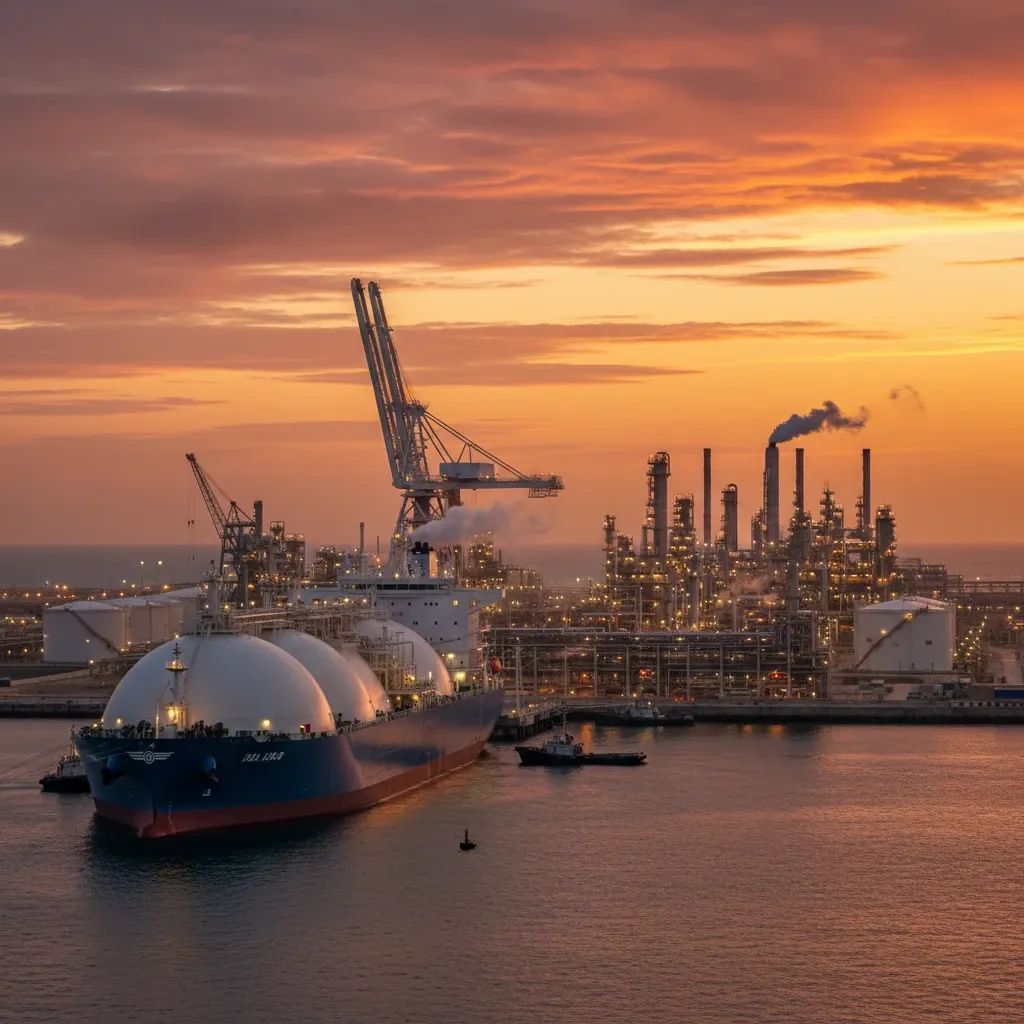
Prime Minister Giorgia Meloni joined European leaders in Paris on April 17 for a summit aimed at securing the Strait of Hormuz—without the United States playing a formal role. The diplomatic gathering brought together roughly 30 delegations spanning Europe, Asia, the Middle East, and Latin America to formalize what participants are calling the European Maritime Initiative for the Strait of Hormuz. This multinational response represents Europe's independent effort to address potential disruptions following Iran's temporary closure of one of the world's most economically important shipping passages. Notably absent: any formal role for the United States or Israel—a deliberate choice reflecting Europe's determination to act as an independent force on regional security.
Why This Could Matter for Italian Residents
The stakes are significant because Italy depends heavily on Gulf energy supplies. Italy imports 90% of its natural gas, and disruptions to the Strait would affect:
• Energy supplies: When Iran temporarily closed the Strait on February 28, approximately one-fifth of the world's petroleum supply and one-third of global liquefied natural gas commerce were at risk.
• Insurance and shipping costs: War-risk insurance premiums for vessels transiting the region spiked from 0.25% to 5-10% of vessel value—a 40-fold increase that raises costs for imported goods.
• Food prices: The Strait closure froze 86% of fertilizer shipments from the Gulf, which directly affects grain production in regions that supply Italy with critical food imports.
Should tensions escalate or the Strait remain closed, these disruptions could translate into higher fuel prices, increased food costs, and reduced availability of imported goods that Italian households depend on daily.
Why Europe Chose to Act Independently
Europe's decision to lead this initiative reflects frustration accumulated since Russia's invasion of Ukraine. The continent absorbed enormous economic and security costs from that conflict—sanctions exposure, energy shortages, defense spending surges—while being positioned as a secondary stakeholder rather than a principal actor. Officials in Paris were explicit about rejecting repetition of that approach.
When German Chancellor Friedrich Merz initially proposed incorporating the United States directly into the coalition, arguing that American military credibility would strengthen the mission, French officials rebuffed the idea firmly. According to Catherine Vautrin, France's Defense Minister, any formal American role would transform the initiative from a "European security response" into a "proxy for American policy"—negating its core political value: European independence in security decisions.
Italy's positioning at the summit represents a meaningful shift in Rome's diplomatic posture. Historically, Italy has operated as a reliable transatlantic bridge, careful to avoid separation from American leadership. By accepting a France-and-UK-led framework in a region where American military dominance is traditionally uncontested, the Meloni government is signaling a willingness to pursue European-coordinated solutions when national interests diverge from Washington's approach. For a government that has campaigned on sovereignty and Italian national interest, this is a calculated decision that European naval coordination can deliver tangible outcomes—reopened shipping lanes, stabilized energy prices, maintained supply chains.
The Critical Question: Will This Actually Happen?
Before any European ships deploy to the Strait, three conditions must be met—currently, none of them exist:
First: Iran must provide a credible, formalized commitment against attacking transiting vessels. An informal ceasefire is technically in place, but it lacks treaty language, defined duration, or enforcement mechanisms. Either Tehran or Washington could escalate within hours or days.
Second: The United States must guarantee unrestricted passage for vessels entering or exiting Iranian ports. Washington currently maintains a de facto commercial blockade on Iran, which contradicts the coalition's commitment to "freedom of navigation." This would require American political approval—which has not been granted.
Third: The Strait must be confirmed mine-free through multinational survey operations. This process alone can consume weeks or months and carries inherent military risks.
Until all three conditions materialize—an event whose timing and likelihood remain genuinely uncertain—the coalition exists as a diplomatic framework and planning apparatus rather than as an operational presence. Military staffs will conduct scenario analysis and prepare deployment plans, but actual naval escorts and mine-clearance operations depend on external political actors delivering commitments they have not yet publicly made.
What Italy Might Contribute—And the Political Challenges
The Italian Navy has begun preliminary coordination with French and British counterparts to assess potential contributions. These discussions center on frigate escorts, corvette vessels, logistical support ships, and specialized de-mining units. However, any actual deployment triggers immediate political constraints in Rome. The Italian Parliament retains constitutional authority over armed forces deployments abroad and maintains budget allocation power.
If the Strait mission advances to active operations, the Meloni government will face political tests on multiple fronts. Support from center-right parliamentary allies is likely, and the Five Star Movement has traditionally endorsed European military operations. Opposition could emerge from the League (Lega), which emphasizes national sovereignty, or from the left, which may argue that naval escort operations risk entanglement in larger conflicts.
Domestically, success or failure will shape public perception acutely. If the mission stabilizes shipping corridors, fuel prices will moderate and inflation will ease—allowing Meloni to claim credit for pragmatic European diplomacy. If tensions worsen, European vessels encounter hostile fire, or the Strait remains closed, political recrimination will follow swiftly.
What's Next: Timeline and Realistic Expectations
The Paris summit produced no binding deployment orders, firm timelines, or legal commitments with enforcement mechanisms. What it produced was a political declaration: Europe can and will define its own interests in global energy security.
For Italian residents, the practical impact depends on whether this diplomatic initiative translates into actual operation. Currently, the informal ceasefire in the Gulf holds. Whether it endures long enough for the European coalition to move from planning to active operations remains the defining open question—and the factor that will ultimately determine whether Italian households see fuel bills stabilize or energy costs harden further in the months ahead.
In the near term, monitor international news about the three conditions mentioned above. Any announcement that Iran has agreed to formal protections for transiting vessels, that the United States has modified its Iran embargo, or that a mine-survey operation has begun would signal that the coalition is transitioning toward actual deployment. Until then, this remains a European diplomatic initiative preparing for a scenario that may or may not require active intervention.


