
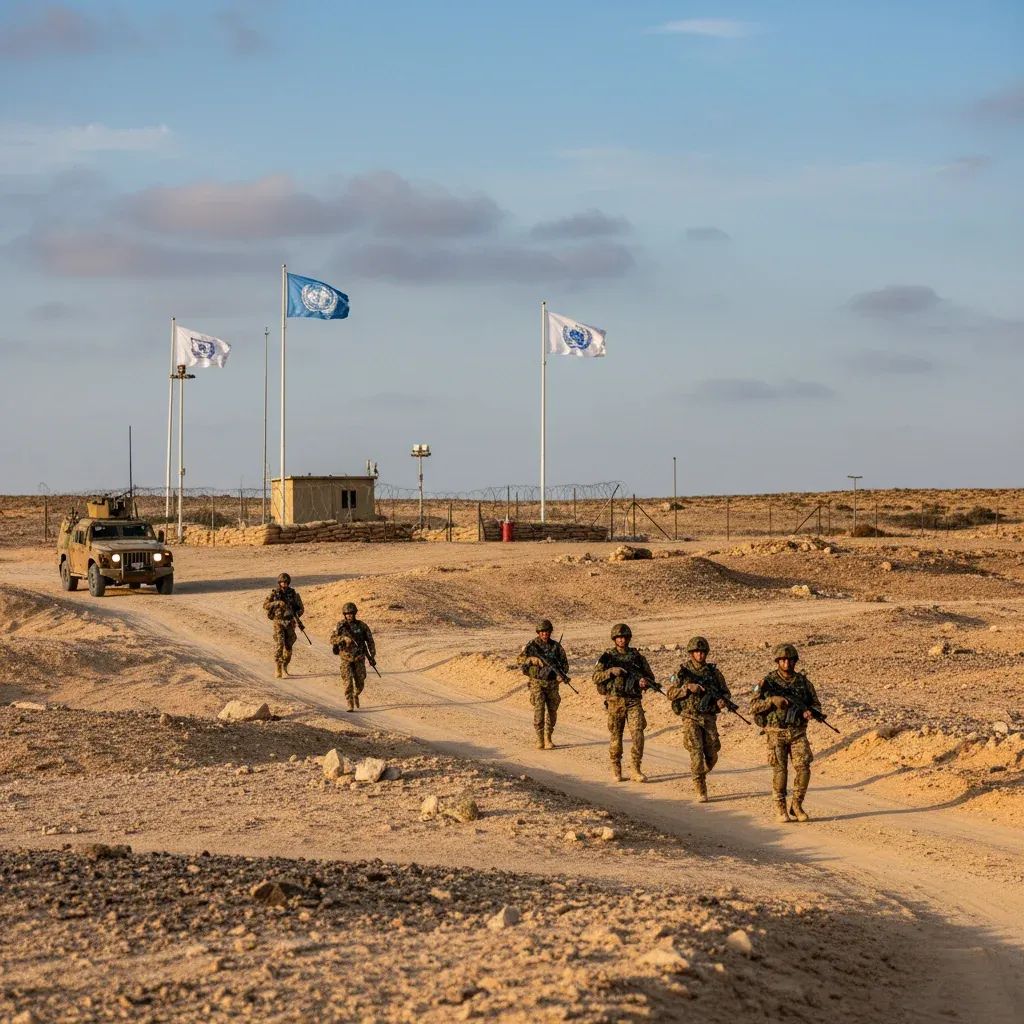
The Italian Defense Ministry confirmed that rocket debris struck the UNIFIL base at Shama in southern Lebanon this afternoon, the second such incident in as many days. One Italian soldier reported eye pain but no visible injuries, and remains under observation by base medical staff. The debris originated from Hezbollah rockets intercepted mid-flight by Israeli Iron Dome systems, underscoring the precarious position of Italian peacekeepers caught between escalating cross-border fire.
Why This Matters:
• Italian troops stationed at the Sector West Command base in Shama face daily exposure to military crossfire as Israel and Hezbollah exchange hundreds of strikes.
• Italy contributes roughly 1,200 personnel to UNIFIL's 10,000-strong mission, the largest European contingent in a region now under active combat conditions.
• The UNIFIL mandate expires on December 31, 2026, leaving Italy's government to weigh the strategic value versus mounting risk to its troops. The situation is increasingly debated within Italian Parliament and among the public, with concerns about defense budgeting and Italy's role in international military commitments shaping domestic political discourse.
• Defense Minister Guido Crosetto remains in direct contact with the Chief of Defense Staff and on-ground commanders to monitor the safety of Italian forces.
Second Incident in Two Days Raises Alarm
Italian soldiers at Shama experienced an almost identical event on March 16, when intercepted rocket fragments fell onto the base perimeter. In that instance, one servicemember also complained of ocular discomfort without sustaining a wound. Both episodes followed the same pattern: Hezbollah launches rockets toward Israeli territory, Israeli air defense destroys them in flight, and the wreckage rains down on the UNIFIL compound sandwiched between the combatants.
The Shama base serves as the operational hub for UNIFIL's western sector, coordinating patrols and liaison activities along the volatile border zone. Its geographic position—roughly midway between the Mediterranean coast and the contested frontier—places it directly beneath the trajectory of long-range rocket volleys. Italian commanders have reinforced protective shelters and tightened movement protocols, yet the nature of aerial interceptions means debris can scatter unpredictably across a wide radius.
Broader Pattern of Attacks on UN Forces
March has proven particularly dangerous for international peacekeepers. On March 15, an unidentified armed group opened fire on three separate UNIFIL patrols, prompting blue helmets to return fire in self-defense. That same day, heavy weapons fire sparked a blaze at a UN position near Meiss ej Jebel, injuring one peacekeeper. A week earlier, on March 7, two missile strikes hit the UNIFIL base at Qawzah, wounding three soldiers—two critically—and incinerating the officers' mess hall.
Multiple troop-contributing nations, including France and Spain, issued a joint statement condemning attacks on peacekeepers as potential violations of international humanitarian law. UNIFIL's freedom of movement has shrunk dramatically: supply convoys struggle to reach forward positions, roadblocks erected by the Israel Defense Forces (IDF) restrict access to key sectors, and personnel spend extended periods sheltering in bunkers rather than conducting patrols. The mission recorded over 210 Hezbollah missile launches toward Israel since March 2, while Israeli air and ground operations target Hezbollah infrastructure across southern Lebanon.
Diplomatic Fallout and Italy's Dilemma
Italian Defense Minister Crosetto has maintained a direct line to both the Chief of Defense Staff and the Joint Operations Command, receiving real-time updates on troop welfare and tactical developments. Rome faces a delicate balancing act: affirming its commitment to multilateral peacekeeping while ensuring its soldiers are not reduced to passive targets in a conflict neither side shows signs of de-escalating.
Past incidents triggered sharp diplomatic responses. In November 2024, when four Italian servicemembers were injured in a missile strike attributed to Hezbollah, Foreign Minister Antonio Tajani summoned Lebanon's ambassador and declared the contingent would not become "hostage to militia attacks." When IDF fire struck Italian positions in October 2024, Prime Minister Giorgia Meloni expressed "profound indignation," and Crosetto warned that repeated hostile acts could constitute war crimes.
Israel has consistently argued that UNIFIL should withdraw from combat zones, claiming the mission inadvertently provides "human shields for Hezbollah terrorists" or that UN surveillance cameras feed intelligence to the militant group. Prime Minister Benjamin Netanyahu publicly called for the "immediate withdrawal" of peacekeepers from frontline areas. UNIFIL leadership rejected that demand, emphasizing its mandate to monitor the border and serve as the sole communication channel between the warring parties.
What This Means for Italy's Military Posture
Italy's Sassari Brigade, the backbone of the Italian UNIFIL deployment, operates under increasingly constrained conditions. Troops rotate through hardened positions, conduct limited reconnaissance when security permits, and prioritize force protection over expansive patrolling. The Ministry of Defense in Rome has not publicly discussed contingency plans for early withdrawal, but parliamentary defense committees are scrutinizing the risk-benefit calculus as UNIFIL's December 31, 2026 expiration date approaches.
The collapse of the November 2024 ceasefire agreement—brokered after a previous round of hostilities—removed the last framework for predictable calm. Hezbollah resumed rocket barrages following coordinated U.S. and Israeli strikes on Iranian targets on March 2, and Israel launched "limited and targeted ground operations" in southern Lebanon shortly afterward. Since then, Hezbollah has claimed responsibility for more than 280 attacks involving rockets, drones, and anti-tank guided missiles.
For Italian personnel, the immediate concern is not grand strategy but basic safety: will tomorrow bring another shower of intercepted debris, a stray artillery round, or deliberate fire from an armed group seeking to pressure the UN mission? Medical staff at Shama treated today's affected soldier with standard eye-trauma protocols, and his condition remains stable. Yet the incident adds to a growing tally of near-misses and minor injuries that, cumulatively, erode confidence in the mission's viability.
Regional Context and the End of UNIFIL's Mandate
In late 2025, the United Nations Security Council voted to extend UNIFIL's mandate, setting December 31, 2026 as the firm endpoint for the current mission. This extension represents what many member states view as the final renewal before a comprehensive reassessment of international peacekeeping in Lebanon. The decision tasked the Secretary-General with exploring "alternative mechanisms" to implement Resolution 1701—the 2006 framework meant to keep the border demilitarized—once international peacekeepers depart. Lebanese authorities have lobbied for a continued foreign troop presence, fearing that a security vacuum will invite deeper Israeli incursions or embolden Hezbollah to expand its military posture.
Hundreds of thousands of Lebanese civilians have fled the south since early March, with displacement estimates nearing one million people. Israeli evacuation orders have covered the entire UNIFIL area of operations, instructing residents to move north of the Litani River. Humanitarian corridors remain tenuous, and the mission itself struggles to resupply forward bases with fuel, food, and potable water.
Italy's diplomatic investment in Lebanon extends beyond peacekeeping. Rome has historically supported Lebanese Armed Forces capacity-building programs and advocated for state control over all territory, a stance that implicitly challenges Hezbollah's parallel military structure. The missile debris falling on Shama thus carries symbolic weight: it illustrates the limits of international intervention when neither protagonist seeks a genuine ceasefire.
Looking Ahead
No Italian casualties have been reported today beyond the single case of eye discomfort, and military health assessments indicate no long-term complications. Yet the frequency of incidents—three separate events involving the Italian base in a span of three days—signals that luck and protective infrastructure may not suffice indefinitely. Defense officials in Rome are acutely aware that a single fatality could shift public opinion against the mission and force a premature pullback.
As the calendar moves toward year-end, Italy must decide whether the strategic and humanitarian rationale for staying outweighs the operational hazards. That calculus will unfold in cabinet meetings, parliamentary hearings, and confidential military assessments over the coming months, all while Italian soldiers at Shama continue scanning the skies for the next interception—and the debris that follows.


