
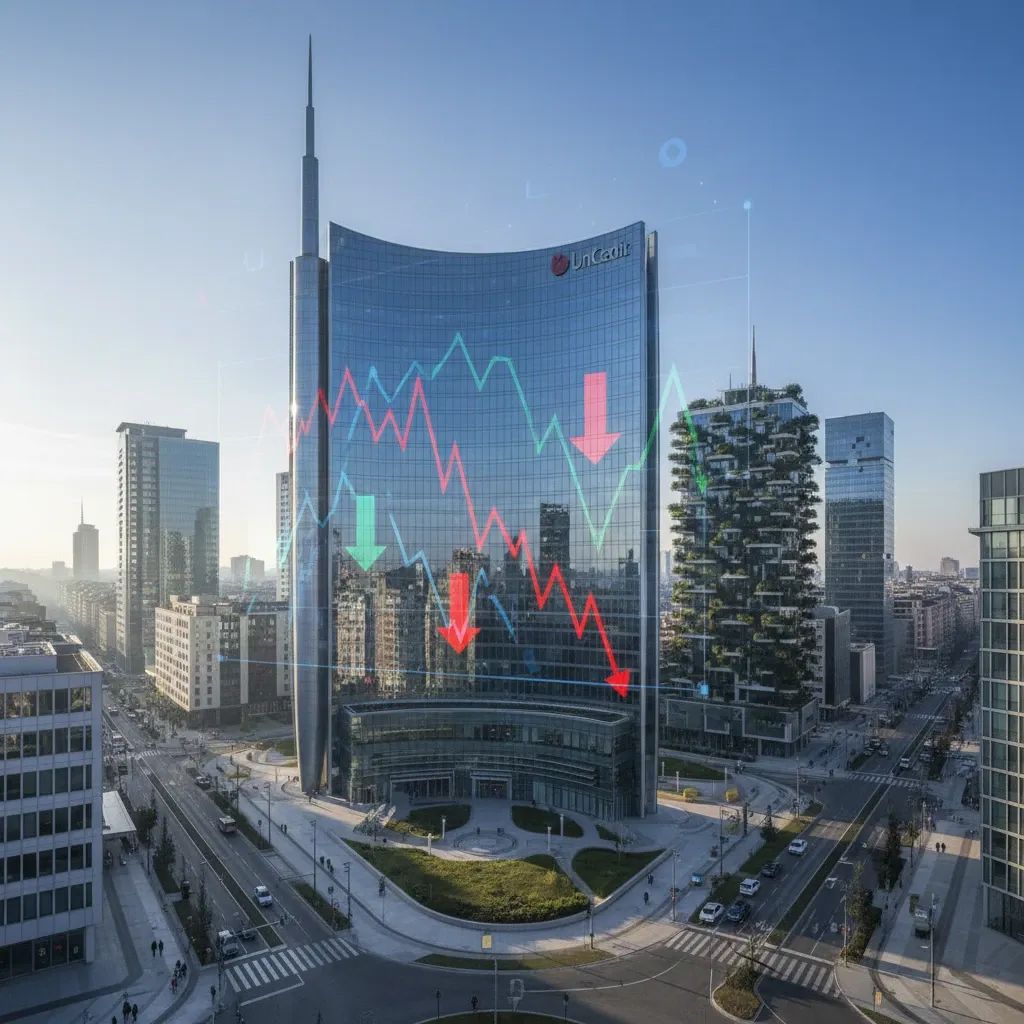
The Milan Stock Exchange closed lower on Monday, dragged down by financial heavyweights as reports of geopolitical developments in the Middle East weighed on investor sentiment across European markets. The FTSE MIB index shed 0.7%, settling at 43,701 points in a session marked by selective selling pressure concentrated primarily in the banking sector.
European Context: Milan Follows Broader Retreat
Milan's decline mirrored losses across major European bourses, with Frankfurt's DAX and Paris's CAC 40 both finishing lower. The common thread: uncertainty around developments in the Middle East and their potential impact on oil markets and trade routes. Italy's export-heavy economy makes it particularly sensitive to such disruptions, as companies like Iveco, Leonardo, and STMicroelectronics rely on stable global logistics.
Why This Matters
• Banking stocks led the retreat: UniCredit and Intesa Sanpaolo both dropped nearly 2%, reflecting broader risk-off positioning across European financials.
• Energy and pharma offset losses: Eni and Saipem surged on crude oil price movements, while Recordati jumped nearly 5%.
• Portfolio implications: Investors holding Italy-heavy portfolios saw mixed results, with sector rotation favoring commodity-linked equities over financials.
Banking Sector Drags Milan Lower
Italy's two largest retail banks absorbed the heaviest selling pressure Monday. UniCredit fell 2%, while Intesa Sanpaolo declined 1.8%, both tracking a wider malaise among European financials. Uncertainty tied to Middle Eastern developments typically influences investor positioning, with capital rotating toward safe-haven assets and away from bank shares, which are sensitive to both credit demand and economic volatility.
Banking stocks remain a cornerstone of the FTSE MIB, comprising roughly a quarter of the index by market capitalization. When these titans stumble, the benchmark follows. For Italian residents with pension funds or exchange-traded products tied to the MIB—particularly common through employers and Poste Italiane savings vehicles—Monday's session underscored the index's structural concentration risk: a handful of names can dictate overall performance.
The sell-off in financials mirrored moves in Paris, Frankfurt, and Madrid, where banks also closed in negative territory. Analysts attribute the weakness to heightened geopolitical uncertainty rather than domestic fundamentals, but the distinction matters little to daily portfolio values.
Energy Giants Shine Amid Crude Rally
While banks faltered, Italy's energy champions delivered standout performances. Eni, the state-linked oil and gas major, climbed 1.98% to close at €23.64. The gain reflects a spike in Brent crude futures, which advanced on supply concerns tied to Middle Eastern developments. Financial analysts suggest this reflects a classic pattern where commodity markets tighten when geopolitical risk rises.
Saipem, the Milan-based oilfield services contractor, surged even more dramatically, posting a 5.8% rally to €3.80. The company benefits directly from elevated oil prices, as upstream producers accelerate drilling and infrastructure projects when crude markets tighten. For investors tracking Italian equities, Saipem's volatility often serves as a barometer for global energy sentiment.
Eni's resilience also highlights the company's strategic importance to Italy's energy security. As the nation continues to diversify away from Russian gas imports, Eni's expansion into African liquefied natural gas and renewable projects positions it as a policy-critical asset—one that often trades on geopolitical narratives as much as earnings fundamentals.
Pharmaceutical Standout Bucks the Trend
Recordati, the Milan-headquartered specialty pharmaceutical firm, notched the session's second-largest gain with a 4.7% jump to €48.40. The move came without specific company news, suggesting either sector rotation into defensive healthcare names or technical buying after recent consolidation.
Recordati's business model—focused on orphan drugs and rare disease treatments—typically insulates it from macroeconomic swings. In volatile sessions like Monday's, that defensive profile attracts capital fleeing cyclical sectors. The stock's strength also reflects broader optimism around Italy's pharmaceutical export sector, which has grown steadily as domestic firms capture niche therapeutic markets across Europe and North America.
What This Means for Italian Residents
Monday's session illustrates a sector divergence that financial advisors note warrants attention for portfolio holders. Positions overweight in Italian banks absorbed meaningful losses, while those with energy or healthcare exposure saw gains.
For Italian residents using domestic banking relationships for investments—whether through wealth management services at their primary bank, Poste Italiane savings products, or pension fund allocations—this highlights the importance of diversification beyond the domestic financial sector. Many Italians hold bank stocks and bank-managed funds as their primary equity exposure, making them particularly affected by days like Monday.
The 0.7% decline in the FTSE MIB also reflects Italy's vulnerability to external shocks. Unlike indices with heavy technology or consumer goods weightings, Milan's benchmark leans on banks, energy, and industrials—all sensitive to geopolitical risk and commodity swings. For expats and foreign nationals holding Italian equities, monitoring currency effects remains important; a weaker euro can amplify or cushion losses depending on one's home currency.
The contrast between banking and energy performance also signals a market responding to competing risk narratives. Italian residents should expect continued volatility as these crosscurrents play out, particularly if geopolitical developments escalate or central bank policies shift unexpectedly.
In practical terms, Monday's session serves as a reminder that Italian equity exposure is not a passive investment. The FTSE MIB's sector composition demands active monitoring, especially when global risk sentiment shifts. Whether managing a personal portfolio, contributing to a pension fund, or evaluating Italian corporate bonds like BTPs, understanding these sector dynamics provides context for investment decisions.


