
The Italian Football Federation (FIGC) has awarded the prestigious Enzo Bearzot Prize to Cesc Fabregas, the 40-year-old Spanish coach steering Como to an improbable Champions League qualification campaign. The recognition marks a watershed moment for the Italy-based Serie A club, which currently sits fourth in the league table with 54 points after 29 matches—a position that would secure direct entry to Europe's elite club competition for the 2026-2027 season, as Serie A's top four teams qualify for the Champions League.
Why This Matters
• Historic achievement: Como, a club promoted from Serie B only two seasons ago, is on track for its first-ever Champions League appearance under Fabregas's tactical vision.
• First foreign winner: Fabregas becomes the first non-Italian coach to receive the Bearzot Prize since its establishment in 2011, a recognition traditionally reserved for Italian managers.
• Economic impact: Champions League qualification would inject an estimated €40M-€60M into the club's budget, transforming the financial landscape for a mid-sized Italian football operation.
• Timing: The award ceremony will take place in the coming weeks, though no specific date has been announced by US ACLI, the organizing body in collaboration with FIGC.
Revolutionary Transformation at Lake Como
When Fabregas arrived at Como in August 2022 as a Serie B player, the project backed by Indonesia's Hartono family seemed more interested in producing football documentaries than winning trophies. That vision collapsed under the weight of results. After retiring from professional play in July 2023, Fabregas took charge of the youth academy before being promoted to interim head coach in November 2023. By July 2024, he held the permanent position—and a stake in club ownership.
The impact has been seismic. Como secured promotion to Serie A in 2023-2024, finishing second in the second division with 70 points. Last season, their first back in the top flight after more than two decades, the team finished 10th with 49 points—a club record in Serie A—and equaled the league mark for consecutive wins by a newly promoted side with six straight victories. This campaign, they've gone further still, boasting the third-best attack and second-best defense in the division, conceding just one goal more than AC Milan through late March.
Tactical Blueprint: Guardiola Meets Wenger
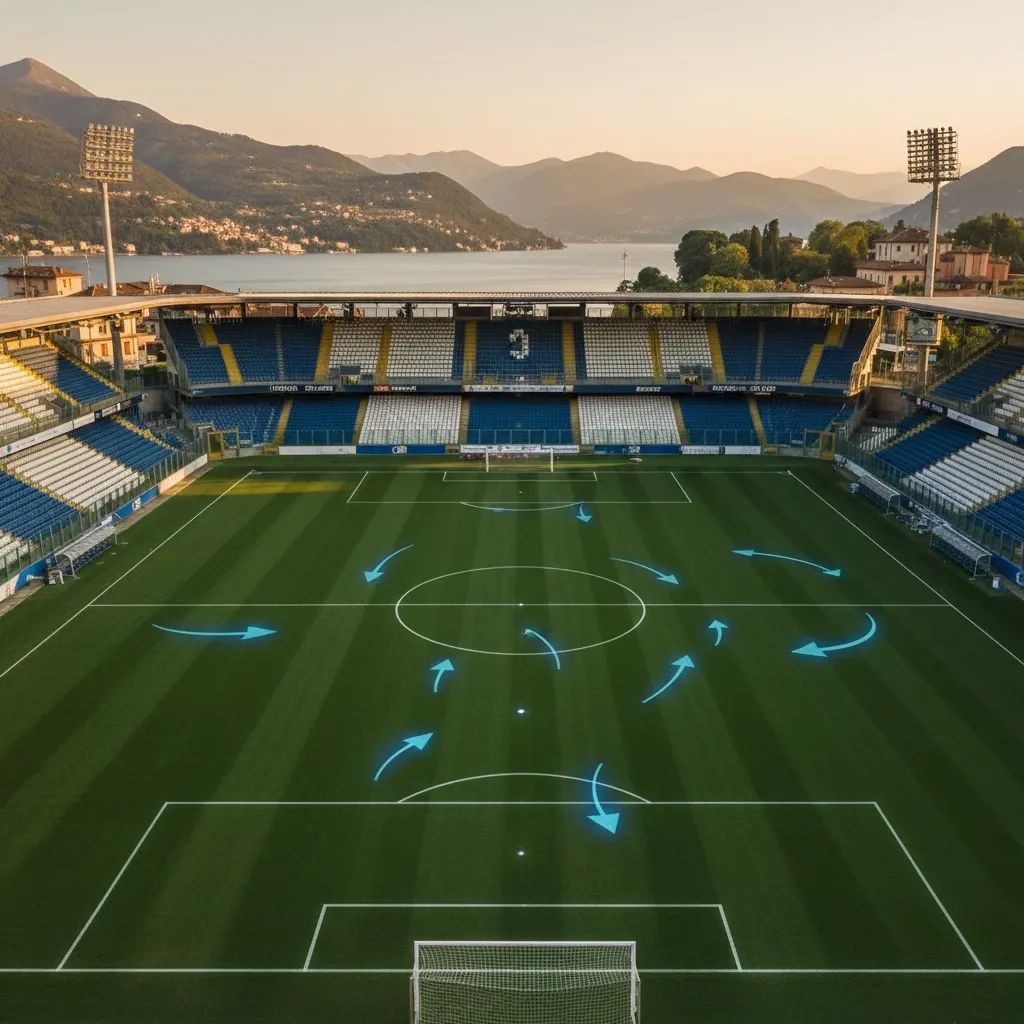
Fabregas has imported a hybrid philosophy shaped by his mentors—Pep Guardiola's possession-based "tiki-taka" and Arsène Wenger's emphasis on technical precision and attacking movement. Como typically deploys a 4-2-3-1 formation, with one of the two holding midfielders dropping deep to facilitate build-up play. This allows the full-backs to push forward while the wingers cut inside, creating numerical superiority in central zones.
The team applies Gegenpressing—immediate collective counter-pressing—when losing possession in midfield, aiming to recover the ball before opponents can organize. Rather than rigid man-marking, Como uses a mixed system: pressing the ball carrier while teammates cover passing lanes. When space opens in transition, verticality trumps patience. Fabregas has also experimented with a false nine and a back three to maximize control against specific opponents, demonstrating tactical flexibility uncommon among coaches in their first full Serie A season.
The squad itself reflects this vision: a blend of young talent and seasoned internationals with strong technical fundamentals, courage in possession, and the willingness to attack depth. It's a roster constructed not for survival, but for competition at the highest level.
The Bearzot Legacy and What It Represents
Established in 2011, the Premio Nazionale Enzo Bearzot honors the legendary Italy manager who led the Azzurri to World Cup glory in 1982. The award, determined by a jury of journalists and football experts, prioritizes ethical conduct, sporting values, and behavioral standards alongside on-field achievement. It's a recognition of character as much as competence—qualities embodied by Bearzot, who coached Italy for a record 104 matches between 1975 and 1986.
FIGC President Gabriele Gravina called Fabregas a "generational symbol" during the announcement at the federation's Paolo Rossi Hall. Gravina noted that Fabregas earned his UEFA Pro coaching license at Coverciano, Italy's famed coaching school, demonstrating a commitment to formal training rather than relying solely on his star playing career. "Awarding him this prize recognizes both training and quality, because he's doing extraordinary things," Gravina said.
The FIGC president drew a parallel between Fabregas and the "Grande Vecio" (Great Old Man), as Bearzot was known: both rejected shortcuts, imposing themselves through results and performance. Both also lifted World Cups—Bearzot as coach in 1982, Fabregas as a player with Spain in 2010.
Additional Honors and Recognition
This year's Bearzot Prize includes several supplementary awards. Legendary coach Fabio Capello, who turned 80 this year, receives a lifetime achievement honor. The Stefano Farina Prize for referees goes to Marco Guida, while a special recognition will be presented to Valentina Zamburru, a 17-year-old referee who was physically assaulted during an Under-17 match in Sardinia just weeks ago. The inclusion of Zamburru underscores the award's broader mission: promoting integrity and resilience within Italian football culture.
What This Means for Como and Italian Football
For Como, the Bearzot Prize validates a project that many dismissed as a vanity exercise. The club's ownership has pivoted from entertainment to genuine sporting ambition, and Fabregas—who holds equity in the team—has become the architect of that shift. A top-four finish would represent not only a sporting miracle but also a financial windfall: Champions League participation brings media rights revenue, match-day income, and global exposure that could redefine Como's competitive ceiling for years.
For Italian football, Fabregas's success challenges entrenched assumptions. Serie A has long been skeptical of foreign coaches without extensive managerial pedigrees, yet here is a Spaniard with minimal head-coaching experience outperforming established tacticians. His willingness to study at Coverciano, earn proper credentials, and adapt his philosophy to the Italian tactical environment has earned him credibility in a notoriously insular system.
Looking Ahead
Fabregas accepted the award with characteristic humility, releasing a statement through ANSA: "I am truly moved, proud, and grateful to receive this important recognition, dedicated to a legend of Italian and world football. I want to thank the jury members, Como 1907, all my players, and the staff. Every personal recognition is the result of a journey built with many people, and for this reason, I want to share this award with them."
With eight matches remaining in the Serie A season, Como's fourth-place position remains precarious. Juventus and Roma trail closely, and every point will matter in the final sprint. But whether or not the Champions League dream materializes, Fabregas has already rewritten the narrative for a club that was playing second-tier football just 18 months ago. The Bearzot Prize confirms what observers across Italy are beginning to accept: this is no fluke, and Fabregas is no novice. He is, as the jury noted, "a young coach already brilliant after being an extraordinary player, representing one of the most significant coaching innovations at the international level."


