
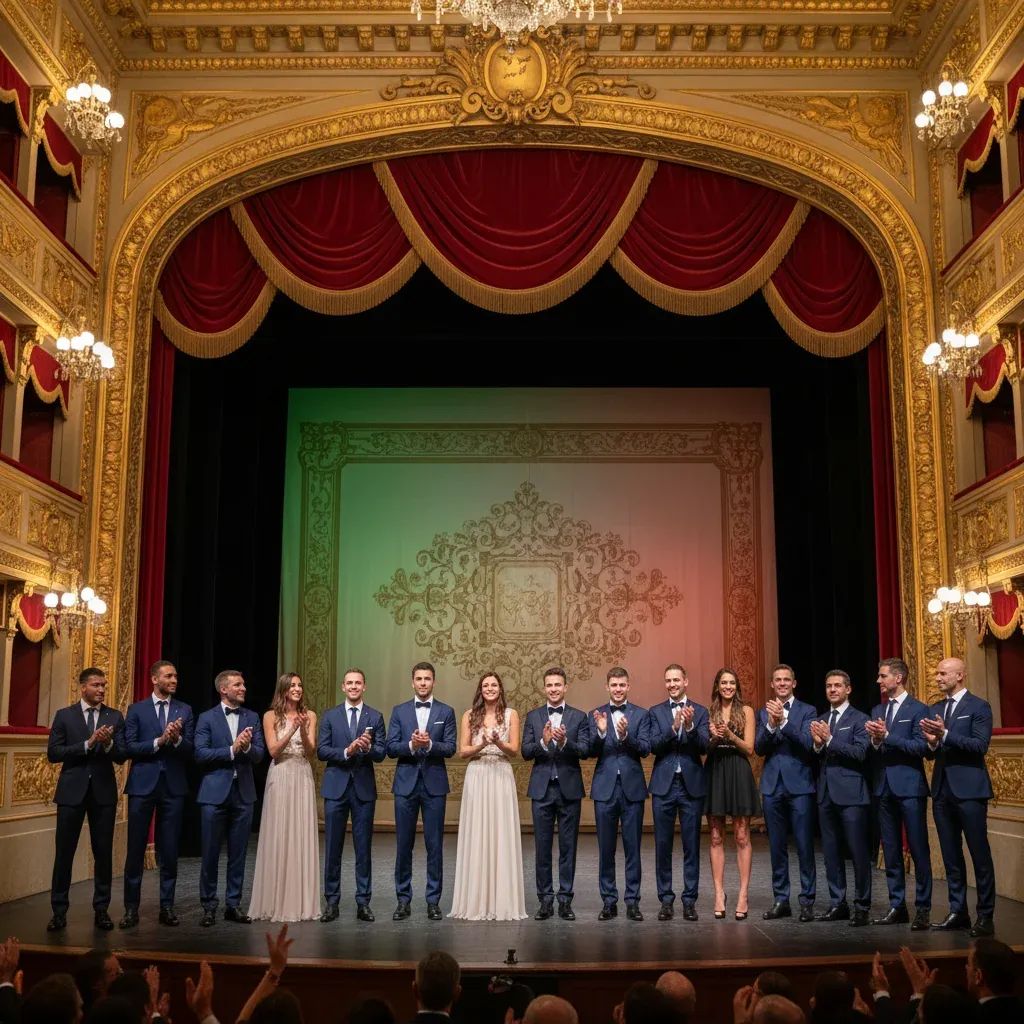
The Italian Paralympic Committee has selected snowboarder Emanuel Perathoner to carry the national flag at tonight's closing ceremony for the Milano Cortina 2026 Paralympic Winter Games on March 15, 2026, a symbolic honor recognizing an athlete whose journey from Olympic contender to Paralympic champion encapsulates resilience in the face of career-ending injury.
The ceremony takes place at 20:30 local time at the Cortina Curling Olympic Stadium, marking the end of ten days of competition that began on March 6. Italy's national broadcaster Rai will carry the event live on RaiSport and RaiPlay, including the extinguishing of the Paralympic flames in both Milano and Cortina, the lowering of the three-agitos flag, and the formal handover to France, which will host the 2030 Winter Paralympics in the French Alps.
Why This Matters:
• Record-breaking home Games: Italy has secured its best Paralympic Winter performance ever, surpassing previous medal totals with 6 golds and 14 medals overall by March 13.
• Perathoner's double gold: The 31-year-old won both the snowboard cross SB-LL2 on March 8 and the banked slalom SB-LL2 on March 13, becoming the first Italian to achieve a double gold in Paralympic snowboarding.
• Symbolic selection: One of only a handful of athletes in history to compete at both Winter Olympics and Paralympics, Perathoner was forced to miss Beijing 2022 due to a catastrophic knee injury that required full joint replacement.
From Sochi to Surgery: A Career Interrupted
Perathoner's athletic biography reads in two distinct chapters. The first began with his Olympic debut at Sochi 2014, followed by Pyeongchang 2018, where he represented Italy as an able-bodied snowboard cross competitor. During that phase, he claimed two team World Cup victories alongside Omar Visintin in 2017 and 2018, his first individual World Cup win at Cervinia in December 2018, and a bronze medal at the 2019 World Championships.
Then came January 2021. A training accident left him with a shattered tibial plateau and a medical verdict that ended any hope of competing at the Beijing 2022 Olympics. The damage was so severe that surgeons performed a total knee replacement—a procedure rarely undertaken in active elite athletes because it typically marks the end of high-level competition. The surgery replaces the damaged joint with an artificial implant, fundamentally altering the athlete's biomechanics and proprioception. That Perathoner would return to elite snowboarding after such an intervention placed his comeback among the most medically improbable recoveries in winter sport. Over the following year, Perathoner endured four separate surgical interventions and a grueling rehabilitation process.
By October 2022, instead of retiring, he made a calculated pivot: para-snowboard. The decision proved transformative. Within months, he was winning again, eventually racking up 15 World Cup victories and two world championship golds in the lead-up to Milano Cortina 2026. His motto, repeated in interviews throughout his comeback, became a rallying cry: "Mai arrendersi, con o senza disabilità"—never give up, with or without disability.
Double Gold in Cortina: The Victories That Changed Everything
On March 8, Perathoner claimed his first gold in the snowboard cross SB-LL2 category, a fast-paced head-to-head racing format that demands explosive acceleration and tactical positioning. Five days later, on March 13, he captured his second title in the banked slalom SB-LL2, a technical discipline requiring precision and control through a series of banked turns. The dual victories, achieved across two distinct snowboard disciplines within a week, demonstrated both his versatility and his dominance in the sport. No Italian snowboarder had ever achieved this feat at the Paralympics, making Perathoner's accomplishment historically significant for the nation's para-sport program.
Why Perathoner Got the Flag
Marco Giunio De Sanctis, president of the Italian Paralympic Committee, outlined three reasons for the choice. First, Perathoner is the only Italian athlete to win two golds at these Games. Second, his victories came in snowboard, a discipline where Italy had never won Paralympic gold before this edition. Third, and perhaps most poignant, the committee wanted to honor an athlete who embodies both the Olympic and Paralympic ideals, having competed at the highest level in both arenas.
Italy's snowboard program had been relatively modest on the Paralympic stage before this year. The country's entire medal history in the sport consisted of a single silver—Manuel Pozzerle's snowboard cross podium at Pyeongchang 2018. Milano Cortina 2026 changed that calculation entirely. Alongside Perathoner's double gold, Jacopo Luchini—competing with aplasia of the left hand—won gold in the banked slalom SB-UL category on March 12, finally reaching the podium after finishing fourth at Pyeongchang 2018 and fifth at Beijing 2022. Together, these two athletes transformed Italian para-snowboarding from a niche program into a medal-winning powerhouse.
A Delegazione That Broke the Mold
Italy fielded its largest-ever Winter Paralympic delegation for these Games: 42 athletes and four guides, competing across six sports—alpine skiing, biathlon, cross-country skiing, para ice hockey, snowboard, and wheelchair curling. The size and depth of the squad reflected years of targeted investment and strategic preparation coordinated between the Comitato Italiano Paralimpico (CIP), national federations, and military sports groups.
The home advantage proved significant. Athletes trained extensively on the actual competition venues: alpine and snowboard events took place on the Tofane slopes in Cortina, while Nordic skiing and biathlon were contested in Tesero, Val di Fiemme. Wheelchair curling athletes familiarized themselves with the Cortina Ice Stadium well before the opening ceremony. That level of access, combined with the emotional charge of competing in front of home crowds, created an environment in which Italian athletes consistently exceeded expectations.
The delegation included a mix of 13 Paralympic debutants and established champions like René De Silvestro, who carried the flag at the opening ceremony and won gold in the sitting giant slalom, and Giacomo Bertagnolli, who returned to improve on his Beijing 2022 results. Athletes in visually impaired categories, such as Chiara Mazzel and Martina Vozza, competed alongside their guides Fabrizio Casal, Nicola Cotti Cottini, and Ylenia Sabidussi, underscoring the collaborative nature of Paralympic sport.
What This Means for Italian Para-Sport
The results at Milano Cortina 2026 represent more than a statistical anomaly. By mid-March, Italy had already surpassed the total medal count from Lillehammer 1994, previously the country's best Winter Paralympic showing, and set a new record for gold medals. The performance signals a structural shift in how Italy develops and supports Paralympic athletes, particularly in sports like snowboard that were once peripheral to the national program.
Perathoner's selection as flag bearer reflects the values the CIP wants to project: perseverance, adaptability, and the capacity to rebuild after catastrophic setback. For an athlete who underwent knee replacement surgery at an age when most snowboarders are nearing their competitive peak, his double gold at Milano Cortina 2026 demonstrates that elite performance remains possible even after medical interventions once considered career-ending.
Tonight's ceremony will also include the formal transition to France 2030, when the Paralympic flame will pass to the French Alps. For Italy, the closing marks the end of a decade-long project to host the Winter Games and Paralympics, a logistical and symbolic undertaking that required coordination across multiple mountain venues and two host cities.
The Broader Picture
Perathoner's story demonstrates that the boundaries between Olympic and Paralympic sport can be more fluid than traditionally assumed. The fact that he is among a rare group of athletes to compete at both Winter Olympics and Paralympics—a feat that requires not just athletic versatility but a profound reckoning with identity and capability—underscores his significance as flag bearer for these Games.
The Games have also provided a platform for athletes like Luchini, who spent years on the margins of the podium before finally breaking through at home, and for newcomers who used the spotlight of a home Paralympics to announce themselves on the world stage. The CIP has emphasized that the long-term goal is not just medals but the normalization of Paralympic sport within Italian culture, leveraging the visibility of Milano Cortina 2026 to build sustained public interest and institutional support.
As the Paralympic flames are extinguished tonight in Cortina, the immediate focus will shift to how Italy translates this unprecedented success into lasting infrastructure—both physical and cultural—for para-sport. Perathoner, flag in hand, will carry that message forward.


