
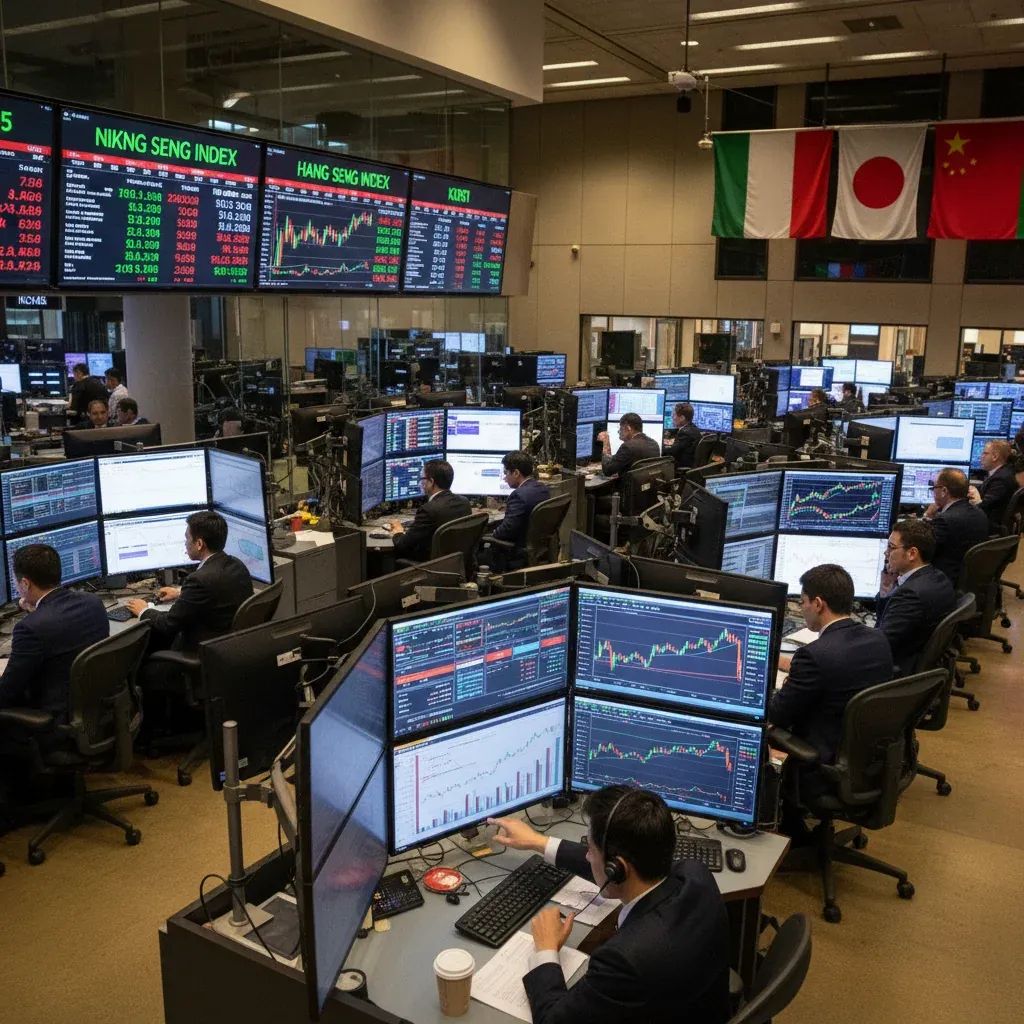
Asia's markets are in sharp retreat following a fresh geopolitical escalation that has sent shockwaves through global trading. A new ultimatum from U.S. President Donald Trump to Iran has triggered a significant sell-off across Asian bourses, with potential spillover effects for Italian investors and European markets.
The Immediate Impact
Asian markets bore the brunt of the overnight decline. Tokyo's Nikkei 225 fell 3.48%, while Seoul's benchmark collapsed by 6.5%, marking one of the steepest single-session drops in recent memory. Hong Kong's Hang Seng tumbled 4.16%, Shanghai's composite fell 3.6%, and Shenzhen dropped 4.19%. Both Japan and South Korea are among the most vulnerable to energy supply disruptions due to their near-total dependence on imported fossil fuels, and India faces similar exposure.
The catalyst: Trump's ultimatum to Iran has raised immediate concerns about potential disruptions to energy supplies, particularly through critical maritime chokepoints in the Gulf region. With energy-dependent economies under pressure, investors have shifted away from risk assets, triggering the broad-based sell-off.
Why This Matters for Italian Investors
For Italians holding diversified portfolios—especially those with Asia-Pacific ETFs or multinational equity funds—the damage is already visible. The sell-off across Asian equities directly impacts anyone exposed to the region.
More importantly, European futures are pointing downward, signaling that Italian blue-chips on the FTSE MIB are likely to open lower when trading resumes. The broader European market is expected to absorb losses as Asian weakness spreads through global trading networks.
Italy's energy security is also a consideration. The country imports significant quantities of natural gas and crude oil, much of it originating from or transiting through the Gulf region. Escalating tensions could increase pressure on energy costs, with potential implications for Italian households and businesses already navigating an uncertain economic environment.
What Comes Next
European markets are expected to open in negative territory on Monday, extending losses from earlier trading sessions. Italian investors should monitor energy price movements and central bank communications in the coming days, as these will likely drive near-term market direction.
The conflict's trajectory remains unclear, and any further escalation could trigger additional market volatility. For now, investors should maintain awareness of their exposure to Asian equities and energy-sensitive sectors as the situation develops.


