
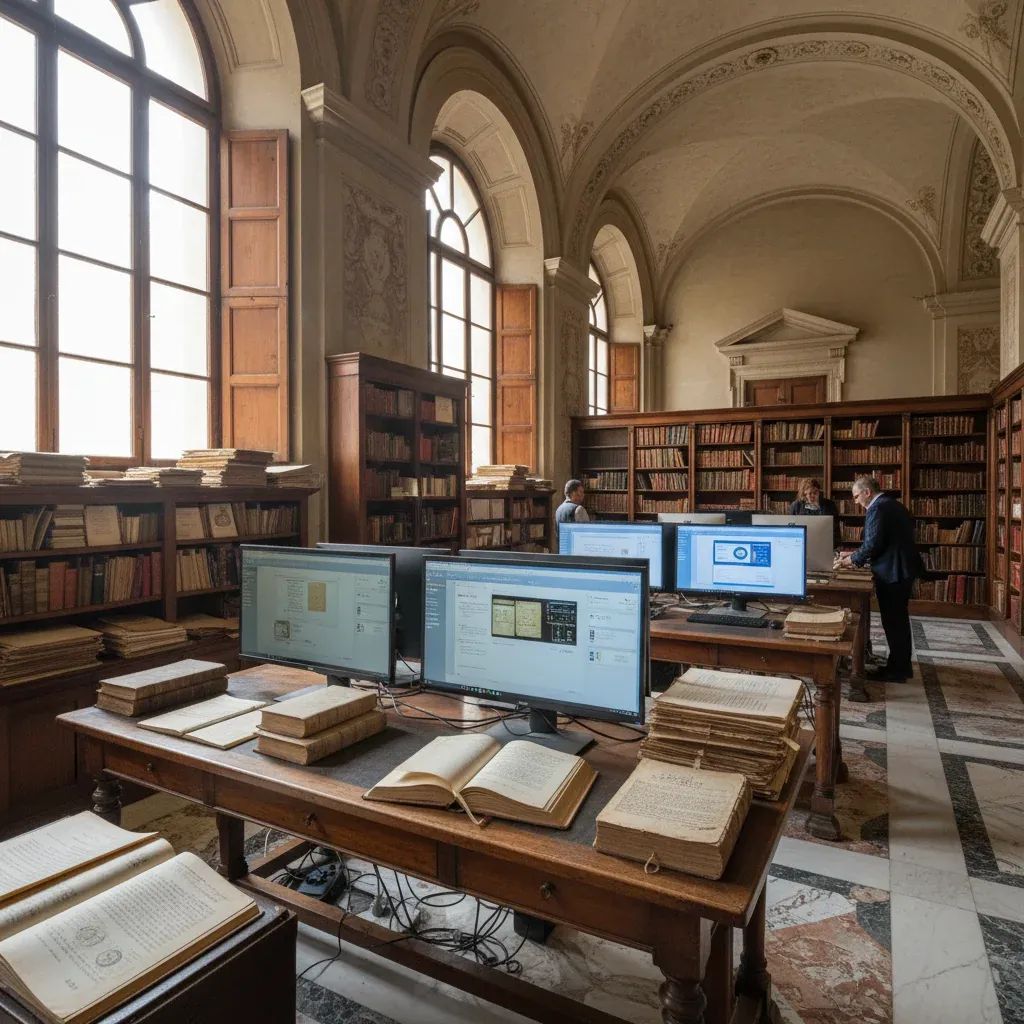
The Italian Chamber of Deputies has made accessible a new tranche of declassified documents related to the Aldo Moro kidnapping and murder case, adding to a growing digital archive that now allows citizens to examine one of the republic's most contested chapters from their laptops. The move, announced by Chamber President Lorenzo Fontana on the 48th anniversary of the Via Fani ambush, represents what officials describe as a concrete step toward transparency in a case that continues to fracture Italian collective memory.
Why This Matters
• New access: 64 additional acts and 3 transcripts from the Moro commission are now searchable online, completing the XVII legislature's investigative record.
• Ongoing desecretation: Millions of pages from judicial proceedings are being digitized by the Italy Ministry of Culture under the "Rete degli archivi per non dimenticare" platform, with the project's completion slated for mid-2025.
• Constitutional relevance: The anniversary coincided with public debate over Italy's upcoming referendum on judicial reform, a vote Luca Moro—Aldo Moro's grandson—invoked as a test of the same direct democracy principles his grandfather championed as a constituent.
The Via Fani Attack: What Happened on March 16, 1978
On that Thursday morning in Rome, a Red Brigades commando intercepted the convoy carrying Aldo Moro, then president of the Christian Democracy party, along Via Mario Fani. The ambush left five bodyguards dead—Oreste Leonardi and Domenico Ricci (Carabinieri), Raffaele Iozzino, Giulio Rivera, and Francesco Zizzi (State Police)—and Moro himself kidnapped. He would be executed 55 days later, his body abandoned in a parked Renault 4 on Via Caetani, equidistant between the DC and Communist Party headquarters, in a final symbolic gesture by his captors.
The event remains the most traumatic rupture in Italy's post-war political settlement. It terminated Moro's attempt at a "Compromesso Storico," a grand coalition between the Christian Democrats and the Italian Communist Party designed to stabilize governance and integrate the left into institutional power. His death effectively closed that door, reshaping the trajectory of Italian democracy for decades.
A Grandson's Testimony: Sacrifice and the "Simple People"
Luca Moro, Aldo's grandson, issued a statement marking the anniversary with a pointed reflection on memory and political sacrifice. "The love for Aldo Moro remains alive in the hearts of ordinary people, who understand what his sacrifice meant for them," he said. "My grandfather always put people before himself. A sacrifice of that kind is never useless."
He expressed concern that Italy is running short of individuals willing to risk their lives for the country, but maintained that "peacemakers and builders of peace always return at some point in history." He paraphrased his grandfather's philosophy: "There is no path to peace; peace is the path."
Luca also shared a lesser-known detail about the escort detail. "My grandfather wanted to transfer the agents to protect them, because he sensed his moment was arriving," he recounted. "But they approached my grandmother and asked not to be reassigned—they didn't want to leave him to die alone. The bitter irony is that the escort died at Via Fani, and my grandfather died alone anyway, at another time and in another place."
What This Means for Constitutional Debate Today
Luca Moro explicitly linked his grandfather's legacy to the referendum on judicial separation of careers scheduled for just days after the anniversary. He recalled Aldo Moro's vigorous defense of referendums during the Constituent Assembly, describing them as "the privileged moment in which the people themselves can directly express 'the evolution of public conscience.'"
"This definition tells us today, more than ever, what a referendum is and how important it is for people now, a week before the vote," Luca said. "It is the people directly who must choose by looking at the merit of the proposal—it is not the party that must dictate the line. People vote outside the party discourse. And this time they must use heart united with head, because that vote they are expressing, they express for themselves."
He also cited his grandfather's words as a constituent on justice: "The value of civilization is notably deduced from the justice it manages to promote and realize." He concluded: "So, welcome, finally, steps forward toward a fairer trial process."
Political Tributes and the Memory Industry
Italy's institutional leadership issued coordinated statements. Deputy Prime Minister and Foreign Minister Antonio Tajani called March 16, 1978, "one of the darkest moments in republican history," vowing that the sacrifice of the five guards "remains a warning against violence and requires us to renew collective commitment to a more just, free, and democratic society."
Democratic Party Secretary Elly Schlein attended a wreath-laying ceremony in Via Fani with a PD delegation. "For us, remembering means continuing to defend, every day, the values of democracy against all political violence and terrorism," she said, extending solidarity to the victims' families.
Rome Mayor Roberto Gualtieri framed the attack as "a deep wound, imprinted in the memory and conscience of our country and our city," while praising Italy's united response that "found the strength to defeat the season of armed struggle."
Senate President Ignazio La Russa emphasized that "remembering that dramatic day means honoring those who sacrificed their lives and reaffirming, with force, the value of freedom and democracy against all forms of terrorism."
The Archive Project: Transparency or Containment?
The desecretation effort has accelerated markedly since 2025. The Italy Central State Archive has been receiving declassified documents from intelligence services and the Foreign, Interior, and Defense ministries since 2014, but the volume has expanded substantially. By June 2025, the digitization project—coordinated by the Directorate General of Archives at the Ministry of Culture—will have scanned millions of pages from judicial proceedings related to the Moro trials. The eight-year effort involved inmates at Rebibbia prison in Rome as part of the scanning workforce.
In March 2026, the Chamber added 64 acts and 3 transcripts to the existing 992 documents already online, completing the public record of the XVII legislature's Moro commission. These are now searchable via the Chamber's parliamentary inquiry portal.
Among the revelations from the 2025 releases: confirmation that members of Gladio, the NATO-linked stay-behind network, were activated during the kidnapping for a "passive intelligence mission" monitoring sources and information of potential interest. The disclosure reignited debate over the extent of foreign and domestic intelligence involvement in the case, a subject that has never been satisfactorily resolved despite five parliamentary inquiries and countless judicial investigations.
Impact on Residents and Civic Memory
For Italians—especially those who lived through the anni di piombo (years of lead)—the Moro case remains a litmus test for the state's honesty and accountability. The digitization of records allows citizens, researchers, and journalists to bypass institutional gatekeepers and examine the evidence directly. It also creates a resource for younger generations, many of whom encounter the case only through textbooks or conspiracy theories circulating online.
Yet the flood of documents has not quieted suspicions. Key questions remain unresolved: the role of intelligence agencies, the decision not to negotiate, the contents of Moro's prison letters, and the possible involvement of foreign powers. The archive expansion may provide raw material for answers, but it also risks deepening the fragmentation of collective memory by enabling competing narratives to cite "official" sources in support of mutually exclusive conclusions.
A Test of Democratic Culture
The 48th anniversary coincides with a broader reckoning over Italy's democratic health. Political analysts note that the reduction of participatory spaces, the weakening of parliamentary sovereignty, and the rise of executive-dominated governance—trends accelerating since the mid-1990s—stand in sharp contrast to the constitutional equilibrium Moro helped design. His emphasis on dialogue, compromise, and inclusion is frequently invoked by politicians across the spectrum, yet rarely modeled in practice.
The Premio San Sebastiano for 2026, dedicated to the heirs of the five slain bodyguards, will be awarded in Campania later this year. The prize links the courage of the escorts to Saint Sebastian, a universal symbol of fidelity and sacrifice for justice. RAI aired a special episode of its historical program "Passato e Presente" on March 16, 2026, on RAI 3 and RAI Storia, revisiting the kidnapping and its aftermath.
As Luca Moro suggested, the case endures not merely as historical trauma but as a moral question: whether Italy can sustain the kind of political culture—patient, inclusive, willing to risk unpopularity for the sake of stability—that his grandfather represented. The answer may depend less on what the archives reveal than on what citizens choose to do with the information once they have it.


