
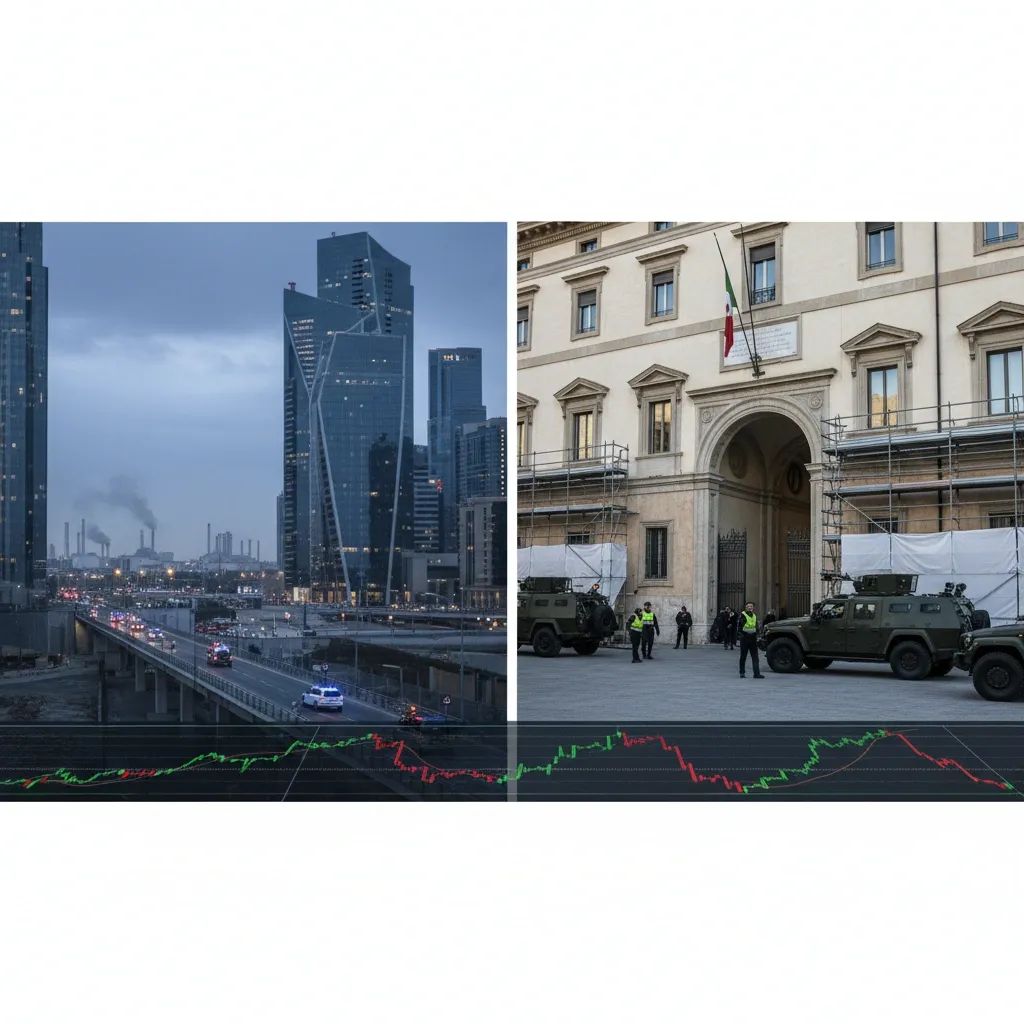
Italy's young business leaders have issued a strong call to the nation's political establishment: implement sweeping structural reforms or watch the country's economic stagnation deepen further. The assessment came from Confindustria's under-40 cohort at their 55th annual conference in Rapallo this week, where President Maria Anghileri declared that "the country is not working" and young Italians are increasingly "angry and stuck."
Important context for residents: These proposals remain under active political debate, with no legislation yet enacted. The following represents demands and policy ideas being advocated by business leaders and various political parties.
Why This Matters
• Tax proposal: A five-year graduated IRPEF (Italy's personal income tax) exemption for workers under 35, delivering up to €1,000 extra monthly income in year one—equivalent to rent in many Italian cities.
• Structural crisis: Italy remains Europe's most indebted nation despite fiscal prudence, with GDP growth projected at just 0.5–0.7% through 2026.
• Brain drain cost: Italy loses roughly 34,700 young professionals (aged 20–39) annually, translating to €1.66B in lost GDP each year.
• Political timing: With election season heating up, young industrialists are demanding accountability akin to corporate shareholder reporting.
The Proposal: €1,000 More Per Month for Young Workers
The centerpiece of Anghileri's Rapallo address was a concrete fiscal intervention aimed at making Italian salaries competitive for the under-35 cohort. The mechanism: a degressive IRPEF exemption over five years for workers earning up to €50,000 annually. Year one would bring a 100% tax holiday—translating to approximately €1,000 extra monthly take-home pay for many entry-level professionals—tapering to 20% relief by the fifth year.
"This changes lives," Anghileri told an audience of political leaders from across the spectrum. "Now we need someone with the courage to implement it."
The plan reflects proposals already circulating in the political arena. Italia Viva's Matteo Renzi advanced a "Start Tax" concept at his Leopolda conference in October 2025, calling for 50% IRPEF cuts for those under 25, tapering to 30% at 30 and 20% at 35. The young industrialists' version differs slightly in its earnings threshold and degressive schedule.
Deputy Prime Minister Antonio Tajani of Forza Italia responded from the same Rapallo stage, proposing to "detax anyone who invests in startups for five years, so young people can consolidate their business initiatives." Meanwhile, Democratic Party leader Elly Schlein referenced her coalition's own tax relief variant and proposed a dedicated fund to support youth-led startups in Italy's struggling internal regions.
What This Means for Residents
For young professionals and entrepreneurs in Italy, these proposals represent a rare alignment of business and political interest around a single policy lever. If enacted, the IRPEF relief could mean:
• Higher disposable income: An extra €800–€1,000 monthly for new graduates in their first job, providing breathing room for housing deposits, mobility, or savings.
• Startup runway: Five-year tax holidays for investors in new ventures would lower the barrier to founding or joining early-stage companies.
• Remote voting access: The Rapallo conference also pressed for distance voting rights for Italy's 5M residents living away from their registered commune for work, study, or health—ending the chronic disenfranchisement of mobile youth.
But skeptics note the cost. The young industrialists framed it as "an investment in the future," not a budget hole. Their pitch: redirect spending from pension and welfare budgets—which consume nearly €400B annually—toward education, research, and family support, currently allocated just €99B combined. "The ratio between past and future is 3-to-1," Anghileri said. "It must become 1-to-3 in favor of young people."
A Nation Running in Place
Italy's economic malaise forms the backdrop. Official data show youth unemployment (ages 15–24) at 16.9% in April, the lowest since 2004 but still double the EU average. Overall unemployment sits at 5.1%, yet GDP growth limps along at half the eurozone pace. The Italy National Statistics Institute (Istat) projects 0.5% expansion in 2025 and 0.7% in 2026—barely enough to service the national debt, let alone fund generational renewal.
Confindustria's research arm warns of a negative external demand contribution through 2026, as geopolitical tensions and energy price volatility weigh on export sectors. The only bright spot: domestic investment driven by the National Recovery and Resilience Plan (PNRR), Italy's share of EU post-pandemic funds.
Yet even PNRR capital struggles to compensate for structural dysfunction. "The state must remove the yoke it has placed on our backs—and on our employees' backs," Anghileri said, noting that businesses generate 80% of Italy's tax revenue while bearing the brunt of bureaucratic inefficiency and Europe's highest energy costs.
The European Context: Italy as an Outlier
Across the EU, member states are grappling with youth emigration and sluggish growth through a patchwork of policies. The Youth Guarantee program, backed by €10.8B from the European Social Fund (2021–2027), promises job or training placements within four months for anyone under 30. Germany's apprenticeship model remains the gold standard, while Portugal battles a housing crisis that drives 30% of young adults abroad despite robust growth.
Italy's position is anomalous: it possesses the GDP of an advanced economy but offers young workers conditions worse than peers in Eastern Europe. The result is a hemorrhage of human capital—34,700 annually in the 20–39 bracket—at an estimated annual cost of €1.66B in lost productivity.
The EU's "Choose Europe" initiative, which dedicates over €500M to stem talent outflows via Marie Curie fellowships and research "supergrants," has struggled to reverse the tide in southern member states. Italy's own €142B allocation from EU cohesion funds aims to upgrade infrastructure, seed innovation hubs, and fund scholarships, but bureaucratic inertia slows disbursement.
The Reform Wishlist
Beyond tax relief, the Rapallo agenda included:
• A single digital portal for business registration, incentive access, and guarantee applications—currently scattered across dozens of agencies.
• Entrepreneurship fellowships modeled on PhD grants, funding would-be founders to launch innovative firms.
• Spending review: Rebalance the €1.1T public budget away from pensions (€400B) toward education, R&D, and family support (€99B total).
• Energy cost relief: Remove the "systemic inefficiency burden" of high electricity and gas prices that undermine competitiveness.
Anghileri's language was direct for an employers' association. "Young people are not waiting on the bench anymore—they're leaving the stadium," she said. "We need to rebuild a promise of the future that has cracked in Italy."
Political Crosscurrents
The Rapallo conference, a decades-old tradition, brings under-40 industrialists face-to-face with party leaders during what Anghileri termed "the start of a long election campaign." This year's edition drew commitments—some overlapping, others distinct—from across the spectrum.
Tajani pitched his detaxation of startup investors alongside Forza Italia's broader proposal to eliminate taxes on year-end bonuses and overtime, aiming to stimulate consumer spending. Renzi positioned his centrist coalition as the natural home for fiscal pragmatism with the "Start Tax" framework. Schlein countered with her progressive alliance's own tax relief variant plus the regional startup fund.
Yet translating rhetoric into law requires navigating Italy's notoriously fragmented legislature. The 2026 budget, already strained by debt service and EU fiscal rules, offers limited room for new expenditures. Any IRPEF relief would need offsetting revenue—hence the young industrialists' call for "uncomfortable choices" on pension and welfare spending.
A Shareholder Model for Politics
The conference's framing was telling. Anghileri repeatedly invoked corporate accountability: businesses must justify investments to shareholders, and governments should justify policies to citizens. "We need a reckoning from politics, just as in companies we must account to shareholders for having invested their money well," she said.
It's a market-liberal critique that resonates beyond Confindustria's membership. Italy's generational wealth gap is widening as boomers retire on defined-benefit pensions while millennials and Gen Z face precarious contracts, stagnant wages, and vanishing home ownership. The €400B pension bill versus €33B for families and natality support epitomizes the imbalance.
Whether electoral pressures force action remains uncertain. Italy's political calendar shows regional and municipal contests through late 2026, with national elections possible by 2027. The young industrialists bet that voter frustration—especially among the mobile, educated cohort most likely to emigrate—will compel parties to compete on concrete reform rather than symbolic gestures.
The Bottom Line
Italy's young business elite have handed the political class a detailed blueprint and a public challenge. The fiscal tools exist; the economic case is documented; the European precedents are visible. What remains to be determined is whether political will materializes.
"We are the most indebted country in Europe despite government prudence on public accounts, which we fully recognize," Anghileri said. "But we don't grow. And until we grow, nothing else works."
The coming months will test whether Italy's leaders treat the Rapallo proposals as serious policy options or convenient election talking points. For the 5M young Italians living and working far from their hometowns—and the tens of thousands considering exits abroad—the distinction carries immediate and personal stakes.


