
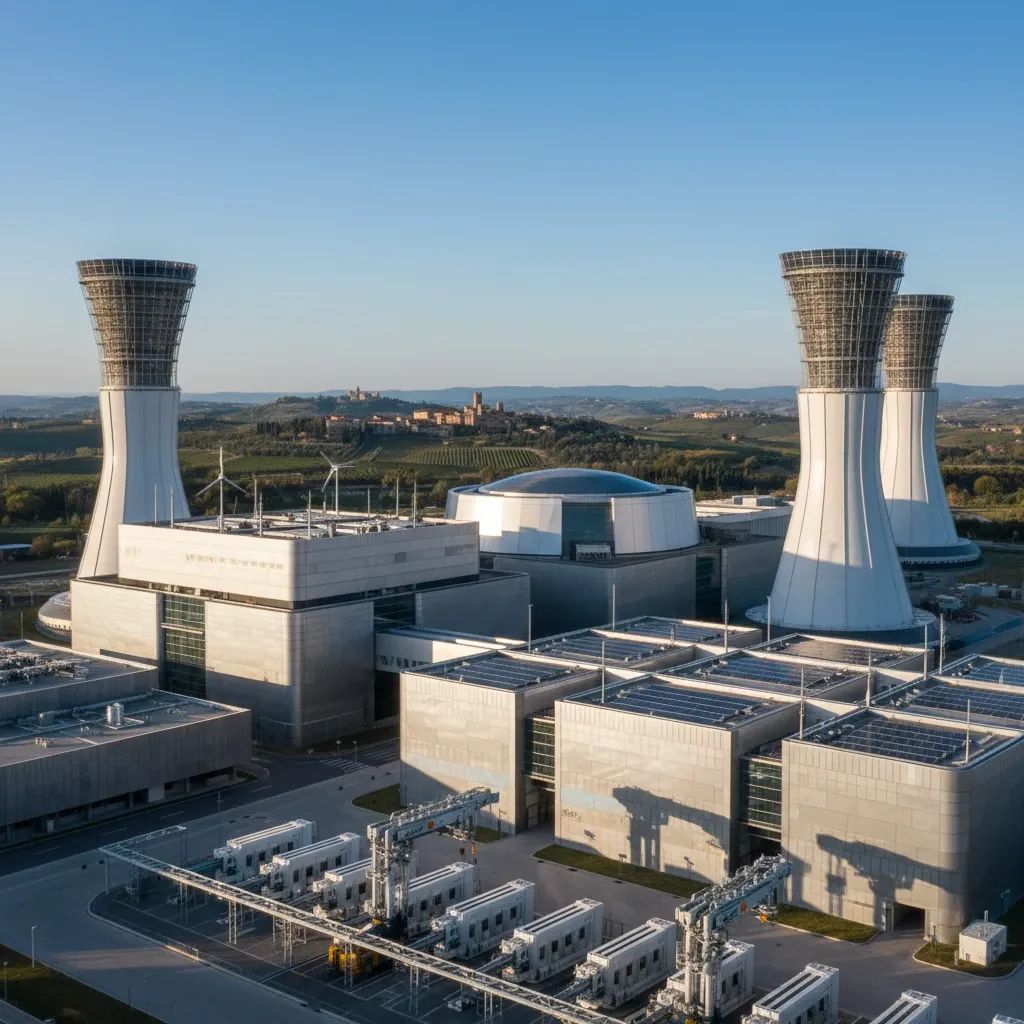
Italy's lower house has approved legislation that could see the first nuclear reactors operating on Italian soil by 2034-2035, though the bill still requires Senate approval before becoming law. The measure passed with 155 votes in favor, 86 against, and 8 abstentions, and now moves to the Senate for final approval before the summer recess.
Why This Matters
• Implementation decrees will arrive by Christmas 2026 if the Senate approves the framework law this summer.
• Nuclear could comprise 11-22% of Italy's energy mix, according to the National Energy Plan—but no decision yet on how many reactors.
• Small Modular Reactors (SMR) occupy roughly 3 football fields, compared to 3,000 fields of solar panels for equivalent output, according to the Ministry of Environment.
• Operational timeline targets the mid-2030s, though critics point to international project delays and spiraling costs.
What the Bill Actually Does
The legislation is a framework law, not a construction permit. It grants the government a one-year window to issue decrees covering reactor licensing, operation of advanced modular reactors (AMR) and micro-reactors, nuclear-derived hydrogen production, spent fuel management, safety protocols, and reorganization of regulatory bodies.
Environment and Energy Security Minister Gilberto Pichetto Fratin emphasized that the bill addresses only civil nuclear energy, explicitly ruling out military applications. "The objective is to hand the country a legal framework that makes it possible to secure energy for the coming decades," he told reporters at Montecitorio.
The government frames the move as essential preparation for technologies that will mature "at the beginning of the next decade," betting heavily on SMR and AMR designs that have yet to achieve widespread commercial deployment in Western nations. Only three SMRs are currently operational worldwide—one in China, two in Russia—and none have demonstrated the promised cost advantages over traditional reactors.
The Economic Calculus
Pichetto Fratin cast nuclear power as a response to soaring electricity demand driven by data centers, artificial intelligence workloads, and industrial electrification. "In a world where energy demand is set to rise rapidly, whoever can produce energy will be freer, stronger, and more secure," he said, pitching nuclear as a complement—not replacement—for renewables and hydrogen.
Yet the financial case remains contested. Academic estimates place SMR construction costs at €4,000-€6,000 per kilowatt—five times the competitive threshold identified for Italy of €2,200 per kilowatt. International precedent offers little comfort: France's Flamanville reactor ballooned from €3.3 billion to €19.1 billion, while SMR projects in China, Russia, and Argentina have seen cost overruns exceeding 200-700%.
The Italian government has committed €67.5 million for the 2027-2029 period from the Infrastructure Investment and Development Fund, with an additional €135 million earmarked for nuclear R&D under the Mission Innovation framework. A public-private vehicle involving Enel, Ansaldo Nucleare, and Leonardo is under consideration, and the state has already invested €200 million in the nuclear startup Newcleo.
What This Means for Residents
For households and businesses, the promise is lower electricity bills through greater energy independence. Pichetto Fratin argued that "the bill arrives indiscriminately in the homes and businesses of all Italians," positioning nuclear as a pragmatic tool rather than an ideological banner.
But the timeline is long. Even under optimistic projections, no electrons will flow from Italian nuclear plants until the mid-2030s—a decade away—raising questions about whether nuclear can meaningfully address near-term decarbonization targets. Renewables, by contrast, already supplied 49.6% of Italy's electricity in 2024 and can be deployed far more quickly.
Waste disposal remains unresolved. Italy has yet to identify a permanent geological repository for radioactive waste, which remains hazardous for millions of years. Studies suggest SMRs could generate 2-30 times more radioactive waste per unit of energy than conventional reactors.
The site selection process for reactors will be critical. The bill defers specifics to future decrees, but local consent and environmental assessments will shape whether projects can proceed. No region has yet volunteered to host a facility.
Political and Public Resistance
The vote exposed deep fissures. The Democratic Party (PD), Five Star Movement (M5S), and Green-Left Alliance (AVS) voted against the measure, describing it as a "blank check" that ignores the will of Italian voters, who rejected nuclear power in referendums in 1987 and 2011.
Environmental groups, including Greenpeace Italia, Legambiente, and WWF Italia, condemned the move, arguing that the government is slowing renewable deployment in favor of an unproven technology. The 100% Rinnovabili Network noted that solar and wind are already cheaper and faster to build than nuclear, with battery storage systems rapidly improving grid reliability.
Pichetto Fratin acknowledged the possibility of a third referendum on nuclear energy but expressed confidence that "greater transparency" and "scientific evaluation" among younger voters could shift public opinion. "We are in a democracy," he said. "There are people who ran for office on a platform of degrowth. I hope we don't take steps backward."
Europe's Nuclear Revival
Italy's move aligns with a broader European nuclear renaissance. France's 2026-2035 energy plan envisions six new EPR2 reactors and extensions for all 57 existing units, alongside 15 GW of offshore wind and up to 80 GW of solar by 2035. Sweden has abandoned its "100% renewable" target in favor of "100% fossil-free," greenlighting two conventional reactors by 2035 and exploring SMRs. The Netherlands and Belgium are collaborating on SMR development and supply chains, while Finland already derives 95% of its electricity from fossil-free sources, including nuclear.
Even Germany, which shut its last fission reactors in April 2023, is investing heavily in fusion research as a long-term option, though its near-term strategy centers on renewables, which generated 59.4% of its electricity in 2025.
Spain has taken the opposite path, confirming a nuclear phase-out by 2035 and channeling €10.5 billion into a sovereign fund for renewables. The strategy has delivered some of Europe's lowest electricity prices.
The Technology Gamble
The Italian strategy hinges on fourth-generation reactor designs that are largely untested at commercial scale in the West. Proponents argue that modern SMRs offer passive safety systems, reduced construction times due to modular assembly, and the ability to site reactors near industrial facilities or existing grid infrastructure.
Skeptics counter that construction timelines for nuclear projects routinely stretch 10-18 years, even for conventional designs. A study released in early 2026 concluded that SMRs may be "too slow to build and too risky" to play a meaningful role in the energy transition over the next 10-15 years.
Italy also lacks domestic uranium reserves, raising questions about the "energy independence" claim. The global uranium supply chain is dominated by Russia, Kazakhstan, and Canada, and enrichment capacity is concentrated in a handful of countries.
The Bottom Line
For residents, investors, and businesses in Italy, the nuclear bill represents a long-term bet on technology and geopolitics rather than an immediate policy shift. Electricity prices are unlikely to be affected until the 2030s, and the bulk of near-term decarbonization will continue to rely on solar, wind, and battery storage.
Property owners near potential reactor sites should monitor site selection announcements, as proximity could affect real estate values and local economic development. Industrial users with high electricity demand may benefit if nuclear power eventually lowers wholesale prices, though cost competitiveness remains unproven.
The Senate review this summer will clarify whether opposition parties can force amendments or delay passage. If the bill clears by August, the December implementation decrees will reveal the government's specific plans for reactor types, financing mechanisms, and regulatory oversight.
For now, Italy has taken a legislative step toward nuclear energy—but the economic, environmental, and political battles over its return are just beginning.


