
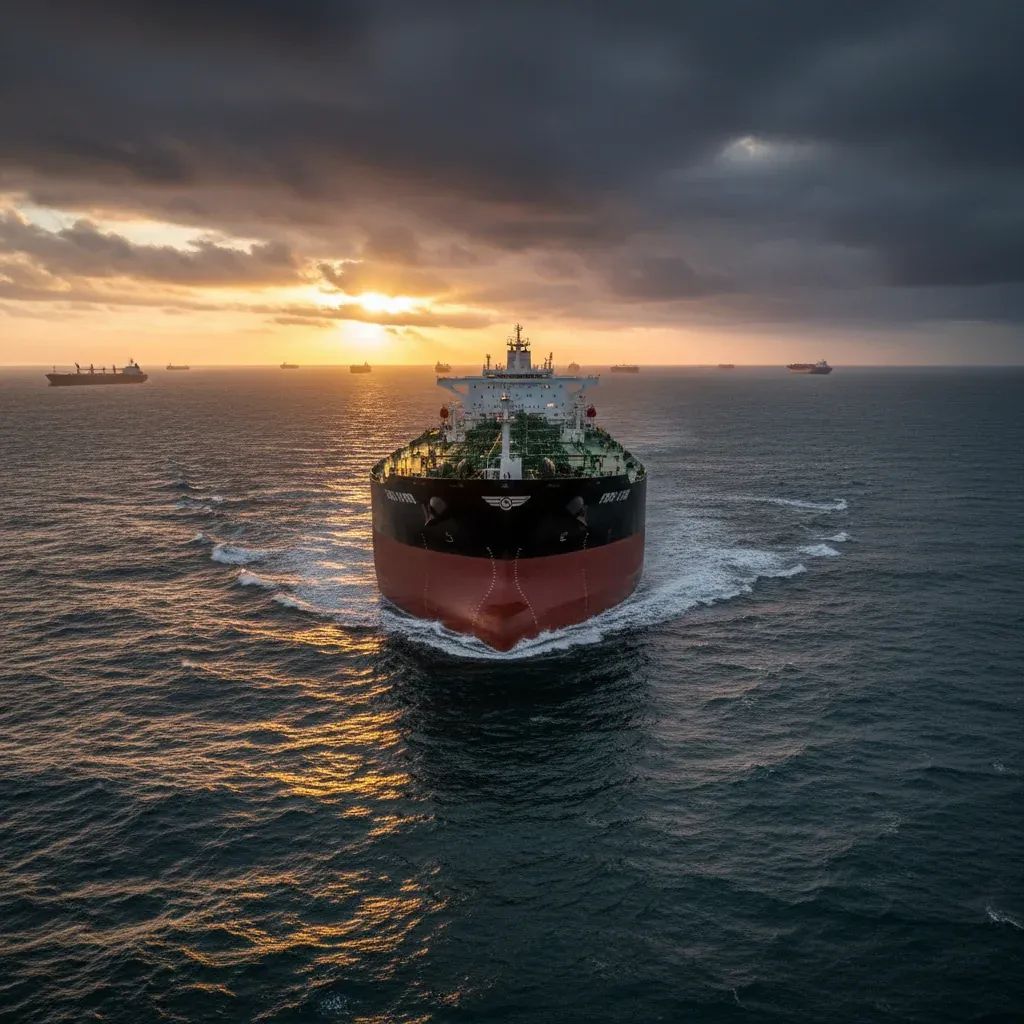
The United States Navy has seized an Iranian cargo vessel in the Gulf of Oman, triggering a fresh spike in global oil prices and reigniting fears that the world's most critical energy chokepoint could close again. Within hours of the operation, Brent crude climbed 5.6% to $95.46 per barrel, while West Texas Intermediate (WTI) jumped nearly 6% to $88.86—a sharp reversal after markets had begun to stabilize following Iran's earlier pledge to reopen the Strait of Hormuz.
For anyone living in Italy, where energy costs directly impact everything from household bills to transport and food prices, this development matters. The Italian economy remains acutely vulnerable to oil shocks, and the latest surge threatens to compound inflation pressures just as growth forecasts were being revised downward. Analysts now warn that prolonged instability in the Gulf could slash Italy's GDP growth by half in 2026 and push fuel prices significantly higher.
Why This Matters
• Oil prices surged: Brent jumped to $95.46 and WTI to $88.86, with further increases expected if tensions escalate.
• Strait of Hormuz at risk: The waterway handles 20% of global oil exports and 30% of seaborne crude—any closure could drive prices toward $200 per barrel.
• Italy's economic exposure: Higher energy costs threaten to halve GDP growth and erode consumer purchasing power in 2026.
• Retaliation looming: Iran has condemned the seizure as "piracy" and threatened a "rapid response," raising the risk of military escalation.
The Seizure and Immediate Fallout
On the night of April 19–20, the U.S. Navy intercepted the Iranian cargo ship Touska as it attempted to navigate past a U.S.-imposed naval blockade in the Gulf of Oman, just outside the Strait of Hormuz. According to reports, American forces fired into the vessel's engine room to disable it, then boarded and took control. President Donald Trump confirmed the operation publicly, framing it as enforcement of the blockade on Iranian ports—part of a broader economic pressure campaign dubbed "Economic Fury."
The move came just days after Iran had announced a "complete reopening" of the Strait of Hormuz on April 17, a declaration that had briefly sent oil prices tumbling. WTI had plunged more than 10% to $84.52 per barrel, and Brent slid 11% to $88.73, as traders bet on a return to normal shipping traffic. That optimism evaporated almost instantly. Tehran responded to the seizure by reasserting "strict control" over the waterway, effectively bringing tanker traffic to a near standstill once again.
Iran's Response and the Strategic Calculus
The Iranian Ministry of Foreign Affairs and the country's joint military command issued statements condemning the U.S. action as a violation of the ceasefire agreement brokered earlier this year. Tehran has pledged "retaliatory measures," though the exact form remains unclear. Historically, Iran has employed a strategy of "calibrated pressure"—seizing foreign vessels, deploying naval drones, or attacking commercial ships with mines or projectiles. In 2022, for example, Iranian forces seized two Greek tankers in retaliation for the impounding of an Iranian vessel in Europe.
The Islamic Revolutionary Guard Corps (IRGC) has made clear that the security of the Strait is not "free" if Iran's oil exports remain restricted. This doctrine transforms the waterway into a bargaining chip, one that Tehran has used repeatedly to signal its willingness to disrupt global energy flows in response to sanctions or military pressure. The stakes are enormous: the Strait carries roughly 20% of the world's oil and over 30% of liquefied natural gas (LNG) traded by sea.
Impact on Global Energy Markets
The immediate market reaction underscores how fragile the current energy equilibrium has become. Brent crude, which had traded as high as $124.61 per barrel on April 10, fell sharply after Iran's reopening announcement but has now rebounded to the mid-$90s. WTI followed a similar trajectory, surging from the low $80s back toward $90. European natural gas prices also jumped by 11% as traders priced in the risk of prolonged LNG supply disruptions.
Analysts at Trading Economics had forecast WTI at $86.46 by the end of Q2 and $97.49 within 12 months, assuming moderate geopolitical risk. Those projections now look conservative. If the Strait remains closed or heavily restricted for an extended period, some models suggest crude could reach $200 per barrel—a scenario that would devastate economies dependent on imported energy, including Italy.
A 50-day closure of the Strait earlier this year resulted in the loss of 500 million barrels of crude and an estimated $50 billion in global revenues. During that episode, gasoline prices rose 37% and diesel 53%. The threat of a repeat has sent shockwaves through supply chains and reignited concerns about inflation, particularly in Europe.
What This Means for Residents and Businesses in Italy
Italy imports the vast majority of its energy, making it one of Europe's most exposed economies to oil price volatility. The latest spike in crude prices will translate directly into higher costs at the pump, increased heating bills, and elevated prices for goods transported by road and sea. For households already grappling with inflation, this represents a significant erosion of purchasing power.
For businesses, the impact is twofold. First, energy-intensive industries—manufacturing, logistics, agriculture—face margin compression as input costs rise. Second, the uncertainty surrounding supply chains makes long-term planning difficult, dampening investment and hiring. Economic forecasts for Italy in 2026 have already been revised downward, with growth and consumer spending now expected to halve compared to earlier projections.
The Italian government has limited fiscal space to subsidize energy costs, having deployed such measures extensively during previous crises. If oil prices remain elevated, policymakers may be forced to choose between supporting households and businesses or adhering to budget constraints under EU fiscal rules.
Historical Context: A Pattern of Disruption
The Strait of Hormuz has long been a flashpoint. During the Iran-Iraq War in the 1980s, both sides targeted each other's tankers in what became known as the "Tanker War." More recently, Iran has used seizures and attacks to signal its displeasure with Western policy. In 2019, the IRGC detained the British-flagged tanker Stena Impero after the UK seized an Iranian vessel near Gibraltar. In 2021, an Iranian drone struck an Israeli-linked tanker. In March 2026, unidentified projectiles hit at least three merchant vessels in the Strait, and in November 2025, Iranian forces seized the tanker Talara en route from the UAE to Singapore.
Each incident has produced a similar market response: a spike in crude prices, a flight to safe-haven assets, and heightened volatility. The April 2026 seizure fits this pattern but comes at a particularly sensitive moment, with ceasefire negotiations stalled and both Washington and Tehran under domestic pressure to appear strong.
The Broader Geopolitical Chessboard
The U.S. operation is part of a wider strategy to weaken Iran's economy and force concessions on its nuclear program. The "Economic Fury" campaign aims to block Iranian oil exports that bypass the dollar-denominated system, which Washington views as a challenge to U.S. financial hegemony. For Iran, maintaining the ability to export oil—even in limited quantities—is essential to regime stability and domestic legitimacy.
China, a major buyer of Iranian crude, has expressed concern over the escalation and called for restraint. European diplomats have urged both sides to honor ceasefire commitments, but progress remains elusive. The risk of miscalculation—a naval skirmish, an accidental strike, or a retaliatory attack—looms large.
What Comes Next
For now, the focus is on whether Iran will follow through on its threat of retaliation and whether the U.S. will seize additional vessels. Any further escalation could trigger a full closure of the Strait, with cascading effects on global energy markets. Conversely, a diplomatic breakthrough—however unlikely—could ease tensions and allow tanker traffic to resume.
For Italian consumers and businesses, the prudent course is to prepare for sustained volatility. Energy hedging, contingency planning for supply chain disruptions, and close monitoring of government support measures will be critical in the months ahead. The situation in the Gulf is no longer a distant geopolitical concern—it is a direct factor shaping the cost of living and economic prospects in Italy and across Europe.


