
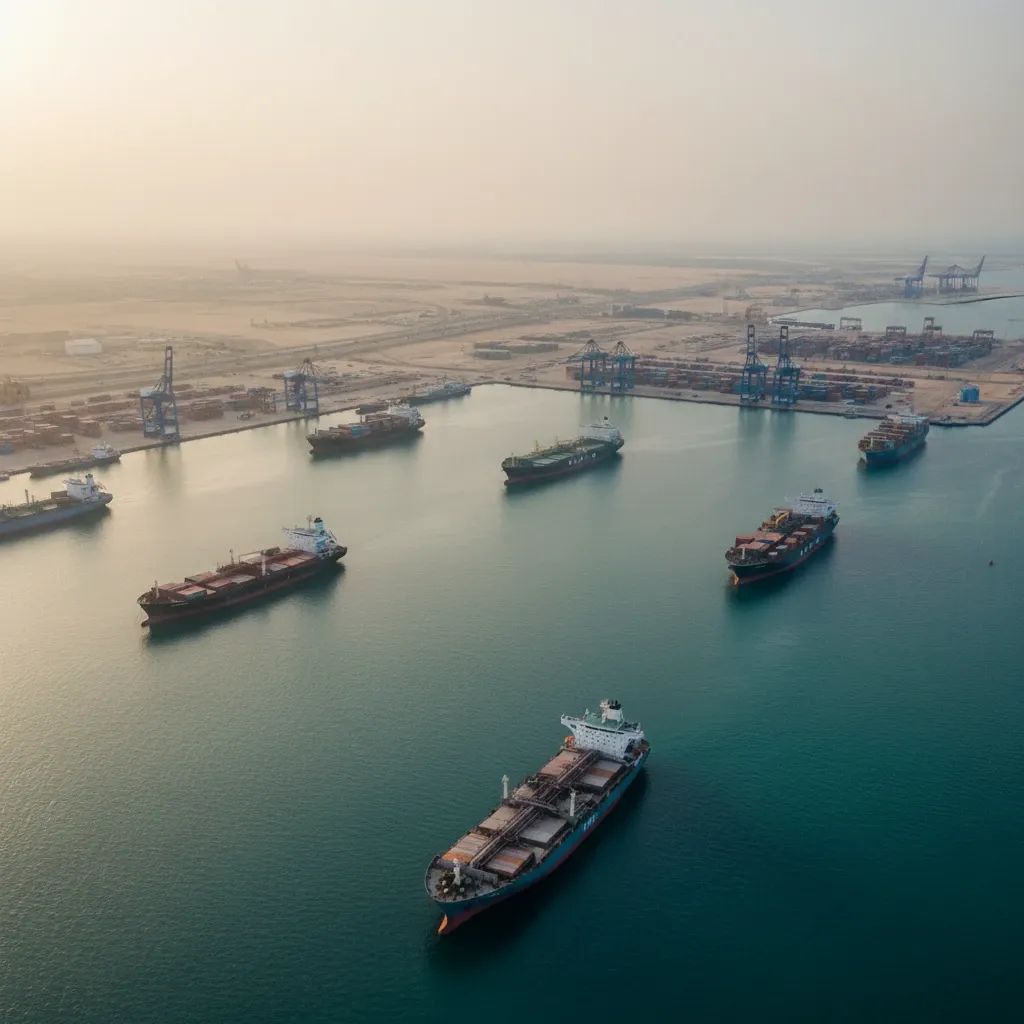
Why Italy's Energy Bills Depend on Europe's New Hormuz Mission
On April 17, 2026, France and the United Kingdom convened a multinational coalition in Paris aimed at restoring safe passage through the Strait of Hormuz, a maritime chokepoint that handles roughly 20% of the world's oil trade. The initiative, which deliberately excludes the United States, now includes India after New Delhi confirmed an official invitation from London and Paris to join the mission. This coalition will shape whether Italians see fuel price spikes in the coming months.
Why This Matters for Italian Residents
• Direct energy security risk: Italy's refineries depend on stable crude imports from the Gulf; any prolonged closure could spike fuel costs at the pump within weeks.
• Insurance costs drive prices up: War-risk premiums for vessels have already multiplied tenfold. These costs feed directly into consumer prices for fuel and heating oil across Italy.
• Strategic European positioning: Italy's participation through Prime Minister Giorgia Meloni signals Rome's commitment to European-led security operations independent of Washington.
The Coalition Takes Shape in Paris
At the Élysée Palace summit, France President Emmanuel Macron and UK Prime Minister Keir Starmer co-chaired a gathering of roughly 50 countries and international organizations, including German Chancellor Friedrich Merz and Italian Prime Minister Giorgia Meloni. The conference aims to finalize a strictly defensive, multinational naval mission focused on demining, convoy escorts, and surveillance—explicitly avoiding entanglement in the US-Iran confrontation.
Senior Élysée sources framed the initiative as a "third way" between the maximum-pressure campaign previously waged by Washington on Tehran and outright renewed warfare, including Iranian strikes against Gulf Arab states. "We will not enter a coalition with the US simply because this is not our conflict," one French official stated, emphasizing that European vessels will operate under European command structures.
The mission hinges on two non-negotiable conditions: that the strait remain free of mines and that no toll be imposed on commercial traffic. French Defense Minister Catherine Vautrin underscored the uncertainty this morning on TF1, acknowledging that "no one knows at this moment whether the strait is mined or not." If mines are present, coalition members with specialized capabilities—particularly Germany's minesweeping fleet and Italy's eight dedicated minesweepers (cacciamine vessels, purpose-built for clearing naval mines in confined waters)—would deploy once a ceasefire takes hold.
India Joins the Coalition
New Delhi's Foreign Ministry spokesperson confirmed that India has been formally invited by the UK and France to participate in the Coalition of the Willing for Hormuz. The announcement followed a telephone conversation between Prime Minister Narendra Modi and President Macron on April 16, 2026, during which both leaders agreed on the urgent need to restore freedom of navigation.
India imports significant crude volumes from the Gulf and has maintained traditionally warm ties with Tehran while simultaneously deepening defense cooperation with European navies. By joining the mission, India gains a seat at the table shaping post-crisis maritime security architecture in a region vital to its energy imports, without aligning with US military operations that risk inflaming relations with Iran.
Tehran's Restrictions Hide Behind "Open Strait" Claim
Iran's position remains deliberately ambiguous. On April 17, 2026, Iran's Foreign Ministry declared the Strait of Hormuz "completely open" to commercial vessels, but this claim masks significant restrictions. The strait is only open via a designated corridor along Iran's southern coast near Larak Island, with Tehran citing the "possibility of anti-ship mines" in the main channel. Ships belonging to or associated with "aggressor parties"—a term Tehran uses to describe the US and Israel—remain barred from transit.
The Islamic Revolutionary Guard Corps (IRGC) has enforced a selective transit system since early March, following joint US-Israeli strikes on Iranian targets in late February. The International Maritime Organization confirmed 21 attacks on commercial vessels since hostilities began, with 10 seafarers killed and several wounded. Roughly 20,000 civilian mariners remain stranded aboard hundreds of ships anchored in the Gulf, creating a humanitarian crisis that European officials describe as untenable.
Meanwhile, the US Navy imposed a naval blockade on Iranian ports and coastal waters starting April 13, 2026, positioning destroyers east of the strait to intercept vessels carrying Iranian crude or those that have paid Tehran's controversial transit toll. President Trump has stated the blockade will remain in force until a "transaction" with Iran is concluded, maintaining maximum leverage while keeping diplomatic channels nominally open.
What This Means for Italy's Economy Right Now
For Italy, the Hormuz crisis poses direct and immediate economic risks. Italian refineries in Sicily and along the Adriatic coast depend on stable crude flows from Gulf producers. Any sustained interruption would cascade through diesel, heating oil, and petrochemical supply chains—affecting what you pay at the pump and for home heating this winter.
War-risk insurance has already surged tenfold, adding measurable costs to shipping contracts that are passed directly to distributors and consumers. Industry analysts project that if the crisis persists beyond May 2026, Italian households could see fuel costs rise 12-18% above current levels, with heating oil and transported goods experiencing similar increases. The Italian government has not yet announced mitigation measures, though officials are monitoring the situation closely.
Italy's participation through Prime Minister Meloni, who met bilaterally with Macron at the Élysée before the plenary session, positions Rome as a key player in shaping Europe's autonomous defense posture. Élysée officials told ANSA that Meloni's presence "contributes to European unity at a moment when collective action is more necessary than ever," noting that the Iran crisis compounds the strain already imposed by the Russia-Ukraine war.
If the coalition proceeds, Italy could deploy specialized minesweepers from its fleet of eight Gaeta-class minesweepers (cacciamine). Such a deployment would require parliamentary authorization and likely a United Nations Security Council mandate, though France and the UK are exploring whether Article 87 of the UN Convention on the Law of the Sea—guaranteeing freedom of navigation on the high seas—provides sufficient legal cover.
First Iranian Oil Exports Slip Through
In a significant development, maritime analytics firm Kpler reported that three Iranian tankers departed the Gulf via the Strait of Hormuz on Wednesday, carrying a combined 5 million barrels of crude—the first such exports since the US blockade took effect on April 13, 2026. The shipments suggest Tehran is testing the limits of Washington's enforcement posture while also signaling a willingness to resume limited oil sales, likely to non-Western buyers such as China or regional customers.
The tankers' movement coincides with Tehran's announcement of a "completely open" strait, though the US Navy has not publicly commented on whether it intercepted or inspected the vessels. Industry sources note that many tankers now disable their Automatic Identification Systems (AIS) to transit undetected, operating in the so-called "shadow fleet" that complicates monitoring and enforcement efforts.
Europe Moves Forward Without Washington
Germany's participation in the coalition remains conditional. Chancellor Merz has publicly expressed interest in involving the United States in the mission, but French and British officials have categorically ruled out joint command with Washington. "Everything will be done in dialogue with the Americans, but we will not enter a US-led coalition," an Élysée source reiterated, underscoring Europe's desire to avoid being drawn into a broader US-Iran confrontation.
China was invited to the Paris summit but has not confirmed attendance. Beijing has vetoed UN Security Council resolutions aimed at guaranteeing freedom of navigation in Hormuz, arguing—alongside Russia—that such texts ignore the "root causes" of the crisis, namely US and Israeli military operations against Iran. Iran's UN delegate praised the veto as "justified."
Roughly 30 additional countries participated in the summit via videoconference, including Canada, Japan, and several Latin American and Indo-Pacific nations. The coalition's diversity underscores the global stakes: beyond oil, the Strait of Hormuz is a critical transit route for liquefied natural gas (LNG) from Qatar, fertilizers from Gulf producers, and containerized goods moving between Asia and Europe.
What Happens Next: Timeline for Relief
Following today's declarations to the press by the four leaders—Macron, Starmer, Meloni, and Merz—the coalition will enter a technical planning phase to finalize rules of engagement, force contributions, and command structures. France has already positioned the aircraft carrier Charles de Gaulle and several frigates in the Eastern Mediterranean, assets that could be redeployed to the Gulf if the mission proceeds.
The coalition's success depends on securing Iranian consent to refrain from attacking transiting vessels and US agreement not to block ships entering or exiting the strait—a delicate diplomatic bargain that remains unresolved. If both conditions are met by late May 2026, the mission aims to provide insurers and shipping companies with sufficient confidence to resume normal operations, ending the effective paralysis that has seen daily transits plummet from the usual 90–100 vessels to a trickle.
For Italian households and businesses, the stakes are tangible: prolonged disruption in Hormuz risks a global recession driven by soaring energy and food costs, as fertilizers and grain shipments also rely on the waterway. Italy, with its geographic position and dependence on imported energy, has a direct national interest in a swift, credible resolution that avoids further escalation. The coming weeks will determine whether Italians see relief at the pump or sustained price increases through the summer.


