
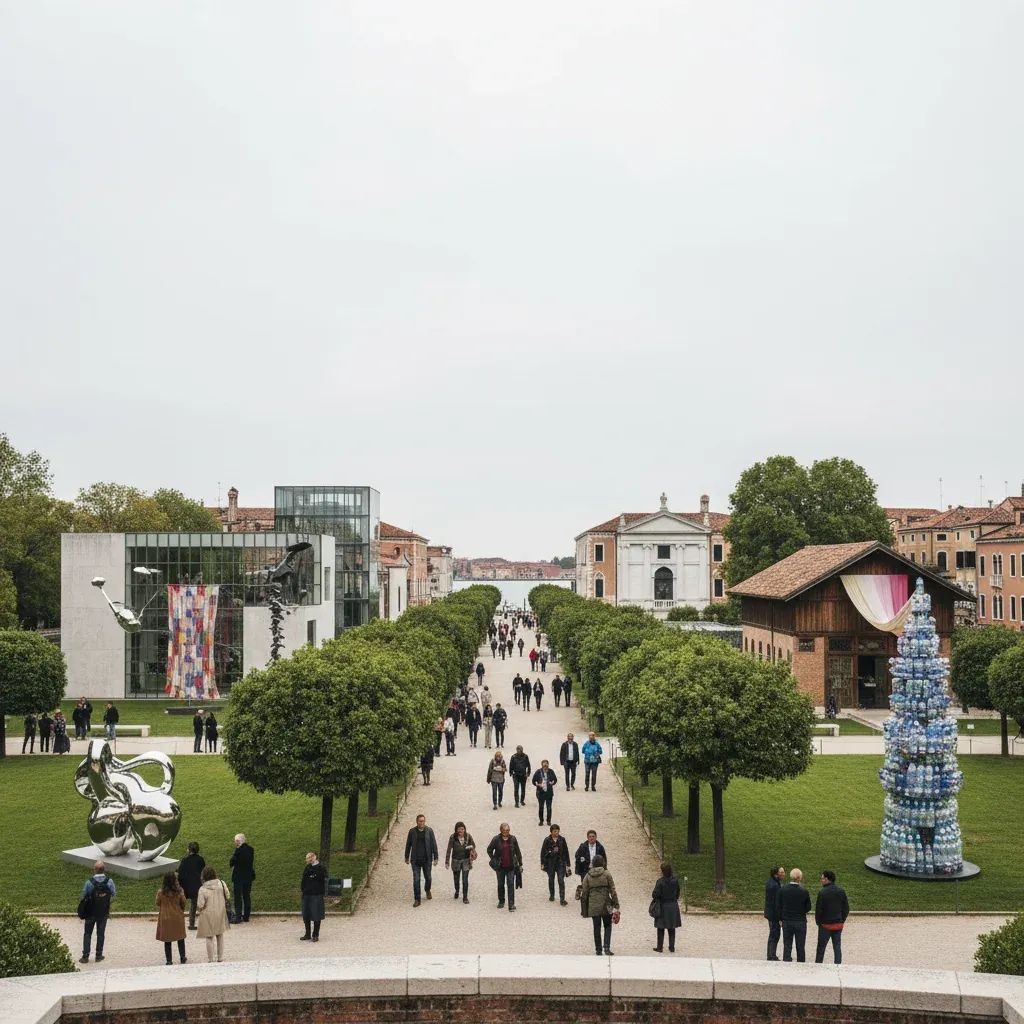
The Italian Ministry of Culture has escalated a diplomatic clash with Brussels over €2M in suspended funding for the Venice Biennale, framing the European Commission's recommendation as "economic blackmail" and an assault on artistic freedom after the institution reopened its Russian pavilion in defiance of EU warnings.
Why This Matters
• €2M on the line: The European Commission formally urged its executive agency, EACEA, to cancel the grant following a months-long dispute over the Biennale's decision to host the Russian national pavilion.
• Political showdown: Undersecretary for Culture Lucia Borgonzoni called the move a "purely political sentence" that undermines Italy's cultural sovereignty, while Veneto President Alberto Stefani accused the Commission of imposing "a single line of thought."
• Final decision pending: The funding suspension is still a recommendation; the European Education and Culture Executive Agency (EACEA) will deliver the binding verdict in coming weeks.
The Trigger: Russia's Return on Europe Day
The controversy erupted on May 9—Europe Day—when the Biennale opened its doors for the 61st edition, titled "In Minor Keys," curated by Koyo Kouoh. The timing was combustible: the same day Europeans commemorate post-war unity, the Venice institution allowed the Russian pavilion to reopen its doors, a structure that had been shuttered since Moscow's full-scale invasion of Ukraine in February 2022.
Biennale President Pietrangelo Buttafuoco defended the decision with a purist argument: the institution "selects works, not passports," and exclusion serves only to "satisfy the ego." He maintained that the Russian pavilion, as a physical building in the Giardini, was never opened for commercial or official state exhibition, and therefore did not violate EU sanctions.
Brussels saw it differently. Vice President of the European Commission Henna Virkkunen stated in a social media post on July 11 that "culture in Europe—funded with taxpayers' money—should promote and safeguard democratic values," adding that "these values are not respected in Russia today." The Commission had already sent multiple warning letters to the Biennale in March and April, insisting that culture "should never be used as a platform for propaganda" and that hosting Russia was incompatible with the EU's collective response to the war in Ukraine.
What This Means for Italy's Cultural Sector
The fallout extends beyond a single grant. Italy's Ministry of Culture now faces a choice: replace the €2M from national coffers or let the Biennale absorb the hit. Some lawmakers have already floated the idea of government integration, arguing that the Biennale's international prestige—and the economic spin-off it generates for Venice—justify the expense.
Culture Minister Alessandro Giuli has publicly distanced himself from Buttafuoco, calling the president's move "a mess" and accusing him of overstepping into foreign policy, a domain reserved for government and Parliament. Giuli described Buttafuoco as "the inconsolable expression of an ancien régime, isolationist and Bourbon-like, that does not recognize the unity of Italy," adding that the Biennale "is not a sovereign state."
That internal rebuke underscores a deeper friction: the Biennale Foundation operates as an autonomous cultural body, legally and financially distinct from the Ministry, yet its leadership is appointed by the Italian government. When the president of that institution makes a call with geopolitical ramifications, lines of authority blur.
For Italian cultural institutions receiving EU funding, this dispute raises immediate concerns: the case could set a precedent for how Brussels applies foreign policy conditions to arts grants. Italy's arts sector will likely be watching closely to see whether the Commission applies similar pressure to other institutions, and what mechanisms Italian cultural bodies have to formally challenge EU funding decisions through administrative or legal channels.
The economic implications for Venice are also significant. Tourism accounts for a substantial portion of the city's economy, and the Biennale attracts tens of thousands of international visitors and generates spin-off revenue for hotels, restaurants, and cultural enterprises. A funding cut could affect exhibition scope and programming, potentially impacting Venice's cultural economy and the livelihoods of workers in the tourism and hospitality sectors. The Biennale remains open to visitors through November 22 at standard ticket prices, though attendance could be affected by the ongoing controversy.
The Legal and Procedural Reality
The European Commission's recommendation is not yet enforceable. Under EU procedure, the EACEA—which manages cultural and education grants—must conduct its own assessment before formally revoking the funding. That assessment will hinge on whether the Biennale violated the terms of its grant agreement, which typically require recipients to uphold EU values and comply with Union foreign policy measures.
Italy's government argues that no concrete evidence has been presented to justify cancellation, and that Brussels is issuing a "political sentence" before due process. Borgonzoni's statement emphasized that "this is the end of law," suggesting the EU is weaponizing administrative procedure to punish dissent.
Legal experts note that the case sits in a gray zone: the Russian pavilion is a permanent structure owned by the Russian Federation, and the Biennale does not directly fund or curate its contents. Whether passively allowing the building to exist on the grounds constitutes active endorsement of the Russian state remains a contested interpretation.
Unprecedented or Overblown?
Notably, the Venice Biennale case appears to be the first time the European Commission has publicly recommended the suspension of cultural funding on foreign policy grounds. While the EU's Fundamental Rights Charter enshrines artistic freedom under Article 13, and Brussels has long championed the principle that culture should operate free from political interference, the Commission argues that public subsidy comes with public accountability.
Research from cultural advocacy groups shows that 34% of European cultural workers have reported restrictions on artistic expression, typically imposed by national governments or political movements, not by the EU. The Commission's own "Culture Compass" strategy and the proposed "European Artistic Freedom Act" aim to protect artists from censorship and political retaliation at the member state level. Yet in this instance, Brussels is the actor applying financial pressure, creating an awkward optics problem for an institution that positions itself as the defender of pluralism.
The Bigger Picture: Culture, Diplomacy, and Sovereignty
The Biennale saga is unfolding against a backdrop of mounting tension over where cultural autonomy ends and foreign policy begins. Italy's Veneto Region, which co-finances the Biennale, sees the Commission's move as encroachment. President Stefani invoked the EU's founding mission—"to guarantee peace among peoples and foster economic development and prosperity, not to impose a single line of thought"—and accused Virkkunen of imposing "censorship via social media."
For the thousands of artists, curators, and visitors who have converged on Venice for the 2025 Biennale edition, the dispute has overshadowed the exhibition itself. The Russian pavilion question was meant to be resolved quietly; instead, it has become a referendum on whether cultural institutions can—or should—remain apolitical in wartime.
What Happens Next
The EACEA is expected to issue a formal decision within the next month. If the funding is revoked, the Italian government will need to decide whether to step in. If it does not, the Biennale will face a financial shortfall that could affect programming, staff, or future grant applications. If Rome does cover the gap, it sends a signal that Italy is willing to pay for cultural independence from Brussels—a message with broader implications for EU cohesion.
Meanwhile, the legal and philosophical questions linger: Can a publicly funded cultural institution claim absolute autonomy when its decisions carry diplomatic weight? Should taxpayers in Warsaw or Vilnius subsidize an event that, in their view, whitewashes Moscow's conduct? And does artistic freedom mean the right to be neutral—or the obligation to take a stand?
For now, the Venice Biennale remains open through November 22, its Russian pavilion standing as a physical monument to the unresolved tension between culture, politics, and power in contemporary Europe.


