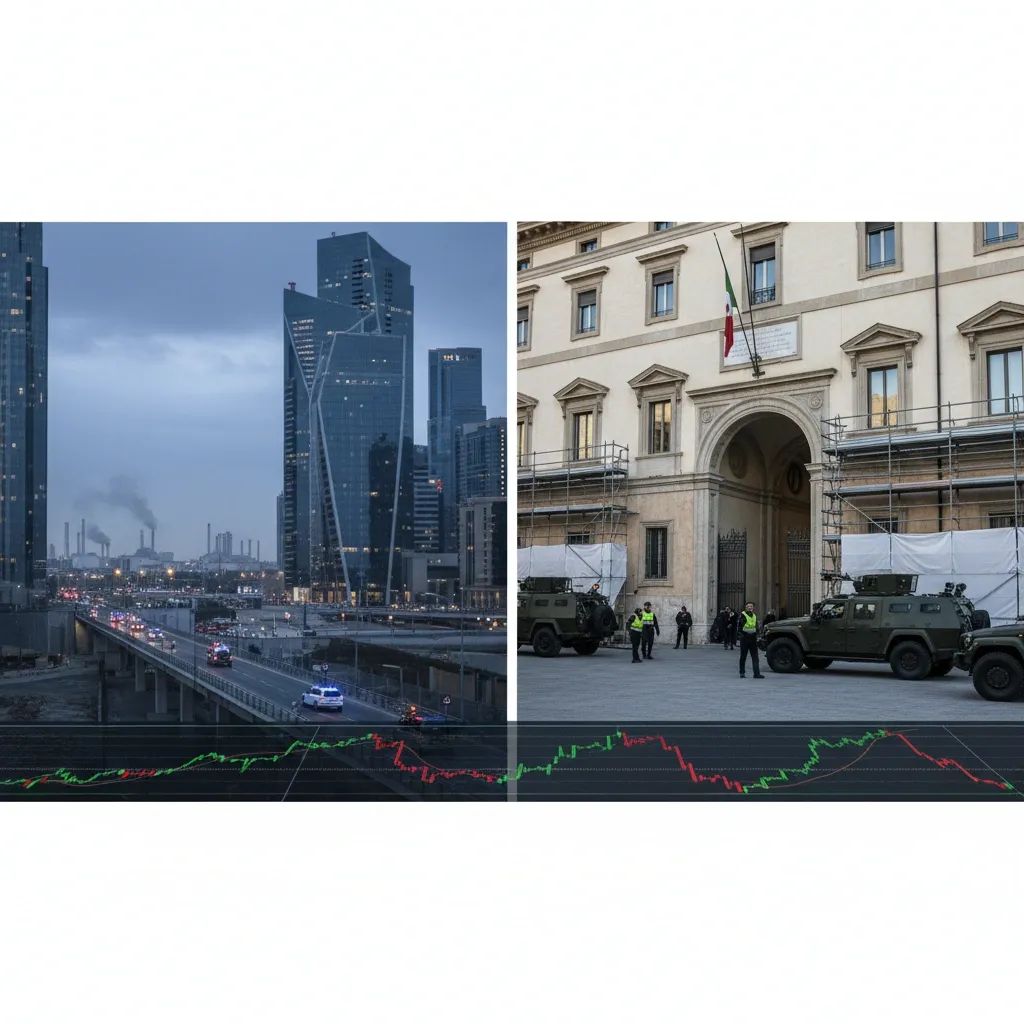
The United States has signaled a prolonged campaign of military strikes against Iran, with President Donald Trump declaring in a Fox News interview that attacks "will continue until I say stop." The escalation now directly threatens to drag energy infrastructure into the conflict, raising the specter of global supply shocks that could send fuel costs surging across Europe, including Italy.
Italy's Direct Involvement: NATO Operations from Italian Soil
A significant development emerged when NATO Secretary General Mark Rutte stated that approximately 500 sorties supporting the US campaign had departed from military bases in Italy. The Italian government swiftly denied the claim, but the assertion underscores how the Middle East conflict is drawing European territory into active military operations. This revelation has sparked political debate in Rome about Italy's role in the escalation and raises questions about the country's alignment with US foreign policy in the region.
Trump confirmed that the US will target power plants and bridges in the coming week, reserving Iran's energy sector—including its oil and gas facilities—for later in the campaign. "I'm leaving energy for last," he said, a statement that has rattled commodities markets already reeling from Iran's blockade of the Strait of Hormuz, the narrow waterway through which 20–25% of the world's seaborne oil and roughly 20% of liquefied natural gas (LNG) flow daily.
Why This Matters for Italian Energy Costs
• Energy prices: Italy's petrol stations and electricity bills will feel the ripple effect within days if oil prices break past the current €100–110 per barrel mark, as analysts predict.
• Strategic closures: Iran's Islamic Revolutionary Guard Corps (IRGC) has formally announced the Strait will remain closed to tankers until US aggression ends, effectively weaponizing a chokepoint that serves Asian giants like China, India, Japan, and South Korea.
• Military toll: At least 7 Iranian soldiers and over 30 civilians have died in recent US raids on southern Iran, according to Tehran's government.
• Sanctions tightening: The US Treasury Department has imposed fresh sanctions targeting Iranian individuals, entities, vessels, and the country's central bank in a bid to choke Tehran's financial arteries.
How Italy's Energy Supply Chain Is Affected
Italy does not import crude oil directly through the Strait of Hormuz, but the nation's fuel economy is intricately tied to global benchmark pricing. Italy sources crude primarily from North Africa (Libya, Algeria), Russia, and the Middle East via alternative routes. However, roughly 40% of Italy's energy imports come from Middle Eastern producers, including those that export through Hormuz. When global oil prices spike due to supply disruptions, Italian consumers feel the impact at the pump and on utility bills within days, regardless of Italy's direct reliance on the Strait.
Additionally, Italy's natural gas supplies—much of which arrives as liquefied natural gas (LNG) by tanker—are vulnerable to spot-market volatility. Although Rome has diversified supply routes via North Africa and the Trans-Adriatic Pipeline (TAP), global LNG prices move in tandem when a fifth of worldwide shipments are blocked. Electricity bills, particularly for Italy's gas-fired power plants, will climb sharply if the Hormuz closure persists beyond two weeks.
The European Commission has activated a task force to monitor energy price volatility and coordinate with Europol on heightened security risks tied to regional instability.
For Italians planning travel or importing goods from Asia, expect logistics delays and premium freight charges. Shipping insurers have already hiked premiums for vessels transiting Gulf waters, and alternative routes around Africa add 10–14 days to delivery schedules. Fertilizer shipments—critical for Italian agriculture—also pass through Hormuz; roughly one-third of the world's seaborne fertilizer trade uses this corridor.
Hormuz: The World's Most Dangerous Bottleneck
The Strait of Hormuz, just 33 kilometers wide at its narrowest point, connects the Persian Gulf to the Indian Ocean. Its closure is happening now. The IRGC announced that "retaliatory operations will continue, and the Strait of Hormuz will remain closed until the United States ceases its acts of aggression," according to Iran's state broadcaster Irib.
Iran has also claimed strikes on facilities housing the US Fifth Fleet in Bahrain, asserting that intelligence centers, command nodes, munitions warehouses, and fuel depots were destroyed. The Pentagon has not confirmed the extent of damage but acknowledged "defensive posture adjustments" in the Gulf.
Washington, meanwhile, has deployed 20 warships and hundreds of military aircraft to the region, imposing a blockade on Iranian ports and enforcing what it calls "freedom of navigation." Initially, Trump floated a controversial 20% "protection toll" on cargo value for vessels escorted through the strait, but he later dropped the proposal in favor of bilateral trade and investment deals with Gulf states.
Civilian Casualties and Regional Impact
Iran's government reports more than 30 civilians killed in US air raids concentrated in the country's south, particularly near the Bushehr nuclear power plant and the town of Bampur. Seven Iranian soldiers also died in the Bampur strike, according to Iranian state media.
Tehran has responded with state-produced imagery depicting resistance to US actions. State media has released murals in Enghelab Square and other central locations as part of ongoing government communication about the conflict. Iran's leadership, particularly President Masoud Pezeshkian, has vowed that Iran would answer "in deeds, not words," and the IRGC continues to launch retaliatory strikes on US-aligned targets in Jordan, Kuwait, and Bahrain.
What Italian Residents Should Do Now
Given the rapid escalation and imminent price impacts, here are practical considerations for Italian households:
• Fuel purchasing: Analysts project Brent crude could reach $130 per barrel if the Hormuz closure persists beyond two weeks. Residents may want to monitor daily fuel prices, but panic-buying is not advisable as prices are expected to stabilize. Check the Italian Ministry of Energy website for official guidance and any temporary price controls.
• Utility bills: Lock in energy contracts if rates are still favorable. Gas-fired electricity generation costs will rise noticeably within 7–10 days if supply disruptions continue. Contact your utility provider about available rate plans.
• Household budgeting: Expect 5–12% increases in transport and heating costs over the next month if the Strait remains closed. Food prices may rise by 2–4% within weeks due to fertilizer supply chain disruptions.
• Government support: Monitor announcements from the Italian government and EU regarding emergency measures, fuel subsidies, or price stabilization mechanisms that may be activated if the crisis deepens.
Economic Shockwaves and Inflation Threat
The standoff has already pushed Brent crude above the $100 per barrel threshold. Analysts project prices could hit $130 if the Hormuz closure persists beyond two weeks. That would trigger a cascade effect: higher diesel and jet fuel costs, elevated electricity generation expenses, and inflationary pressure on virtually every imported good.
The Italian Agricultural Confederation (Coldiretti) has warned that fertilizer shortages could emerge by September if supply chains remain fractured, potentially impacting autumn planting and next year's wheat and corn harvests. Bread, pasta, and dairy prices would follow suit.
Trump's Escalation Timetable
Trump's stated intention to reserve Iran's oil and gas infrastructure for the "last" phase of the campaign suggests a deliberate sequencing aimed at maximizing psychological pressure while managing global energy fallout. By attacking bridges, power stations, and military nodes first, Washington hopes to degrade Iran's defensive and logistics networks before striking the revenue-generating assets that fund Tehran's regional proxies.
This approach, however, risks miscalculation. Iran's leadership shows no sign of capitulation, with public statements emphasizing nationalist resistance and determination to defend national interests. The cycle of retaliation and counter-retaliation creates uncertainty about when—or if—the conflict will de-escalate.
Diplomatic Efforts and European Response
Behind the scenes, Pakistan has attempted to broker dialogue between Washington and Tehran, though rising nationalist sentiment in Iran has made compromise politically difficult for the government. Separate US-mediated negotiations between Lebanon and Israel are underway in Rome, though they remain formally distinct from the Iran dossier.
Within Italy, Eurodeputy Leoluca Orlando has criticized the European Union for "acquiescence, timidity, and complicity," accusing Brussels of outsourcing Middle East policy to the United States without articulating an independent European vision. This reflects broader European concern about being drawn into regional conflicts without adequate consultation or influence over strategy.
Financial Pressure: Sanctions Impact on Italian Businesses
The US Treasury has ramped up financial restrictions, imposing secondary sanctions on Iran's central bank and adding dozens of individuals, entities, and vessels to its blacklist. For Italian businesses with historic commercial ties to Iran—particularly in machinery, petrochemicals, and engineering—the sanctions tighten compliance obligations. Firms risk severe penalties if caught facilitating transactions that touch sanctioned entities, even inadvertently.
Timeline and What Comes Next
Trump's promise that attacks will continue "until I say stop" offers no clear timeline. Iran's insistence on keeping Hormuz closed until aggression ends creates a dangerous stalemate with immediate global consequences.
Immediate impact (days 1–7): Fuel prices at Italian pumps begin rising noticeably. Electricity costs for gas-fired generation increase. Logistics premiums push up import costs.
Medium-term (weeks 2–4): Food prices reflect higher transportation and fertilizer costs. Utility bills reflect new market rates. Shipping delays extend delivery times for imported goods.
Extended scenario (beyond one month): Agricultural supply chains face fertilizer shortages. Broader inflation effects spread across the economy if the Strait remains closed.
For Italian residents, the immediate concern is the fuel pump and the utility bill. For policymakers in Rome and Brussels, the question is whether Europe can articulate an independent diplomatic path—or whether it will remain a participant in a conflict with the power to destabilize the continent's economic recovery.