
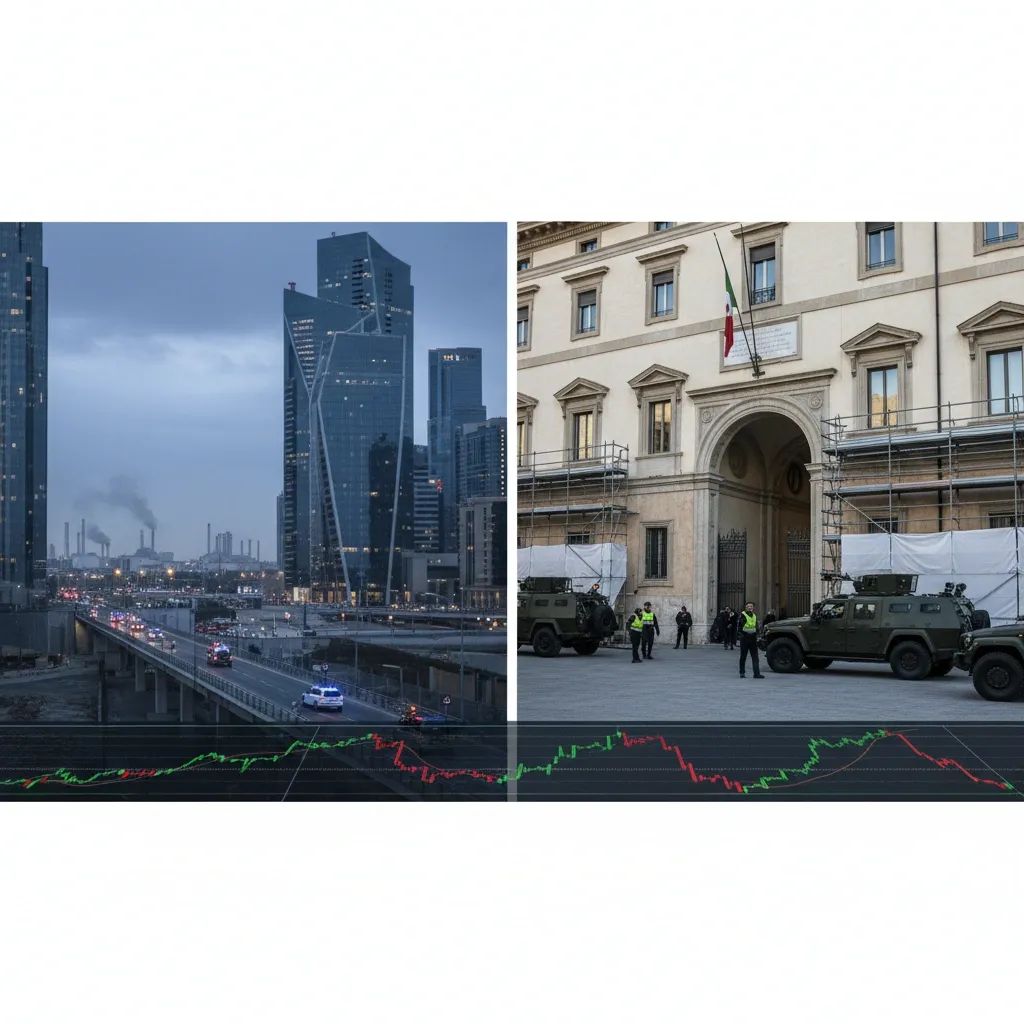
Italy Navigates Perilous Middle East Standoff as Energy and Shipping Face Critical Threats
The Italian government finds itself in an increasingly uncomfortable position as the escalating Iran-U.S. military conflict reshapes energy markets and maritime safety in ways that directly threaten household budgets, agricultural production, and supply chain stability. Deputy Premier Antonio Tajani's warning that Iranian threats against Premier Giorgia Meloni are "unacceptable" masks a deeper vulnerability: Rome has little leverage in a confrontation that could push crude oil significantly higher and disrupt fertilizer supplies that feed Italian agriculture.
Key Takeaways:
• Energy prices could surge 15-20% within weeks if Hormuz shipping remains disrupted; Italian heating oil and electricity costs will climb accordingly.
• Logistics costs and delays multiply immediately: A single route closure affects 30% of global fertilizer shipments, plus petrochemicals and industrial inputs vital to Italian manufacturing.
• Italian expats and businesses face heightened operational risks across the Gulf; consulates have issued security advisories and tightened protocols for staff movements.
How a Conflict Thousands of Miles Away Reshapes Your Energy Bill
The Strait of Hormuz, a 21-mile waterway between Iran and Oman, represents a critical chokepoint in the global energy system. Approximately 20% of world crude oil and 20-25% of liquefied natural gas flows through this corridor annually. For Italy, which sources roughly 85% of its energy needs through imported hydrocarbons, any sustained disruption to Hormuz traffic translates directly into winter heating costs and factory electricity bills.
Current Brent crude hovers near €90 per barrel. Analysts tracking the conflict scenario project prices climbing to €110-120 within 30 days if Iranian blockade threats materialize or U.S. naval interdiction accelerates. For context, heating oil costs have risen substantially in recent years. According to Italian energy sector data, increased crude prices of €30 per barrel typically translate into seasonal heating bill increases of approximately €140-150 for households in northern Italy consuming standard volumes.
The European Union has watched tanker traffic through Hormuz decline notably in recent days, reflecting market caution. That reduced traffic drives up futures pricing and shifts premium costs onto consumers immediately.
Practical Implications for Italian Residents and Businesses
Energy Management and Household Planning:
Monitor announcements from Enel, Eni, and major Italian utilities regarding tariff adjustments. Winter heating season—November through March—will arrive within months. Current pricing already reflects modest geopolitical premium; sustained disruption will compound those charges. Consider energy efficiency investments now: insulation upgrades, efficient heating system replacements, smart thermostats. Capital expenditure of €3,000-5,000 on home energy improvements typically recoups through bill reductions within 2-3 years under elevated pricing scenarios.
Italian Government Response:
As of mid-July, the Meloni government has not announced emergency energy subsidies or consumer price caps specifically addressing Middle East tensions, though the government continues monitoring the situation through energy ministry channels. The approach differs from 2022, when Italy implemented temporary energy subsidies responding to Russian supply cuts. Currently, households and businesses are advised to implement efficiency measures independently while utilities manage supply procurement.
Agricultural and Supply Chain Positioning:
Businesses dependent on Middle Eastern inputs should immediately assess single-source procurement vulnerabilities. Companies with fertilizer contracts expiring in Q3 2026 should execute renewal agreements quickly, before market premiums widen further. Manufacturing firms should consider modest inventory buildup of critical petrochemical inputs—not speculative stockpiling, but rational hedge against known supply chain friction.
Expat Safety and Insurance Review:
Approximately 8,000 Italian expatriates work across the Gulf region in energy, construction, professional services, and finance. The Italian Foreign Ministry has issued travel advisories recommending against non-essential Middle East travel and advising heightened security awareness for personnel already posted in Dubai, Doha, Baghdad, and Kuwait City.
Review insurance policies carefully. Standard business interruption and property coverage often excludes conflict zones; confirm that your policies remain in force and understand exclusion clauses. Employers should establish contingency protocols for staff evacuation should circumstances deteriorate. Italian companies have generally not announced mass departures, but preparations for rapid movement should exist.
Financial Hedging and Forward Contracting:
Entities with exposure to energy price volatility—heating oil users, agricultural producers, transportation firms—should consider commodity hedging through futures contracts or forward purchase agreements to lock current prices before additional escalation. Consult with commodity brokers to structure appropriate hedge ratios that balance downside protection against opportunity costs if prices remain stable.
The Memorandum That Unraveled in Days
The Iran Foreign Ministry articulated a straightforward principle: Tehran would honor a June memorandum of understanding only insofar as Washington demonstrated equivalent commitment. That 14-article agreement, signed to de-escalate after months of tit-for-tat strikes, functioned as scaffolding for deeper nuclear negotiations. It collapsed almost immediately.
Tehran's specific grievances center on three violations:
The memorandum's Article 5 supposedly granted Iran authority over safe passage protocols through Hormuz—a clause Washington never accepted and has since disregarded through unilateral military strikes.
Article 10 prohibited fresh sanctions; the U.S. Treasury announced new measures targeting entities linked to Supreme Leader Mojtaba Khamenei within days of the memorandum's signing.
Article 1 banned military action or threats thereof. U.S. Central Command launched airstrikes on July 8-9 against radar installations, missile production facilities, and drone storage depots—rendering that provision void within 72 hours.
Foreign Ministry spokesman Esmaeil Baghaei characterized the collapse as an American strategy: "The Americans violated the memorandum and shredded the 14-article agreement." The underlying reality is clear: both sides invested insufficient political capital in enforcement mechanisms and neither trusted the other's restraint.
Trump's Unorthodox Gambit: Guardian of Hormuz
President Donald Trump notified the U.S. Congress on July 10 that military operations against Iran resumed—a formal notification triggering a 60-day authorization window permitting sustained combat operations without additional legislative approval. The move signals a prolonged campaign rather than discrete surgical strikes.
Trump's rhetoric surrounding Hormuz reveals his strategic framing: the United States positions itself as the "guardian and protector" of the Strait, with intentions to collect revenue for that role. He specifically referenced a 20% tariff on all cargo transiting the waterway and a coordinated naval blockade of Iranian ports. These measures represent an assertion of control over a maritime corridor that under international law belongs to no single power.
The Strait falls within territorial waters of Oman (south) and Iran (north), with an international shipping lane guaranteed by the UN Convention on the Law of the Sea. Trump's framing inverts established maritime precedent.
U.S. Central Command conducted three consecutive nights of attacks targeting Iranian air defenses, coastal radar, missile production complexes, drone facilities, and small naval vessels. That intensity indicates systematic degradation of Iranian military infrastructure.
In parallel, Trump threatened strikes on the Pickaxe Mountain nuclear facility—a deeply buried complex adjacent to Natanz uranium enrichment operations. Military analysts note this target lies beyond the reach of America's most advanced bunker-busting ordnance. The threat carries limited tactical merit but substantial psychological weight.
Iran's Proportional Response and the Hostage Tanker Problem
Iran's Revolutionary Guard launched cruise missiles targeting "hostile American assets" in Kuwait, Bahrain, and Jordanian military installations. Jordanian air defenses intercepted four Iranian missiles during these exchanges. The pattern reflects Tehran's approach: matching American strikes with proportional retaliation rather than open-ended escalation.
That dynamic shifted when Iranian missiles struck two Emirati tankers—the Mombasa and Al-Bahiyah—transiting the southern Hormuz shipping corridor. One Indian crew member died; eight others sustained injuries. Both vessels caught fire but crews extinguished the blazes. The strikes demonstrated Iran's capacity to impose immediate physical costs on neutral shipping, raising marine insurance premiums and discouraging transit independent of formal closure.
The UAE Ministry of Defence condemned the attack as "a grave violation of international law" and reserved the right to escalate response. Abu Dhabi faces a strategic dilemma: dependent on American military protection yet threatened by Iranian missiles; economically reliant on shipping traffic through Hormuz yet hosting U.S. military infrastructure that makes it a target.
That vulnerability extends to maritime insurance markets. Rates for transiting Hormuz have already increased 40-60% in recent weeks. Shipping companies now price in the likelihood of retaliation, creating a feedback loop where rising insurance costs discourage transit independent of actual closure.
Supply Chain Fragility: Agriculture, Chemicals, and Just-In-Time Logistics
The fertilizer dimension represents an underappreciated vulnerability for Italian agricultural producers. Approximately 30% of global phosphate and potassium shipments transit Hormuz annually. Italy's cereal growers, livestock producers, and fruit exporters depend on seasonal fertilizer applications timed to crop cycles. Even a three-week delay in fertilizer arrival during critical growth periods can reduce yields 8-12% for entire seasons.
Petrochemical inputs—plastics, polymers, sulfur compounds—represent a second critical category. Italian manufacturers dependent on Middle Eastern feedstock face immediate supply chain friction. Some producers have begun shifting procurement toward alternative sources in Central Asia or Africa, but those routes involve longer transit times (adding 2-4 weeks) and higher transportation costs. A 10% supply shock propagates quickly through manufacturing input costs.
Logistics premium escalation has already begun. Shipping companies have raised freight quotes for Hormuz-transiting cargo by 15-25% within the past week. For import-dependent sectors, that translates into immediate margin pressure. Italian distributors and retailers absorb those costs initially, then pass them forward to consumers.
Europe Fractured: Competing Interests Undermine Unity
European Union governments have publicly called for both parties to return to negotiations—diplomatic language masking profound strategic division. Spain explicitly barred U.S. access to Spanish military bases for Iran operations and characterized initial American strikes as violations of international law. Italy raised similar legal concerns through Foreign Ministry channels, though Tajani avoided explicit condemnation.
The United Kingdom and France, by contrast, authorized American use of their regional military installations for strikes on Iranian air defense infrastructure. NATO Secretary General Mark Rutte characterized the conflict as a justified response to Iranian threats.
Germany maintained cautious sympathy for Washington's stated objective—constraining Iran's nuclear program—while avoiding explicit military support. Poland and the Baltic states offered public backing for American operations. Italy, Spain, and France collectively nurse profound doubts about the strategic rationale and international legal grounding of sustained military action without Security Council authorization.
European energy anxiety underlies this diplomatic disunity. The EU replaced Russian pipeline gas with liquefied supplies from Qatar and Abu Dhabi following 2022 sanctions. Any prolonged Hormuz disruption forces utilities toward rationing protocols and industrial demand destruction. Germany's manufacturing sector faces immediate vulnerability; Italy's already-strained energy balance deteriorates further.
Saudi Arabia's Paradoxical Position: Beneficiary and Hostage
Crown Prince Mohammed bin Salman initially resisted American requests for Saudi airspace access during May operations. Yet by June, he reportedly urged Trump to intensify operations, characterizing the conflict as an "opportunity" to diminish Iranian regional influence.
That reversal reflects Saudi Arabia's paradoxical position. Riyadh benefits economically from elevated oil prices—its core export revenue stream increases without incremental production costs. Simultaneously, Riyadh offloads military expenses to Washington while achieving strategic objectives.
That calculus inverts catastrophically if Iran escalates attacks on Saudi oil infrastructure or production facilities. Riyadh has deemed that risk acceptable, betting that American military superiority constrains Iranian retaliation below threshold levels.
The Diplomatic Channel: Talks Occur Parallel to Bombardment
Indirect talks in Doha, Qatar in early July reportedly showed "positive progress," with follow-up negotiations tentatively scheduled for mid-July in Switzerland or Oman. Yet the timeline reveals fundamental contradiction: negotiations and military operations have proceeded simultaneously, a configuration historically associated with negotiating difficulty.
Trump issued contradictory signals designed to maintain negotiation optionality while preserving military prerogative. "A deal with Iran is still possible," he stated Monday, while simultaneously insisting Iran "will not have nuclear weapons" and threatening strikes on Pickaxe Mountain.
The core substantive disagreement remains unresolved. Iran demands sanctions relief and acknowledgment of the right to civilian uranium enrichment; Washington demands Iran cease enrichment beyond civilian thresholds and accept intrusive international verification. The memorandum that collapsed addressed neither issue.
The Path Forward: When Escalation Becomes Self-Reinforcing
Military escalation follows a logic difficult to reverse once initiated. Both Washington and Tehran have invested substantial political capital in demonstrated resolve; backing down invites domestic criticism and appears to signal weakness. Trump confronts pressure from defense contractors and regional allies to demonstrate American resolve; Iranian leadership faces revolutionary credentials demanding resistance to perceived foreign pressure. Each side's domestic audience constrains negotiation flexibility.
The system contains limited circuit-breakers. European pressure has proved inconsequential. UN Security Council action remains blocked by Russian and Chinese vetoes. Humanitarian channels have not yielded breakthrough compromises.
Saudi Arabia represents a significant variable. If Riyadh determines that Iranian attacks threaten oil production—the kingdom's economic foundation—it may demand American bombing of Iranian oil infrastructure in reciprocal exchange for expanded U.S. operations. That escalation would send Brent crude significantly higher and trigger global economic consequences.
For Italy, the immediate imperative involves managing energy exposure and supply chain resilience. Medium-term priority focuses on European energy security independent of Gulf volatility. Until then, Italian households and businesses remain economically exposed to a regional conflict that Rome can neither prevent nor substantially influence through diplomatic pressure.


