
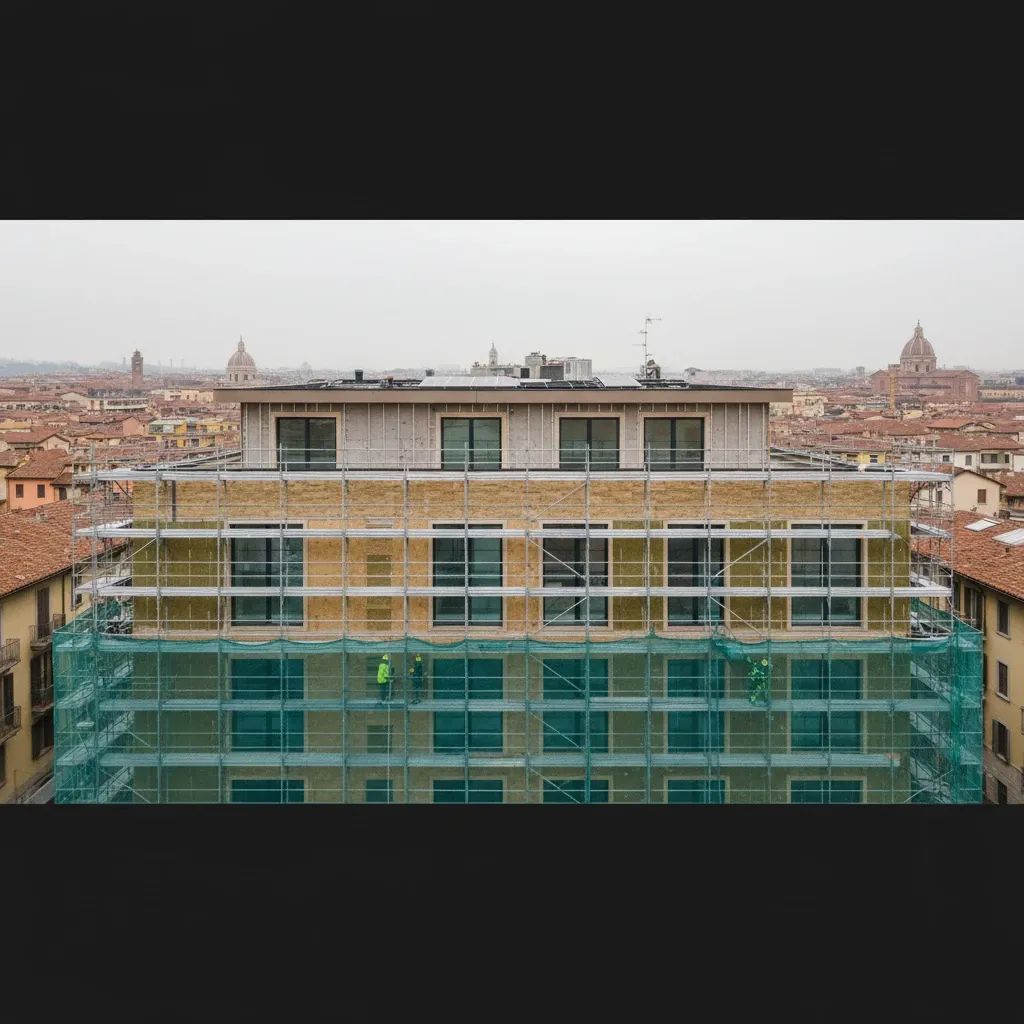
The Italy Revenue Agency has documented a dramatic surge in Superbonus irregularities, with the fraud rate jumping from a historical baseline of 3% to 33% in 2025, the final year citizens could submit invoices under the heavily modified program. The total financial damage from fraudulent claims tied to the construction tax credit scheme now stands at nearly €20 billion, igniting a fierce political confrontation over who bears responsibility for one of Italy's most controversial fiscal policies.
Why This Matters
• 120,000 compliance audits are planned through 2028, with thousands of homeowners already receiving anomaly letters demanding spontaneous corrections.
• 45% of 500,000 buildings upgraded under Superbonus 110% show cadastral irregularities—meaning property values increased without updated tax records.
• Homeowners have 90 days to self-correct after receiving compliance notices or face full penalties and automatic recalculation of property tax rates.
• The Guardia di Finanza has seized €9.3 billion in phantom tax credits, with an estimated €2 billion linked to organized crime including 'Ndrangheta and Camorra networks.
Political Blame Game Erupts Over Fraud Timeline
Fratelli d'Italia parliamentary group leader Galeazzo Bignami triggered the latest clash by citing the Revenue Agency's fraud statistics, arguing that one in three Superbonus applications contains irregularities and describing the program as a "disastrous measure" still embarrassingly defended by former Prime Minister Giuseppe Conte and the Five Star Movement (M5S).
The M5S fired back immediately, with Deputy President Stefano Patuanelli insisting that Revenue Agency Director Vincenzo Carbone actually stated the opposite: historical infidelity hovered around 3%, and the spike to 33% occurred entirely in 2025—during the third year of the Meloni administration—after the program had been "rewritten, demolished, and strangled" by right-wing reforms.
Economic dailies confirm the nuance: the fraud rate explosion is indeed concentrated in 2025, the final eligibility window following multiple regulatory overhauls. M5S representatives argue the surge stems directly from regulatory chaos created by successive amendments under the current government. "The boom in anomalies happens while Superbonus is entirely in your hands. With your decrees. With your continuous modifications," the Movement stated.
Michele Gubitosa, another M5S vice president, escalated the rhetoric: "The right used Superbonus for electoral propaganda—some members even personally—extended and prolonged the measure, and Minister Giancarlo Giorgetti managed it for 90% of the time, most of which under the Meloni government."
Fratelli d'Italia deputy Mauro Malaguti countered that the M5S invented the program and is now attempting to shift blame for its consequences. He argued that extensions were necessary to address "open situations with credit transfers, in which thousands of citizens were victims of fraud."
How the Fraud Unfolded
The compliance checks that intensified in 2025 revealed systematic abuse patterns. Professional engineers, architects, and surveyors issued false certifications attesting to work never performed or inflating costs to generate nonexistent tax credits. Construction firms invoiced phantom renovations. In some cases, ruins were transformed into habitable dwellings without updating cadastral records, or properties with zero taxable value suddenly benefited from major improvements—but owners never reported the upgrade.
The cessation and transfer mechanism—designed to help families and businesses by allowing them to pass tax credits to contractors or banks in exchange for upfront discounts—became the primary vector for organized fraud. Criminal networks, including mafia organizations, exploited regulatory gaps to fabricate credits on paper and launder them through complicit "unsuspicious" professionals.
Italy's Supreme Court of Cassation ruled that the crime of aggravated fraud for obtaining public funds is complete the moment fictitious tax credits are created, even if never actually used. The financial damage to the state materializes with the mere existence of the phantom credit.
What This Means for Residents
If you benefited from Superbonus and improved your property significantly, expect scrutiny. The Revenue Agency is deploying artificial intelligence algorithms and aerial photointerpretation to cross-reference cadastral maps with satellite imagery, hunting for undeclared modifications or unregistered buildings. By late 2025, monitoring covered 75% of national territory, with a goal of 85% by the end of 2026.
Starting in spring 2025, the agency dispatched 15,000 compliance letters to homeowners flagging anomalies such as upgraded homes still carrying outdated, lower property valuations. Between 2026 and 2028, an additional 120,000 letters are scheduled: 20,000 in 2026, 40,000 in 2027, and 60,000 in 2028.
If you receive a compliance letter:
• You have 90 days to respond and self-correct, which qualifies you for reduced penalties.
• Ignoring the notice triggers automatic recalculation of your cadastral value by the state and full sanctions.
• Properties that increased in value post-renovation but were never reassessed will be corrected retroactively, potentially raising annual property taxes.
The enforcement push aims to recover lost revenue and deter future abuse. Homeowners who acted in good faith but failed to update cadastral records due to confusion or oversight are encouraged to regularize immediately. Those who knowingly inflated claims or participated in fraudulent schemes face criminal investigation.
Program Origins and Evolution
The Superbonus 110% was born on 19 May 2020 under the second Conte government via the "Decreto Rilancio" (Relaunch Decree), intended to modernize buildings and revive the construction sector devastated by the COVID-19 pandemic. Conte himself claims to have managed it for approximately six months.
Under the Draghi government (2021–2022), the program was extended and expanded, with deadlines stretched in some cases to mid-2022 or 2023. Draghi began addressing problems in 2022 but did not abolish the measure.
The Meloni government, in office since late 2022, took a sharply critical stance, calling Superbonus a "disastrous measure" and "electoral tool useful only to Giuseppe Conte" that inflicted massive debt. The administration drastically curtailed the program, limiting it to earthquake or flood zones and reducing the incentive percentage on a sliding scale through 31 December 2025. By November 2022, the "Aiuti Quater" decree reduced the rate from 110% to 90% starting 1 January 2023. Further restrictions in February 2023 clamped down on credit transfers and invoice discounts.
Total program cost is estimated at €160 billion as of April 2024, making it one of the most expensive fiscal interventions in Italian history.
European Context
France, Germany, and Spain offer tax breaks for home renovation and energy upgrades, but at much lower rates than Italy's Superbonus and often means-tested or tied to measurable energy performance. No comparable fraud epidemics have been reported, likely because smaller deductions reduce the criminal incentive. Slovenia and Lithuania provide no state tax relief for renovations.
Investigators have traced Superbonus fraud proceeds to accounts in Austria, Belgium, Bulgaria, Croatia, Germany, Lithuania, the Netherlands, Slovakia, and Switzerland, illustrating the cross-border money-laundering dimension. Italy's robust investigative capacity—particularly the Guardia di Finanza—has made it a European leader in prosecuting fraud against public funds, even as it struggles to contain the Superbonus damage.
Enforcement Machinery in Motion
Beyond compliance letters, the Guardia di Finanza is working in tandem with the Revenue Agency to block fraudulent credits at the source. In 2025 alone, authorities intercepted almost €500 million in fake credits from construction-related tax benefits. Seizures since program inception total €9.3 billion.
The Anti-Mafia Investigative Directorate (DIA) estimates that approximately €2 billion in fictitious credits flowed to organized crime syndicates—'Ndrangheta, Camorra, and Stidda—often facilitated by corrupt professionals and shell companies.
The three-year inspection plan running through 2028 will systematically review higher-risk cases, prioritizing properties with extreme anomalies: ruins suddenly habitable, zero-value parcels with luxury upgrades, or multiple ownership transfers immediately after claiming credits.
Lessons and Accountability
The Superbonus saga underscores the risks of designing generous, universal subsidies without robust gatekeeping. The cessation mechanism, while intended to democratize access, created liquidity for fraud on an industrial scale. Continuous legislative tweaks by successive governments—each attempting either to expand eligibility or limit damage—generated a labyrinth of rules that criminals exploited and honest applicants struggled to navigate.
Government officials acknowledge that insufficient resources were allocated to fraud prevention relative to the program's scale. The Court of Cassation's ruling that even unwitting participants in fraudulent schemes can be held liable if they failed to verify documentation has alarmed homeowners who relied on professional advisers.
For now, the political battle over responsibility remains unresolved. What is clear: thousands of Italian homeowners face tax audits and potential recalculations, while law enforcement continues dismantling fraud networks that siphoned billions from public coffers. The final reckoning for Superbonus—both fiscal and political—will unfold over the coming years as the compliance campaign reaches its peak.


