
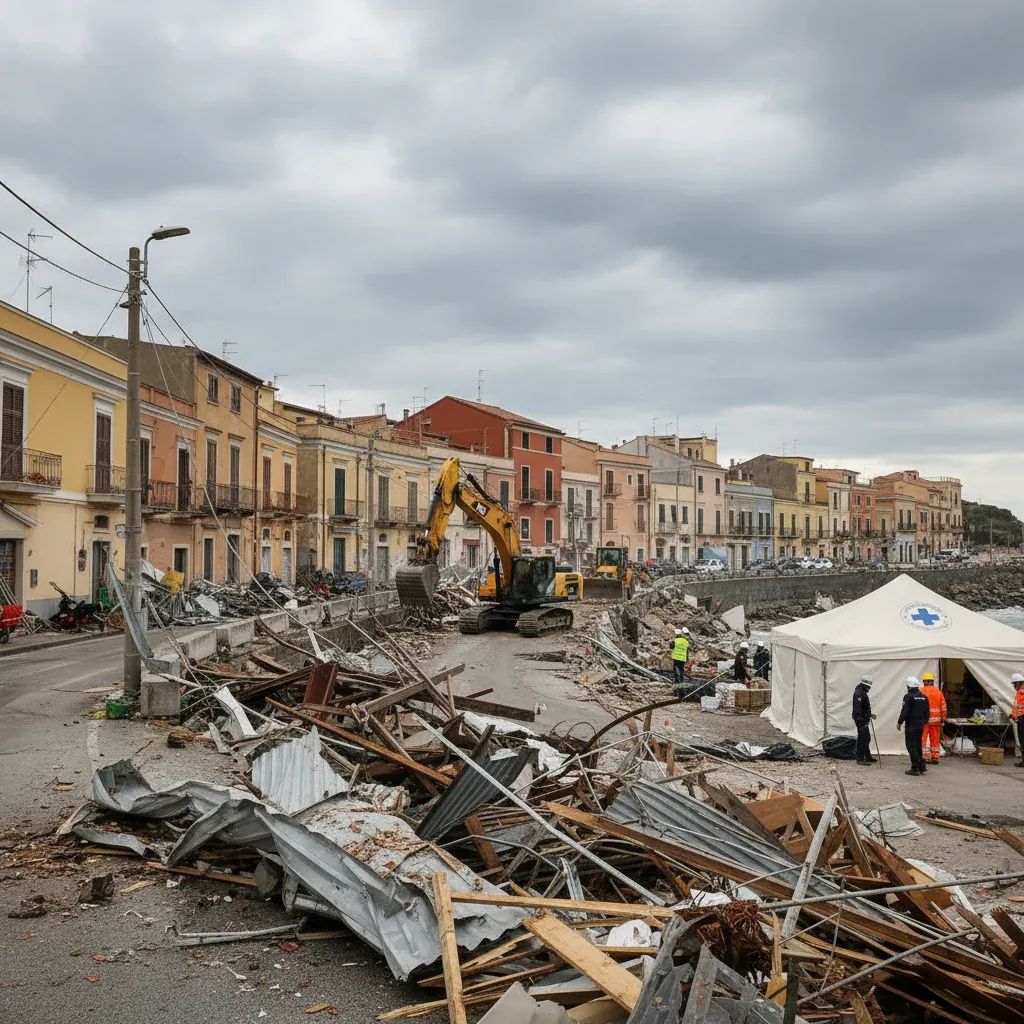
The Italian Senate has granted final approval to the so-called "Decreto Niscemi," converting emergency legislation into law on April 22, 2026—a move that unlocks 165M euros through 2027 for residents and businesses still reeling from the catastrophic storms that battered southern Italy in January.
The measure passed by voice vote in the upper chamber, with only the left-leaning Alleanza Verdi e Sinistra (AVS) voting against and most opposition parties abstaining. Having cleared the Chamber of Deputies earlier this month, the bill now takes full legal effect, triggering a suite of financial relief and reconstruction measures for those who lived through Cyclone Harry.
Why This Matters:
• Tax suspension: Residents in damaged properties get relief from tax and tribute payments from January 18 through April 30, 2026, plus a 3-month extension on "rottamazione quinquies" payment deadlines.
• Immediate funds: 90M euros are released for 2026, with another 75M coming in 2027 (25M direct, 50M from reconstruction reserves).
• Business lifeline: Export firms in Sicily, Sardinia, and Calabria can claim indemnities up to 130M euros total, while self-employed workers receive one-time relief payments.
• Special Commissioner: A dedicated commissioner will oversee resilience work in Niscemi (Caltanissetta province), where a major landslide compounded the storm damage.
The Storm That Triggered the Law
Between January 18 and 26, 2026, Cyclone Harry swept across the central Mediterranean with record rainfall and gale-force winds. Southern Italy bore the brunt: over 100 kilometers of the Ionian coast in Sicily were ravaged, with beachfront roads obliterated, rail lines left suspended in mid-air, and archaeological treasures—including the Nora site in Sardegna—severely damaged.
Early estimates placed the combined damage across Sicily, Sardegna, and Calabria at over 2 billion euros. Sicily alone reported losses exceeding 1B euros, Sardegna tallied damages near 500M euros, and Calabria faced hundreds of millions in losses. Remarkably, no fatalities occurred in any of the three regions; only one person sustained minor injuries, a result widely credited to the Civil Protection Department's early-warning network and preemptive evacuations.
The Italian Cabinet declared a 12-month state of emergency on January 26, designating the regional governors of Sicily, Sardegna, and Calabria as extraordinary commissioners with emergency powers. An initial 100M euros from the national emergency fund was split evenly—roughly 33.3M euros per region—to cover debris removal and immediate service restoration.
What This Means for Residents
The new law translates that emergency footing into concrete financial relief. Here is what individuals, landlords, and businesses in the affected zones can now access:
Tax and Leasing Breaks: Anyone whose home or business premises was damaged—even partially—benefits from an automatic suspension of tax payments and deadlines covering the period from January 18 to April 30, 2026. Separately, the decree suspends leasing installments for buildings rendered uninhabitable or for properties used in commercial activity during the same window.
Income Support Schemes: The bill establishes a supplemental income stream for private-sector employees, including agricultural workers, who lost shifts or wages due to storm damage. Self-employed professionals and tradespeople qualify for a lump-sum indemnity, though exact amounts will be defined by subsequent ministerial decree.
Export and Enterprise Aid: Recognizing that storm disruption crippled supply chains, the law sets aside up to 130M euros specifically for exporters headquartered in the three regions, compensating for lost contracts and delayed shipments.
Leasing Forbearance: If your rented commercial space or leased equipment became unusable, you are entitled to skip installments through the end of April without penalty or accrued interest.
Follow-the-Money: Where the 165M Goes
The decree phases funding over two years. In 2026, 90M euros flow directly into the reconstruction pipeline, prioritized for damage to private property and productive infrastructure—think damaged homes, workshops, and warehouses. Another 25M euros arrives in 2027, supplemented by an additional 50M euros drawn from a dedicated reconstruction reserve fund earmarked for longer-term resilience projects.
Sicily's regional assembly has separately approved a 120M euro package (40M new, 70M previously allocated, 10M in tax relief for coastal lido operators), while the Calabria regional government committed 300M euros for infrastructure repair and private compensation. Sardegna, meanwhile, is negotiating reprogramming of European cohesion funds to fast-track coastal defenses.
All told, the Sicilian Regional Government forwarded a comprehensive reconstruction blueprint to Rome totaling 1.6 billion euros, covering structural works, business restart grants, urgent repairs, private housing restoration, household aid, and landslide mitigation in Niscemi.
Niscemi Gets a Dedicated Commissioner
The decree singles out Niscemi, a town in the interior of Sicily's Caltanissetta province, where a severe landslide during the storm period destabilized hillsides and threatened dozens of homes. A special commissioner will coordinate geological surveys, slope stabilization, and relocation assistance, operating under streamlined procurement rules to accelerate timelines.
The commissioner is also tasked with drawing up long-term resilience protocols—upgraded drainage systems, reinforced embankments, and zoning restrictions—to prevent recurrence. This mirrors similar extraordinary-commissioner models Italy has deployed after earthquakes and floods in recent decades.
Workforce Surge for Civil Protection
To handle the surge in reconstruction oversight, the law authorizes temporary, non-managerial hires within the Civil Protection Department and the three regional administrations for a three-year term. These staff will manage grant applications, audit contractor work, and coordinate with municipalities still tallying damage reports.
The law also suspends certain environmental compliance deadlines—specifically emission limits on wastewater discharge from storm-damaged infrastructure and permit conditions for affected industrial plants—until facilities can be physically repaired and recertified.
Tourism Reboot Campaign
Recognizing that coastal devastation scared off spring and summer bookings, the decree allocates funds for a national and international promotional campaign to rebuild the image of Sicily, Sardegna, and Calabria as safe, welcoming destinations. The Ministry of Tourism will partner with regional tourism boards to launch coordinated digital and print advertising by early summer, targeting key European markets and cruise operators.
Lido owners whose beachfront concessions were destroyed can tap into the 10M euro tax-relief stream Sicily set aside, allowing them to defer VAT and local business taxes while they rebuild changing rooms, sunshade infrastructure, and beach bars ahead of the peak season.
Parliamentary Arithmetic and Next Steps
The bill sailed through the Chamber of Deputies and then the Senate with minimal drama. AVS, the green-left alliance, cast the lone "no" vote, objecting to what it called insufficient climate-adaptation investment and over-reliance on short-term payouts rather than structural flood defenses. Most opposition lawmakers abstained, signaling neither endorsement nor outright rejection of the package.
Now that the decree has royal assent as law, the next procedural phase involves issuing implementing decrees from the finance and economic development ministries, which will set application deadlines, eligibility thresholds, and documentation requirements for each aid stream. Residents and business owners are advised to monitor regional Civil Protection portals and municipal websites for updated guidance, expected to appear within two to three weeks.
The decree also paves the way for a follow-on legislative package, anticipated later this year, that will address longer-term infrastructure hardening—upgraded storm drains, coastal revetments, railway rerouting away from unstable cliffs—and potential reprogramming of EU cohesion funds if Brussels grants the necessary flexibility.
Broader Context: Italy's Storm Vulnerability
Cyclone Harry was the most intense Mediterranean cyclone to strike Italy's southern coasts in over a decade, delivering rainfall totals in parts of Calabria equivalent to half the annual average in just four days. The Messina–Siracusa rail line in Sicily remains partially closed, with engineers still assessing viaduct integrity where embankments washed away.
Climate scientists note that warming sea-surface temperatures in the Mediterranean are amplifying the frequency and severity of such cyclones—locally termed medicanes—raising urgent questions about Italy's preparedness for future events. The National Civil Protection Department has pledged a comprehensive review of coastal early-warning infrastructure by year-end, with particular focus on real-time tide and wave monitoring along the Ionian and Tyrrhenian shores.
For now, the "Decreto Niscemi" offers a financial bridge for thousands of households and businesses navigating insurance disputes, contractor delays, and revenue shortfalls. Whether the 165M euros prove sufficient depends on how quickly municipalities complete damage assessments and forward claims to the regional commissioners—a process that, in past Italian emergencies, has stretched months or even years.


