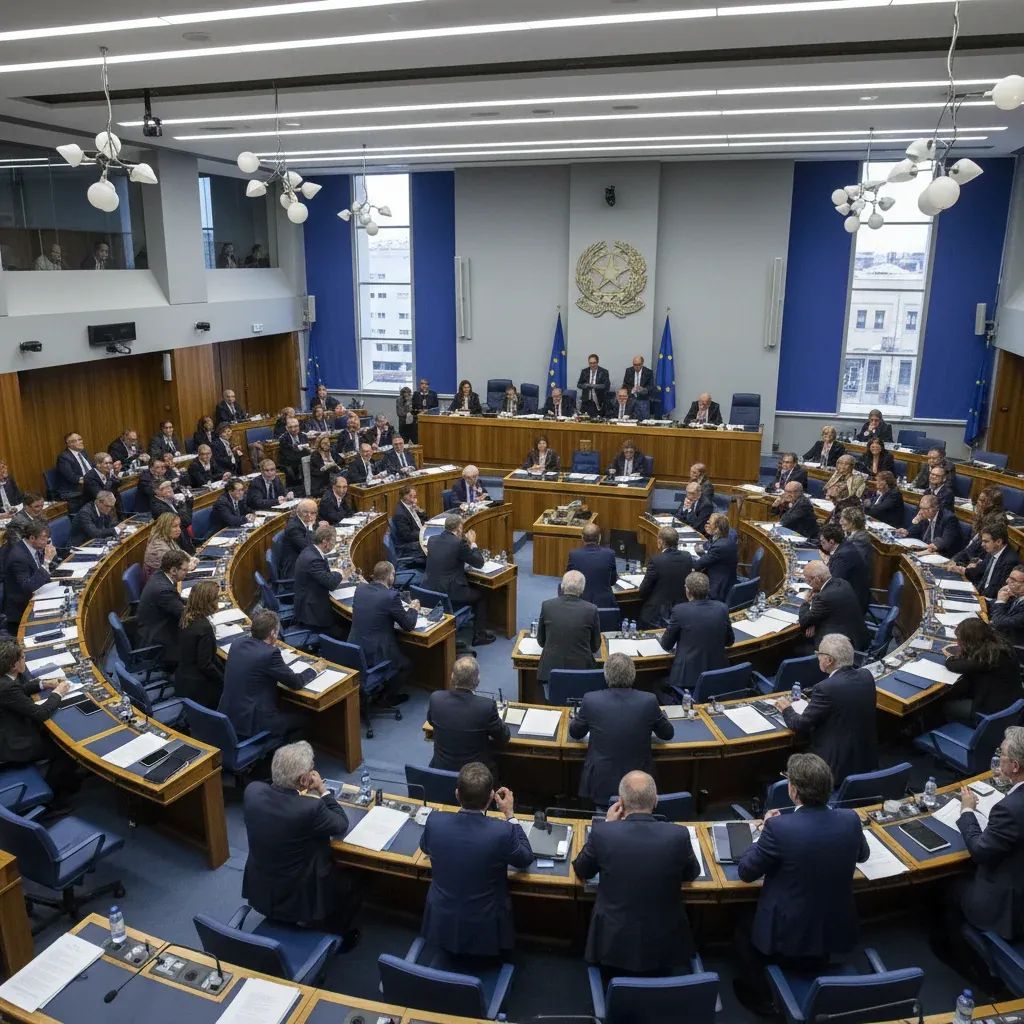
Italy's Constitutional Affairs Commission has suspended its marathon review of the country's electoral law overhaul to allow senators from the ruling party to attend a political celebration in Bari, a pause that pushes final committee voting to next week with implications for how millions of Italians will cast their ballots in future elections.
Why This Matters
• Nearly 700 amendments have been filed on the electoral reform bill, most by opposition parties seeking to reshape how Italians vote for Parliament.
• The measure reaches the Senate floor on Wednesday, 9 September, after committee votes wrap up Monday and Tuesday.
• Voters could gain the right to express up to three preferences, but party leaders would remain locked in top positions under current proposals.
• A 42% threshold would trigger automatic majority bonuses that could reshape Italy's governing coalitions for years.
What's Actually Happening in the Senate
The Constitutional Affairs Commission of Italy's Senate adjourned Thursday after a day of work on the electoral law reform, known informally as the "Melonellum" or "Stabilicum." Proceedings resume Friday at 9 AM with formal opinions on proposed amendments, before a second scheduled suspension.
That interruption isn't procedural wrangling — it's political. Senators from Fratelli d'Italia need to reach Bari for ceremonies marking Prime Minister Giorgia Meloni's government becoming the longest-serving in Italian republican history. The administration surpassed Silvio Berlusconi's second government on Thursday, reaching 1,413 days in office.
The committee's compressed timeline is deliberate. Voting continues Monday and Tuesday with the explicit goal of completing examination before the full Senate takes up the measure on Wednesday. Italy's Chamber of Deputies already approved the bill on 16 July 2026 with 217 votes in favor, 152 against, and two abstentions.
The Heart of the Controversy: Who Chooses Your Representative
At stake is nothing less than how Italians select their members of Parliament. The reform maintains a system of predominantly proportional representation with blocked lists, a mechanism that gives party leadership enormous power over who enters the legislature.
An amendment approved in the Senate commission introduces up to three preference votes for citizens — but with a critical catch. The lead candidate on each list, the capolista, remains unassailable. Party bosses lock that position before a single ballot prints. Gender alternation requirements only kick in after the first name.
Opposition parties have united against this approach. The Democratic Party (PD), Five Star Movement (M5S), Greens and Left Alliance (AVS), and Italia Viva argue that blocked lists reduce voting to ratifying decisions made in secret party meetings. They've proposed instead to eliminate the blocking mechanism entirely, giving voters genuine choice across the entire slate.
The divide cuts to a fundamental question: Should citizens elect individuals or parties? Italy's current system leans heavily toward the latter, and this reform would cement that approach through the majority bonus mechanism.
The Majority Bonus: Stability or Manipulation?
The reform awards 70 seats in the Chamber and 35 in the Senate to any coalition reaching 42% of the vote in both houses — up to a ceiling of 220 deputies and 113 senators, excluding overseas constituencies. Fall short, and seats distribute through pure proportional division.
Supporters frame this as a governance guarantee. Italy suffered decades of short-lived governments and parliamentary fragmentation. A built-in bonus, they argue, ensures the next prime minister can actually govern rather than survive week to week.
Critics see something darker: a mechanism designed to perpetuate current polling advantages. The threshold lands tantalizingly close to where the center-right coalition sits in recent surveys. Opposition figures note the irony — thirty years of leftist governments never proposed such a system, they point out, because eliminating the "perfect bicameralism" between Italy's two houses should come first.
The Runoff Question
Senator Marcello Pera of Fratelli d'Italia has proposed adding a national runoff round. His amendment would trigger a second vote if no coalition reaches 48% in both chambers while at least two coalitions exceed 38%.
The idea has encountered resistance even within the governing coalition. Both the League and Forza Italia have expressed skepticism about the runoff mechanism, leaving its fate uncertain. Opposition parties dismiss it as electoral gamesmanship, noting that runoff scenarios would dramatically reshape campaigning and voter behavior.
Constitutional Challenges Loom
Francesco Boccia, who leads the PD's Senate caucus, has raised pointed constitutional objections. The regional quorum for Senate seats and national threshold for the Chamber may require constitutional amendment rather than ordinary legislation, he argues.
Italy's Constitution contains specific provisions about Senate representation that differ from the Chamber. Attempting to graft new electoral mathematics onto those structures through a simple law, constitutional scholars suggest, almost guarantees a challenge before the Constitutional Court.
Italy Viva has focused on the gender representation issue. The party proposes full parity with 50-50 splits between men and women on electoral lists. The majority's approach — alternation only after the locked leadership position — would disproportionately favor male candidates in the most winnable spots.
What This Means for Residents
For Italians and foreign residents with voting rights, this reform could change ballot design, voting strategy, and ultimately who represents their interests in Rome.
The preference vote: If the three-preference system survives intact, voters gain more power to rank candidates — but only below the party-chosen leader. Understanding how many preferences to use becomes critical, as votes for candidates lower on the list may not translate into seats.
Coalition dynamics: The 42% bonus threshold forces parties into pre-electoral alliances. Voters won't just choose parties; they'll choose coalitions, with all the compromises that implies.
Leadership question: The reform requires parties to name their proposed prime minister when registering their electoral symbol, giving voters more information about who they're actually electing to govern.
Overseas Italians: Proposed changes to how Italy's overseas constituency divides seats could reduce representation for Italian communities abroad, particularly those outside Europe.
Future elections: If the measure passes through the Senate and receives final approval, it would govern the next national election — potentially one called early if political calculations change.
The Bigger Picture
Italy has changed electoral laws with disturbing frequency since the early 1990s. Each new system reflects the political moment of its passage more than any coherent philosophy about representation. The "Melonellum" fits that pattern — a majority crafting rules to preserve its position while facing genuine instability risks from a fragmented parliament.
The pause for Bari's celebration underscores how political imperatives shape even technical debates. Senators will resume work Friday knowing the calendar is tight, the amendments are many, and Wednesday's floor vote awaits regardless of whether consensus emerges.
What happens next week in Rome's Palazzo Madama will determine how millions of citizens participate in Italy's democracy for years to come. The outcome is far from certain, but the stakes are clear: this reform could lock in advantages for the current majority or force compromises that reshape Italian electoral politics entirely.