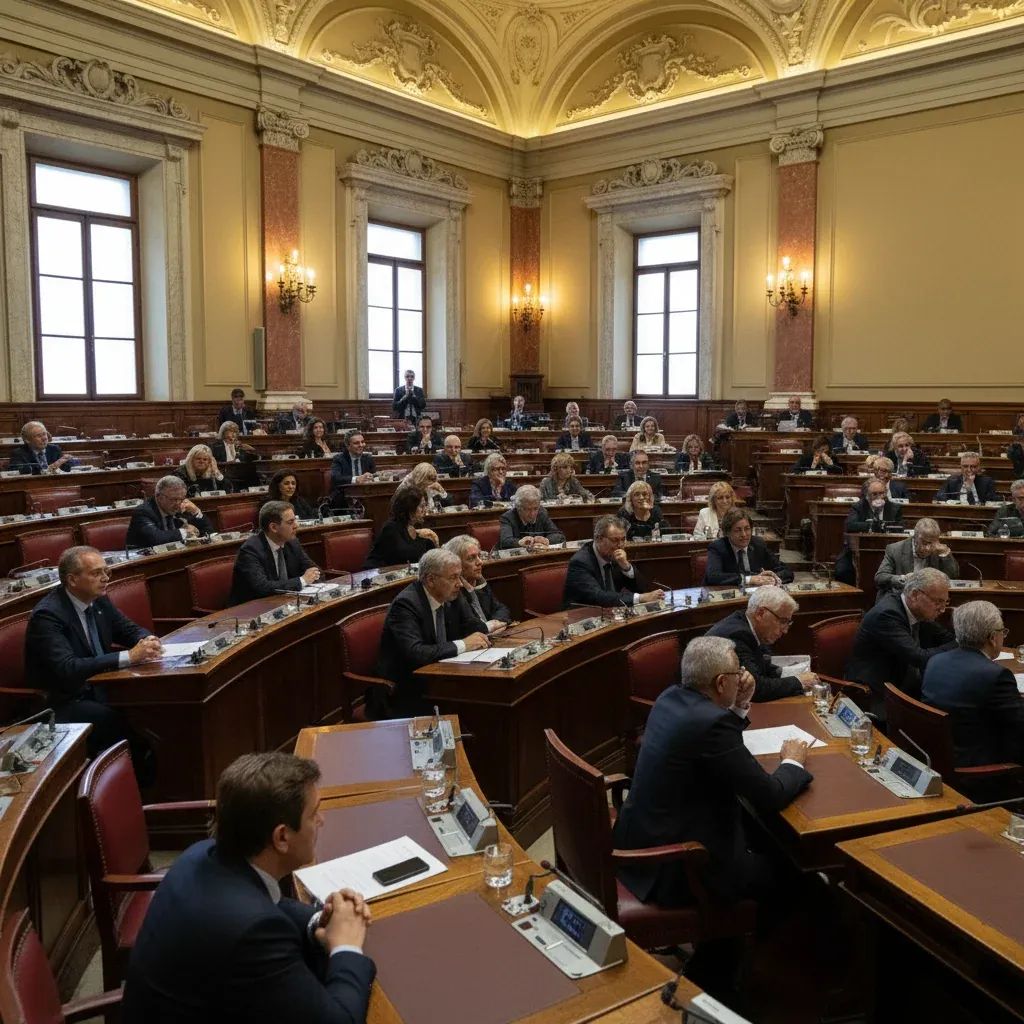
The Italy Chamber of Deputies rejected a government-backed amendment on electoral reform by the narrowest of margins—188 votes against 187—exposing cracks in Prime Minister Giorgia Meloni's coalition and triggering immediate calls from opposition leaders for her resignation. The secret ballot vote on preferences for candidates marks a rare parliamentary defeat for the ruling majority and complicates Italy's effort to overhaul voting rules ahead of the next election cycle.
Why This Matters
• Governance stability questioned: A single-vote loss on a core policy reveals internal dissent within Meloni's coalition despite public unity.
• Electoral reform stalled: The "Stabilicum" proposal—aimed at replacing the current Rosatellum system—now faces uncertain prospects.
• Secret ballot controversy: Opposition parties secured over 100 secret votes on amendments, making it impossible to identify defectors and fueling accusations of cowardice.
• Gender parity rejected: A separate proposal requiring 50% gender balance among list leaders was voted down with 207 against and 155 in favor.
The Anatomy of a Parliamentary Upset
The amendment in question, co-sponsored by Fratelli d'Italia, Noi Moderati, and UDC, proposed introducing voter preferences alongside blocked party-designated list leaders for the proportional allocation of seats. Voters would have been able to express up to three preferences for candidates, provided those preferences alternated by gender. Initially, the proposal faced skepticism from Lega and Forza Italia, but both coalition partners ultimately pledged support following internal negotiations.
Despite securing endorsement from the Italy Cabinet and formal backing from the governing coalition, the measure collapsed when anonymous defectors—popularly known as "franchi tiratori" or snipers—voted against their own side under cover of secrecy. The Chamber presidency, led by Fabio Rampelli, had granted opposition requests for secret ballot scrutiny on roughly 100 of the 200 amendments filed on the electoral law, as well as on the final text itself.
Meloni had publicly challenged opposition parties hours before the vote, posting on social media: "Yes to preferences. No to secret voting." She framed the vote as a litmus test for sincerity, daring critics to vote openly and "take responsibility in front of Italians." That challenge went unheeded. The procedural shield of secrecy allowed dissenters to act without public accountability, a tactic Meloni later described with a terse diagnosis: "The swamp won."
What This Means for Italian Voters
For residents following Italy's tortured relationship with electoral law, this defeat injects fresh uncertainty into an already convoluted reform process. The current Rosatellum system—a hybrid model allocating roughly 37% of seats via single-member districts and the remainder through proportional representation—has been the target of criticism from across the political spectrum. The proposed Stabilicum replacement would eliminate single-member constituencies entirely, awarding all seats proportionally while granting a governability bonus to any coalition surpassing 42% of the vote, guaranteeing up to 60% of parliamentary seats if the coalition wins in both legislative chambers.
The amendment's rejection means Italian voters will not see a hybrid preference-plus-blocked-list model, at least not in this legislative cycle. Opposition figures, particularly from the Movimento 5 Stelle, had dismissed the proposal as offering "fake preferences" that preserved party bosses' control over top positions while giving voters only marginal input on lower-ranked candidates. The defeat also sidelines efforts to tweak gender balance rules: a sub-amendment from Alleanza Verdi e Sinistra MP Luana Zanella—backed by Partito Democratico and M5S—sought to mandate that no more than half of list leaders be of the same gender. That measure was defeated in open voting.
Political Fallout and Opposition Demands
The vote count has triggered the loudest opposition chorus for early elections since Meloni took office. Giuseppe Conte, leader of the Movimento 5 Stelle, declared the result a no-confidence signal from within the majority itself, demanding Meloni "go home." Elly Schlein of the Partito Democratico framed her party's opposition vote as a rebuke to what she called "the premier's arrogance." The rhetoric reflects not just partisan opportunism but a broader calculation that visible fractures in the coalition can be exploited to force a confidence crisis or early dissolution.
Meloni's allies pushed back with equal vehemence. Galeazzo Bignami, the Fratelli d'Italia group leader in the Chamber, accused opposition parties of hypocrisy for demanding preference voting in public while refusing to file their own amendments, then hiding behind secrecy. "We show our faces; cowards hide," he said in remarks directed at the opposition benches. "The difference is between those who take responsibility and those who conceal themselves."
Yet Bignami's indignation cannot mask the arithmetic reality: at least one member of the governing coalition crossed lines, and possibly more. With the majority holding a comfortable nominal edge, a one-vote loss indicates either abstention or active defection—both signs of internal dissent that opposition strategists will seek to amplify in coming weeks.
Legal and Procedural Context
Italy's constitutional framework does not treat every legislative defeat as a confidence matter. A government falls only if it explicitly loses a fiducia vote or if the prime minister voluntarily resigns. Single amendment losses, however politically damaging, do not trigger automatic collapse. Still, the optics matter: Meloni's administration has staked credibility on delivering institutional reform, and a failure to wrangle her own coalition on a signature policy undermines that narrative.
The Chamber presidency's decision to approve secret ballots on such a wide slate of amendments is itself noteworthy. Opposition parties have long argued that electoral law—because it directly affects legislators' careers—warrants secret scrutiny to prevent party whips from coercing votes. Rampelli's ruling upheld that principle, citing the existence of requisite conditions for secrecy. The decision essentially created a parallel legislative universe where loyalty could not be enforced, and where individual conscience—or calculation—took precedence.
Separately, an amendment from Lega seeking to allow regional governors a third term was ruled inadmissible by the Chamber presidency for being "extraneous to the content" of the electoral law. That procedural rejection highlights the narrow scope of debate and the limits on legislative riders in this process.
Historical Echoes and Reform Fatigue
Italy has rewritten its voting rules four times since 1948, cycling through proportional systems, mixed models, and majority bonuses in a perpetual quest for stable governance. The Mattarellum, Porcellum, Italicum, and Rosatellum have each promised to cure Italy's chronic governmental fragility, and each has disappointed. The pattern reflects a deeper dysfunction: electoral engineering cannot resolve structural problems rooted in party fragmentation, weak coalition discipline, and the incentive for small parties to extract concessions by threatening defection.
The Meloni government's Stabilicum proposal represents the latest iteration of this cycle. Its architects argue that a clear majority bonus will discourage post-election horse-trading and reduce the power of minor coalition partners. Critics counter that granting a supermajority to a coalition that may win only a plurality of votes distorts democratic representation and entrenches incumbent power. The debate is both technical and existential, touching on competing visions of how democracy should function in a fractious, multi-party state.
What Happens Next
The electoral reform bill remains alive despite the amendment's defeat, and the Chamber will continue voting on the remaining amendments and articles. Over 100 secret ballots are scheduled, creating ample opportunity for further defections or surprises. If the text eventually passes the Chamber, it must still clear the Italy Senate, where coalition arithmetic is similarly precarious. Final approval is far from guaranteed.
For residents, the practical takeaway is that Italy's electoral rules will likely remain in flux, with potential changes affecting how future governments are formed, how much power voters have to select individual candidates, and whether coalition or single-party victories translate into stable majorities. The stakes are not abstract: the Rosatellum's hybrid model has produced coalition governments prone to internal bargaining and policy paralysis, and any successor system will shape the responsiveness and accountability of future administrations.
Meloni's challenge now is to restore coalition discipline without further alienating partners already chafing under centralized control. The loss, while narrow, is a public signal that her parliamentary majority cannot be taken for granted—and that opposition tactics combining procedural guerrilla warfare with public shaming may yield dividends. Whether that translates into actual legislative leverage or merely extends the timeline for reform remains to be seen.