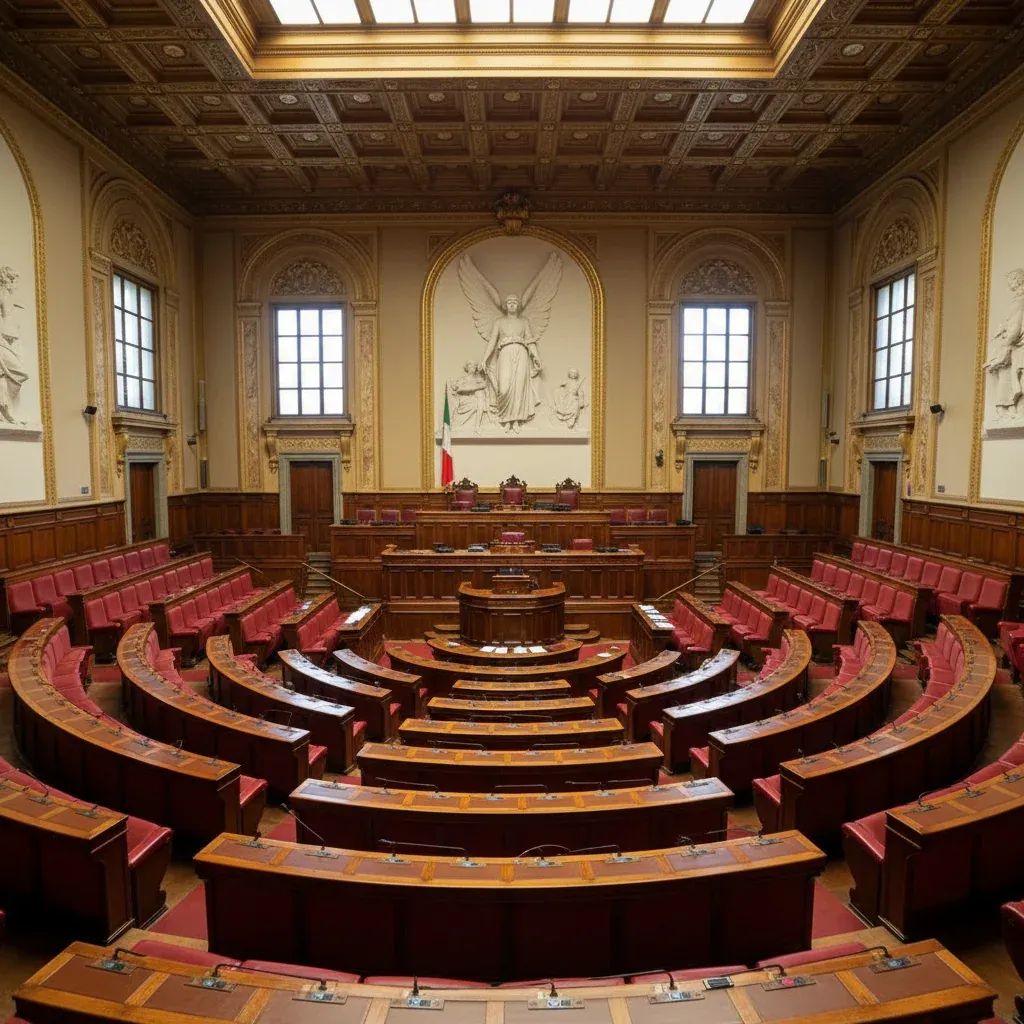
The Italian Chamber of Deputies has delivered a surprise blow to Prime Minister Giorgia Meloni's government, rejecting by a single vote an amendment to restore voter preference ballots to national elections. The July 14 defeat—188 against, 187 in favor—marks the most visible fracture yet within Italy's right-wing coalition.
Important Context: This Is Not an Automatic Crisis
Before examining the political fallout, residents should understand what this defeat actually means. This was a legislative loss on an electoral reform amendment—not a confidence vote in the government. Formal protocol does not require a prime minister to resign after a legislative loss unless it involves a confidence motion, which this was not. While Meloni had warned coalition partners that a defeat might prompt her to visit the Quirinal Palace (traditional shorthand for tendering resignation to President Sergio Mattarella), sources close to Palazzo Chigi confirmed by late evening that "no such trip was imminent" and that "the responsibility to govern the country" prevails. The government remains in place, though the vote has exposed serious internal tensions that residents and investors should monitor.
Why This Matters:
• Electoral reform stalls: The blocked amendment would have allowed Italians to write up to three candidate names on their ballots, ending over 30 years of party-controlled blocked lists.
• Government authority tested: Around 30 deputies from the ruling coalition appear to have defected during the secret ballot, exposing serious internal dissent within a coalition that controls approximately 240 seats.
• Gender parity flashpoint: Women lawmakers across the coalition reportedly protested the proposal's lack of gender-balance safeguards, a concern that may have tipped the vote.
• Coalition stability questioned: While Deputy Prime Minister Antonio Tajani called it an "accident," the size of the defection indicates coordinated dissent rather than random error and has sparked informal discussions among government insiders about potential electoral timelines.
The Mechanics of the Defeat
Italy's Chamber was debating amendments to the electoral law known as the Rosatellum, which currently splits 3/8 of seats into single-member districts and the remainder into multi-member constituencies with closed party lists—voters cannot choose individual candidates. The Fratelli d'Italia amendment, backed initially by Meloni's party and later by coalition partners Lega and Forza Italia, sought to flip that script: keep the party leader at the top of each list but allow voters to rank up to three additional names.
When the secret ballot closed, the display board showed a one-vote margin. Lawmakers on government benches fell silent before opposition deputies erupted in cheers, chanting "Dimissioni!" (Resignations!) and "Elezioni!" (Elections!). The Vannacciani—members of the General Vannacci movement—drew immediate scrutiny, prompting lawmaker Domenico Furgiuele to film himself voting "yes" on his phone and circulate the video in the Transatlantico lobby as proof of loyalty.
Parliamentary tallies suggest the coalition lost between 30 and 53 votes, with multiple sources placing the figure closer to 36. This represents a large enough bloc to indicate coordinated dissent rather than random error.
Gender Parity and Coalition Tensions
Multiple lawmakers and analysts point to women deputies as the likely source of rebellion. The Fratelli d'Italia amendment contained no enforceable gender-balance mechanism—a significant omission in a country where women hold approximately 32-35% of seats in the Chamber of Deputies. By comparison, Italy ranks approximately 14th-15th among the 27 EU member states in female parliamentary representation, placing it among the bottom half of Europe. The European Parliament ballot, by contrast, includes gender-alternation safeguards requiring voters to alternate male and female names if choosing more than one preference.
During debate, Laura Ravetto of Lega proposed eliminating even the existing gender-alternation rule, directing her remarks at female colleagues. Chiara Braga, leader of the Democratic Party group, shot back: "Not all of us switched parties for a guaranteed seat"—a comment that drew applause from the opposition and nods from some Lega benches. That exchange crystallized a broader unease: several Forza Italia women had reportedly pressed Deputy Prime Minister Antonio Tajani for gender guarantees before the vote, and his reassurances evidently fell short.
Maurizio Lupi, secretary of Noi Moderati and a co-sponsor of the amendment, acknowledged afterward that "tensions in the coalition and the gender-alternation question played a role." The Council of Europe and UN bodies have repeatedly urged Italy to enshrine structural gender-balance mechanisms rather than rely on goodwill, making this episode emblematic of a broader reform challenge.
Coalition Finger-Pointing and Immediate Aftermath
In the hours following the vote, aides to Meloni and coalition whips scoured previous roll-call records, searching for patterns that might identify defectors. Riccardo Molinari of Lega was seen reviewing printed vote tallies, while Forza Italia members huddled with Tajani at the government benches. Fratelli d'Italia deputies privately blamed Lega and Forza Italia for insufficient party discipline; those parties deflected in turn.
The Vannacciani became a convenient scapegoat until Furgiuele's self-recorded "yes" vote began circulating on phones in the lobby. Later, opposition lawmakers filed complaints that filming during a secret ballot violated Chamber rules, triggering a procedural dispute that forced the speaker to suspend the session.
Opposition Capitalizes on the Moment
Leaders of the so-called campo largo—the broad left coalition encompassing the Democratic Party, Five Star Movement, Green-Left Alliance, More Europe, and Italia Viva—emerged from Montecitorio together for a media appearance. Elly Schlein, Giuseppe Conte, Angelo Bonelli, and Nicola Fratoianni framed the result as evidence that Meloni's majority is "divided" and called on the prime minister to resign.
The opposition had decided that morning to demand secret ballots wherever the rules allowed, calculating that anonymity would expose coalition fissures. The Five Star Movement filed its own preference amendment—eliminating the designated prime-minister candidate and cutting the majority bonus—which some viewed as a tactical move to embarrass the government rather than a serious legislative proposal. Matteo Renzi of Italia Viva posted on social media that Meloni has now lost not only "the people's trust" but also "the Palace's," and should call elections. Carlo Calenda of Azione, though also opposed, dismissed both sides as actors in "political theater."
Meloni's Response and Government Next Steps
Hours after the vote, Meloni posted on social media: "We tried. The swamp won again. We asked for an open vote so everyone would put their face on it, but the opposition wanted secrecy. The left voted compactly against. But several votes were also missing in the majority, and that requires reflection."
She characterized the opposition as celebrating for "preventing citizens from choosing their own lawmakers."
Tajani, speaking at the French national-day reception at Palazzo Farnese, called the vote "an accident, not a confidence matter. We move forward." Yet he acknowledged the need for "reflection" within the coalition. Government sources stated that Meloni remains focused on shepherding pending legislation, though the vote has prompted informal discussions about potential political scenarios, including possible elections by autumn if coalition tensions cannot be resolved.
The Ministry of the Interior recently ordered 90,000 bottles of stamp ink and 135,000 copying pencils—routine procurement ahead of any ballot, but a detail that has taken on symbolic weight given current political uncertainty.
What Residents Should Actually Monitor
For expatriates, long-term residents, investors, and Italian citizens, several practical considerations emerge:
Electoral Uncertainty and Policy Delays: If the coalition stabilizes, electoral reform efforts will likely stall indefinitely. Voters will continue operating under the Rosatellum system—meaning party bosses control candidate lists and citizens have no direct say over representatives. If informal coalition tensions escalate, the government could call snap elections by late autumn, returning the country to campaign mode and delaying legislative work. This affects pending tax reforms, infrastructure spending, and EU recovery funds allocations tied to Italy's Piano Nazionale di Ripresa e Resilienza (PNRR). Residents and businesses awaiting clarity on budget allocations and specific PNRR project timelines should prepare for potential delays.
European Negotiations: Italy is the eurozone's third-largest economy. Political instability complicates negotiations in Brussels over fiscal rules, defense procurement, and migration policy. Foreign investors monitor Italian bond spreads closely; sustained turmoil typically widens the gap with German benchmarks, affecting borrowing costs and investment appetite.
Women in Politics and Structural Reform: This episode underscores that Italy's approximately 32-35% female parliamentary representation lags behind many EU peers. The Council of Europe and UN bodies have urged Rome to enshrine structural balance mechanisms, not rely on goodwill. Whether the coalition will pursue genuine gender-parity reforms remains unclear.
Practical Steps: Residents should monitor Italian bond spreads relative to German benchmarks as an early indicator of stability concerns. Track parliamentary legislative calendars and budget timelines published by the Chamber and Senate. For visa holders, property owners, or those managing tax obligations, note that any extended political uncertainty typically delays regulatory clarifications and can add months of bureaucratic limbo.
Historical and European Context
Italy abolished preference voting for national elections in 1993 under the so-called Mattarella Law, following a 1991 referendum that had already limited voters to a single preference. Reformers argued the system fueled patronage and vote-buying, particularly in the south. For more than three decades, party secretaries have effectively determined who sits in Parliament by ordering closed lists.
Many EU member states retain open or semi-open preference systems. Austria, Belgium, Denmark, Finland, Netherlands, Sweden, Luxembourg, Greece, Lithuania, Czech Republic, Poland, Slovenia, and Estonia all permit voters to express at least one preference. Ireland and Malta use the single transferable vote, in which electors rank candidates. Advocates for preference voting argue it personalizes democracy and reduces party-machine dominance; critics warn it can intensify intra-party rivalries and, without guardrails, disadvantage women and minorities.
Broader Implications for Coalition Stability
This is not the first stumble for Meloni's government. A 2025 referendum on judicial reform failed to pass, and the signature premierato constitutional amendment—designed to strengthen the prime minister's hand—has languished amid procedural objections and coalition disagreement.
Italy has had 69 governments since 1946, an average tenure of just over a year. Markets and European partners have grown accustomed to frequent reshuffles, but the current legislature was elected in September 2022 with a decisive right-wing majority. A collapse now, less than four years in, would revive questions about whether any coalition can govern effectively under Italy's fragmented party system.
The Chamber has adjourned debate on the electoral law; opposition parties withdrew all remaining amendments except those addressing overseas voters and out-of-district students. Whether the coalition regroups and stabilizes, or whether internal tensions eventually force new elections, will determine not only the fate of preference voting but the political and economic landscape Italians—and those who live among them—navigate for years to come.