
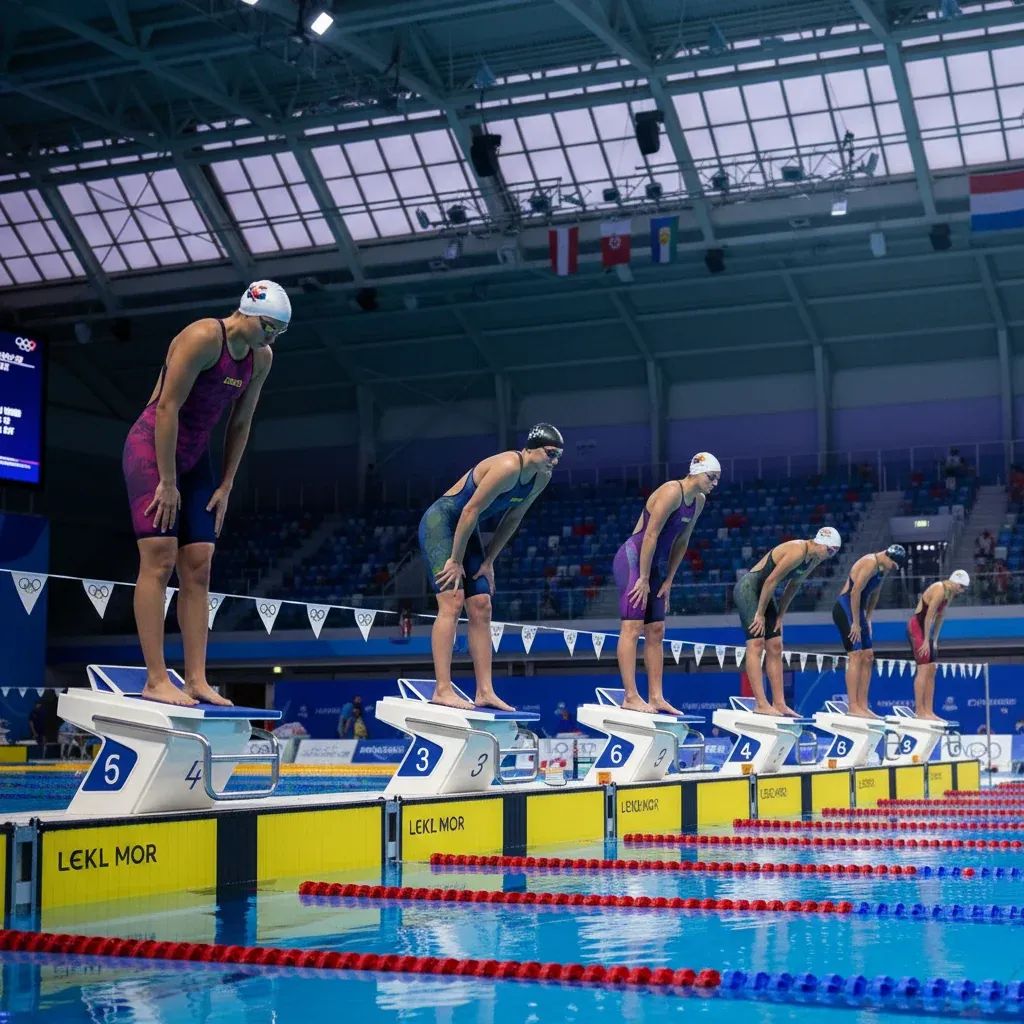
World Aquatics has lifted nearly all competitive restrictions on Russian and Belarusian swimmers, allowing them to return to international meets with full national insignia—a decision that marks one of the most significant reversals in the global sports community's response to the 2022 invasion of Ukraine. Starting now, senior athletes from both nations can compete under their own flags, anthems, and uniforms, provided they pass a series of stringent doping checks.
Why This Matters
• Full national representation restored: Unlike the neutral athlete model used at Paris 2024, Russian and Belarusian swimmers will wear their country's colors and hear their anthems at medal ceremonies.
• Mandatory doping protocol: Athletes must clear at least four consecutive antidoping tests conducted by the International Testing Agency (ITA) and pass background screenings by the Aquatics Integrity Unit.
• Milano-Cortina 2026 implications: This policy shift arrives just months before the Winter Paralympics, where ten Russian and Belarusian para-athletes will also compete with full national symbols—a move that has triggered a diplomatic boycott by eleven nations, including Ukraine.
What This Means for Residents of Italy
For those living in Italy, the return of Russian and Belarusian athletes with full national symbols to international competition is not just a distant headline—it has immediate resonance as the country prepares to host the 2026 Winter Olympics and Paralympics in Milano and Cortina d'Ampezzo (February 6–22, 2026). The Italian government's public opposition to the International Paralympic Committee's decision reflects domestic political pressure and sensitivity to hosting athletes whose nations are under EU sanctions.
Practical impacts for residents and visitors:
The Olympic venues most likely to experience heightened security and potential protests include Stadio Olimpico (Milano) for opening and closing ceremonies, Palaolimpico (Milano) for ice hockey, and Cortina d'Ampezzo Olympic Stadium for alpine skiing and snowboarding events. Officials expect increased police presence and restricted access zones near these locations during the Games period, particularly during medal ceremonies where Russian and Belarusian athletes may compete.
Public transport and access: Milan's metro system and regional trains serving Cortina may experience temporary disruptions during peak competition days. The Italian government recommends that residents in the host regions plan alternative routes during February 6–22, 2026. Local authorities are preparing contingency plans, but details will be released closer to the Games date.
Official guidance: Italy's Sports Ministry and the Milano-Cortina 2026 Organizing Committee have emphasized that while the government opposes the participation decision on diplomatic grounds, security protocols will ensure all athletes and spectators are protected. Residents can monitor updates through the official Milano-Cortina 2026 website and regional government communications.
From a legal standpoint, Italy's anti-discrimination laws do not prevent the participation of athletes based on nationality, but the government's stance suggests it will use diplomatic channels to express dissent without blocking the events themselves. This mirrors the broader European dilemma: how to uphold principles of fairness in sport while maintaining solidarity with Ukraine.
The Announcement and Its Conditions
In a statement released on April 13, World Aquatics said its updated participation guidelines during periods of political conflict now allow "athletes of Russian or Belarusian sporting nationality to participate in World Aquatics competitions under the same conditions as their peers representing other nationalities, with their respective uniforms, flags, and anthems." The federation's president, Husain Al Musallam, framed the decision as a success in keeping geopolitical disputes out of the pool. "We are determined to ensure that pools and open waters remain places where athletes of all nations can come together in peaceful competition," he said.
Yet the pathway back is not frictionless. Each returning athlete must undergo a minimum of four consecutive clean drug tests arranged in partnership with the ITA, as well as integrity vetting by the Aquatics Integrity Unit (AQIU). World Aquatics disclosed that more than 700 such screenings have been conducted on Russian and Belarusian swimmers under the previous neutral-athlete framework. The federation has also reinstated full membership rights for the Russian and Belarusian national federations under Article 6 of its constitution.
This policy applies only to senior-level competition; junior and youth swimmers from both countries have been allowed to compete with national symbols since December 2025, a timeline that underscores the federation's phased approach to normalization.
A Broader Pattern: Other Sports Loosen the Door
World Aquatics is not acting in isolation. Several international federations have recently restored or relaxed bans on Russian and Belarusian athletes, though each has adopted its own criteria and timeline.
Judo led the way: the International Judo Federation (IJF) reinstated full national status—including flags and anthems—for Belarusian judoka on June 1, 2025, and for Russian judoka on November 27, 2025. The International Ski and Snowboard Federation (FIS) was compelled by a December 2025 ruling from the Court of Arbitration for Sport (TAS) to allow Russian and Belarusian skiers to compete as Individual Neutral Athletes (AIN) in qualifying events for Milano-Cortina 2026, provided they meet International Olympic Committee (IOC) eligibility standards—namely, no active support for the war and no affiliation with military or security forces.
The International Paralympic Committee (IPC), operating independently of the IOC, made an even bolder call in February 2026: it cleared six Russian and four Belarusian para-athletes to compete at Milano-Cortina with full national representation. Russia will field two competitors each in para-alpine skiing, para-cross-country skiing, and para-snowboarding; Belarus will send four para-cross-country skiers. That decision drew immediate condemnation from Ukraine, which called it "scandalous" and accused the IPC of welcoming "assassins and their accomplices." Eleven nations, including Ukraine, boycotted the opening ceremony in protest, and the Italian government publicly declared its opposition to the move, despite hosting the Games.
Meanwhile, many sports maintain stricter lines. World Athletics has kept Russian track-and-field athletes banned since 2015 due to state-sponsored doping and shows no sign of relenting. FIFA and UEFA continue to suspend Russian national and club teams. Tennis permits individual participation under a neutral flag but bars teams from Davis Cup and Billie Jean King Cup events indefinitely.
The Doping Shadow That Never Lifted
Russia's reentry into aquatics—and sport more broadly—remains overshadowed by the state-sponsored doping scandal that erupted after the 2014 Sochi Winter Olympics. That systemic cheating led to years of exclusions, neutral status, and the disqualification of dozens of Russian athletes across multiple Olympics. The scandal was never fully resolved; it was merely paused by the war-related bans that began in February 2022.
World Aquatics' insistence on four consecutive clean tests is a direct response to that history. The ITA, an independent antidoping body, will administer the screenings, while the AQIU will conduct background checks to ensure athletes have no ties to military structures or public endorsements of the invasion. These safeguards are intended to restore confidence, but they also acknowledge a persistent climate of suspicion.
The IOC itself has taken a more cautious stance. While it has recommended that international federations allow Russian and Belarusian participation as neutrals, it has suspended the Russian Olympic Committee indefinitely for violating the territorial integrity of the Ukrainian Olympic Committee. The IOC also retains final authority over which athletes may compete at Milano-Cortina 2026, even if federations like World Aquatics or the FIS have cleared them.
The Return of a Contentious Precedent
World Aquatics emphasized that its policy shift reflects a "successful contribution to ensuring that conflict remains outside competition." Yet the decision also sets a precedent that other federations may follow—or reject. The IOC's recommended model of neutral athletes without national symbols was intended as a middle path, a way to preserve individual rights while acknowledging geopolitical reality. By moving beyond that model, World Aquatics has effectively declared that the war in Ukraine no longer justifies blanket exclusions.
Whether that judgment proves durable will depend on several factors: the results of ongoing antidoping tests, the behavior of athletes and officials at competitions, and the broader trajectory of the conflict itself. For now, Russian and Belarusian swimmers are back in the water—but the ripples from that decision are only beginning to spread.


