
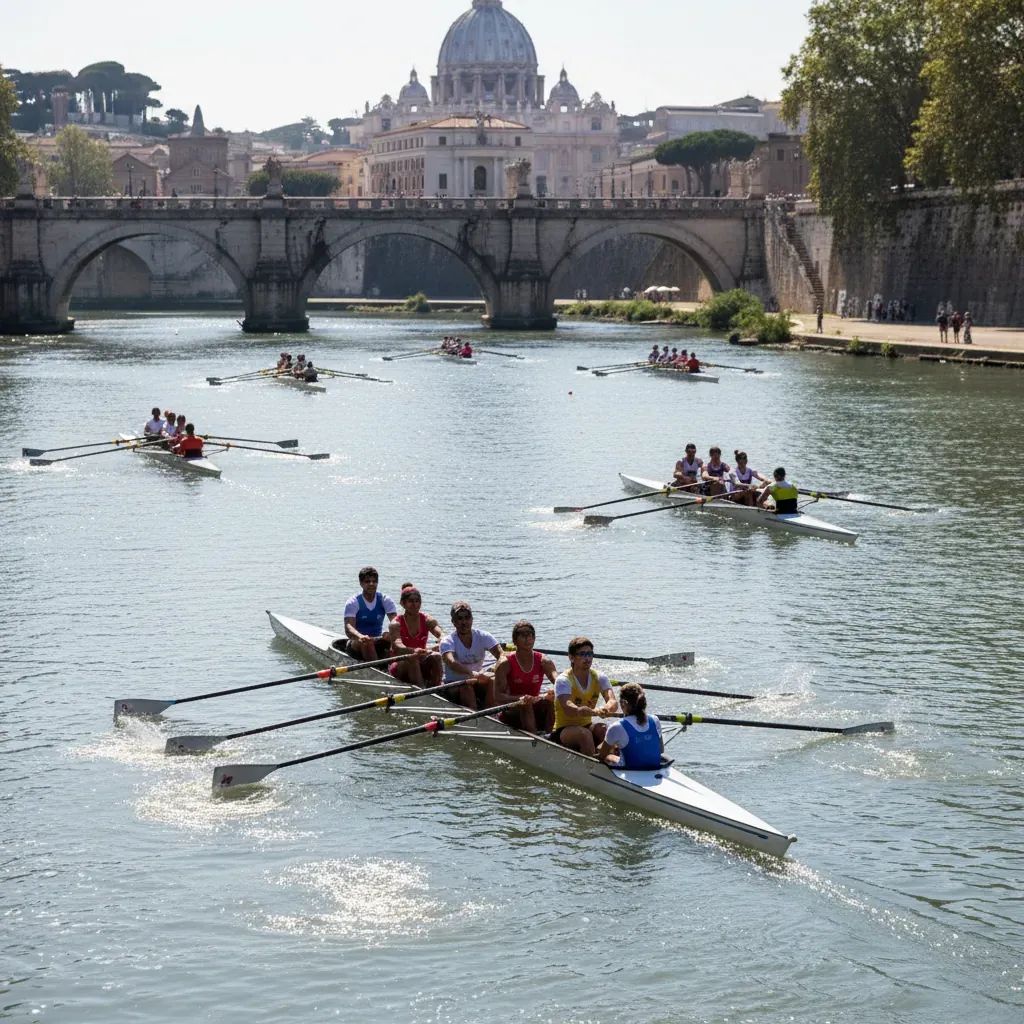
Special Olympics Italia is hosting an International Rowing Meeting on April 24–26, 2026 at Rome's historic Reale Circolo Canottieri Tevere Remo, drawing athletes with and without intellectual disabilities from across Europe and the Mediterranean. The three-day gathering—unfolding as competitions, unified training sessions, and coaching workshops—underscores Italy's expanding role as a pilot hub for inclusive rowing within the Special Olympics movement.
Why This Matters:
• International showcase: Delegations from Germany, Greece, Libya, and Portugal are joining Italian crews, reinforcing Rome's position as a crossroads for inclusive sport policy.
• Preparation track: The meeting serves as a stepping stone toward the National Summer Games in Lignano Sabbiadoro (May 19–24, 2026) and the Saarland Special Olympics in Germany in June 2026.
• Legislative backing: Italy's Department for Policies for Persons with Disabilities and the Ministry for Disabilities are co-funding the event, signaling institutional commitment to barrier-free sport.
A Discipline With Deep Italian Roots
Rowing entered the Special Olympics Italia calendar in 2005 and gained official discipline status worldwide in 2011. Since then, clubs from the Alps to Sicily have woven adaptive rowing into their programs, making Italy a reference point for Unified Sports® crews—teams pairing athletes with intellectual disabilities alongside partners without. The 2026 Rome meeting will mark the most international edition to date, codifying nearly two decades of grassroots work into a pan-European training and competition model.
The tagline, "Looking Back to Move Forward," captures the event's dual mission: celebrate proven methods while scaling infrastructure for larger competitions. Rowing—a sport that demands synchronized rhythm, mutual trust, and precise communication—translates inclusion from slogan to measurable team performance. Every oar stroke depends on every crew member; there is no passenger seat in a four.
Competition Structure and Timeline
Racing will unfold across three days in April 2026. The opening day will feature acclimatization runs on the Tiber, allowing mixed crews to adjust to local water conditions and finalize lineups. The second day's schedule will include 500-meter water heats, individual indoor-rowing sprints, and unified relay finals, with medal ceremonies scheduled for late afternoon. Results will be published as officials verify divisioning—a classification process that groups athletes by ability level to ensure fair, competitive brackets.
The final day's Unified Experience will close the meeting with symbolic mixed crews: athletes, coaching staff, and institutional representatives rowing together in exhibition format. The Italy Ministry for Disabilities confirmed that LIS interpreters (Italian Sign Language) and accessible viewing platforms will be in place throughout, ensuring full participation for spectators and competitors alike.
What This Means for Residents
For Rome-based families with children or adults on the intellectual-disability spectrum, the meeting offers a tangible proof-of-concept. Local rowing clubs participating in the event are actively recruiting for autumn programs, with several announcing subsidized membership schemes backed by municipal sport budgets. The visibility of international delegations also pressures regional authorities to maintain funding parity: if Libya and Portugal can field crews, Lazio has little excuse to cut adaptive-sport line items.
Tourists and expats planning to be in Rome in April 2026 can attend free of charge; the venue sits along the Lungotevere near Ponte Milvio, easily reached by tram. Watching a heat provides immediate, visceral understanding of how Unified Sports® works—partners and athletes row in unison, not in a helper-and-helped dynamic. For anyone navigating Italy's often opaque disability-services landscape, the event is a rare window into what full inclusion looks like when administrative barriers lift.
Coach for Inclusion: Training the Trainers
Parallel to the races, the "Coach for Inclusion" seminar will run during the event, drawing 47 Italian and international coaches through a three-tiered curriculum. Participants will learn adaptive rigging techniques, communication strategies for athletes with varying cognitive profiles, and the Special Olympics classification system. Graduates receive certification from Special Olympics Italia and entry into the national technical registry, a credential recognized by the Italian Rowing Federation (FIC) for club-level coaching roles.
The program addresses a persistent bottleneck: many clubs want to launch adaptive sections but lack staff trained in individualized coaching plans. Standardized FIC courses cover biomechanics and periodization; they rarely address how to scaffold instructions for an athlete who processes verbal cues more slowly or who thrives on visual demonstration over auditory explanation. Coach for Inclusion fills that gap, blending sports science with pedagogy drawn from special education.
Italy's focus on coach capacity-building aligns with its broader Special Olympics strategy. Following the 2025 World Winter Games in Turin—which will bring 1,500 athletes from 102 countries—Italian officials are positioning the nation as a European inclusion laboratory. The rowing meeting will test whether that model scales beyond Alpine ski resorts to urban waterways and whether Mediterranean neighbors will adopt Italian training protocols.
Path to Los Angeles 2028
While Special Olympics operates separately from the Paralympic movement—serving exclusively athletes with intellectual disabilities rather than the broader disability spectrum—the Rome meeting reflects overlapping momentum. European para-rowing officials held a workshop in Szeged, Hungary, in 2025 to prepare coaches for the Los Angeles 2028 Paralympic cycle, focusing on classification updates and equipment standards. Special Olympics, meanwhile, is lobbying for rowing's inclusion in the 2027 World Summer Games program, which would elevate the sport's profile and unlock additional national-federation funding.
For Italian crews, the April 2026 competition will serve as a selection trial. Strong performances in Rome will improve seeding for Lignano Sabbiadoro in May 2026, which in turn will determine who represents Italy at the Saarland Games in June 2026. Athletes like Luca Bracoloni, who has credited rowing with building his independence and social confidence, exemplify the life-trajectory shift that competitive sport can trigger. German rower Fabian Neitzel told organizers the Tiber's urban backdrop offers a "calm intensity" distinct from training lakes, underscoring how venue variety sharpens race-day adaptability.
Institutional and Financial Architecture
Funding flows from two ministerial channels: the Department for Policies for Persons with Disabilities is covering venue costs and travel stipends, while the Ministry for Disabilities is providing the coaching-seminar budget. Comparable Special Olympics events in Italy typically run €150,000–€200,000 for a three-day international meet, including accommodations, meals, and adaptive equipment rental.
The Reale Circolo Canottieri Tevere Remo, founded in 1919, is waiving facility fees and assigning club coaches as volunteer timers and safety-boat operators. Private sponsors—primarily regional banks and insurance firms—are contributing an estimated €50,000, according to event organizers. That public-private split mirrors the broader Italian sports-funding model, where elite Olympic programs draw state investment but grassroots inclusion relies on corporate social responsibility and volunteer labor.
Broader Context: Italy's Special Olympics Footprint
Special Olympics Italia, recognized by both CONI (Italian Olympic Committee) and CIP (Italian Paralympic Committee) as a benevolent association, operates programs in all 20 regions. National membership hovers near 20,000 athletes across disciplines ranging from alpine skiing to bocce, with rowing representing roughly 4% of total participation. The organization targets Italy's estimated 1.3 million people with intellectual disabilities, though only a fraction access organized sport due to logistical, financial, or informational barriers.
Rome's 2026 meeting advances two strategic goals: normalize inclusive sport in mainstream clubs and export Italian coaching methodology to countries with nascent programs. Libya's delegation, for example, comprises three athletes and one coach; their participation was facilitated by Italian diplomatic channels and represents the first Libyan presence at a Special Olympics rowing event. If those athletes return home and launch a Tripoli club, Italy's model propagates—and Italian coaches may be invited as consultants, deepening bilateral sport-diplomacy ties.
Accessibility and Inclusion Measures
Beyond LIS interpreters, organizers are installing tactile pathways from the parking area to the dock, wheelchair-accessible viewing platforms, and audio commentary broadcast via short-range FM for visually impaired spectators. Medical staff includes a neuropsychologist familiar with intellectual-disability presentations, ensuring that any mid-race distress is assessed through an appropriate clinical lens rather than defaulting to emergency-room protocols.
Athletes will receive individualized race briefs, with some using pictogram schedules and others relying on peer mentors. The Unified Sports® model itself is an inclusion mechanism: partner athletes, who are typically club rowers without disabilities, provide real-time tactical guidance during races, making the sport accessible to athletes who might struggle with split-second decision-making under pressure.
What Comes Next
Official results and a detailed competition report will be published by Special Olympics Italia within ten days of the event's conclusion. Video highlights will be archived on the organization's YouTube channel, and several Italian sports networks have committed to airing edited race packages in late May 2026, timed to build interest ahead of Lignano Sabbiadoro.
For Rome residents curious about adaptive rowing, the Circolo Canottieri Tevere Remo offers open-water trials every Saturday morning through June 2026, with equipment and coaching provided free of charge. Interested families can register via the club's website or through Special Olympics Italia's regional office in Lazio. The meeting's legacy, organizers hope, will be measured not in medals but in the number of new athletes who step into a boat for the first time in summer 2026.


