
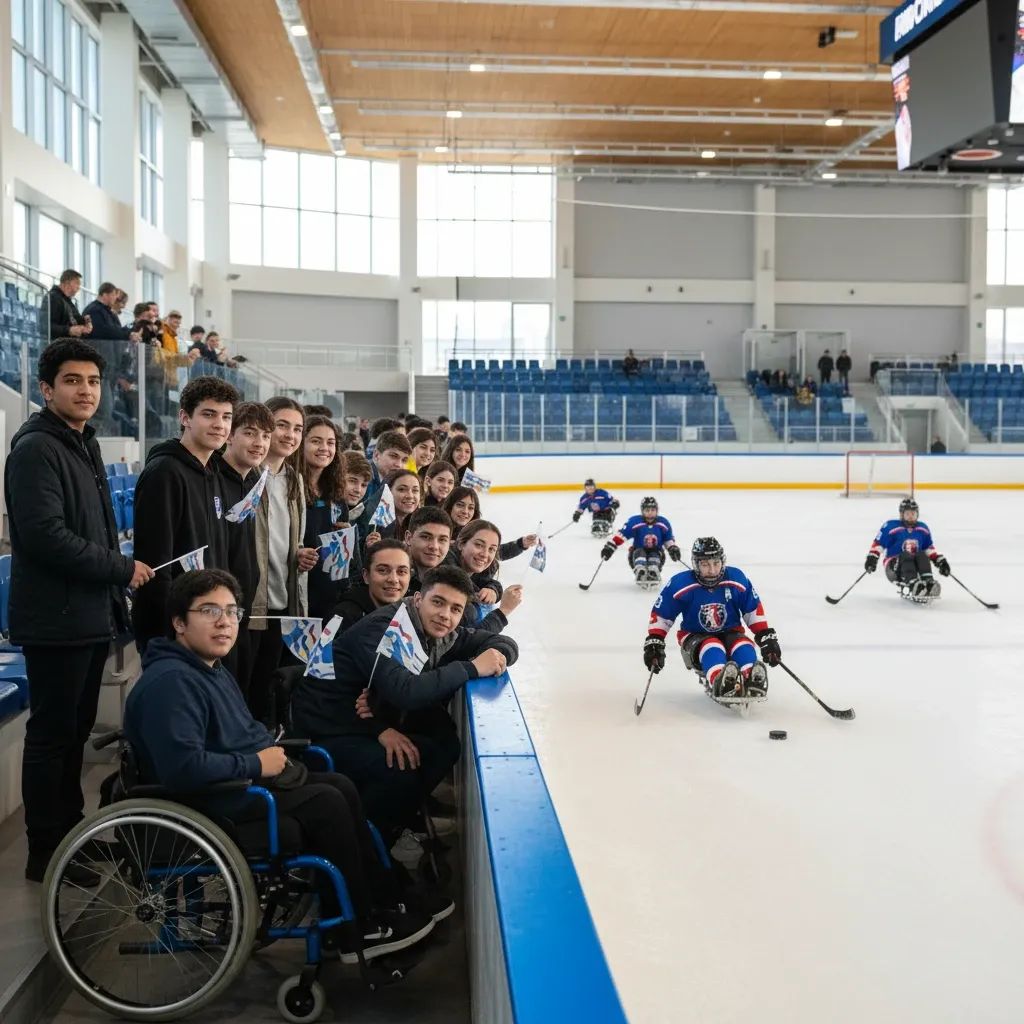
When Italy's Winter Paralympics open in early March, the spectator stands won't belong solely to seasoned sports enthusiasts. The Italy Ministry of Education has orchestrated a deliberate push to fill venues with something rarely seen at Paralympic competitions: thousands of teenagers and younger pupils. Over 20,000 students will attend live events across four key locations—a calculated move to embed disability sport and inclusion values directly into the national educational experience while the world watches.
Why This Matters
• Direct live experience: Students from primary and secondary schools nationwide will witness Paralympic athletes competing at the Tofane Alpine Skiing Center, Cortina Curling Olympic Stadium, Tesero Cross Country Skiing Stadium, and Milano Santagiulia Ice Hockey Arena.
• Affordability meets access: Reduced-rate tickets at €10 per seat make participation financially feasible for schools with modest budgets, removing a traditional barrier to attendance.
• Embedded curriculum connection: Educational materials from the I'mPOSSIBLE programme are designed to be integrated into civic education and sports classes, making the field trip an official learning objective rather than a bonus activity.
• Structured legacy planning: The Foundation has committed to measuring long-term impact through a formal post-Games assessment, tracking shifts in student attitudes toward disability inclusion and Paralympic sport engagement.
A Deliberate Inversion of Typical Paralympic Audiences
For decades, Paralympic events have struggled with a familiar challenge: smaller crowds, demographic skew toward older spectators, and media coverage that trails Olympic events by orders of magnitude. The Italy organizers recognized this pattern early and decided to disrupt it through institutional design rather than hope.
The Gen26 Education Programme—an umbrella initiative housed within the Milano Cortina 2026 Foundation—reimagines what it means to plan for legacy. Rather than cross fingers that good intentions will somehow create lasting cultural change after the torch extinguishes, the Foundation anchored student participation as a core operational feature of the Games themselves. Domenico De Maio, the Foundation's Education & Culture Director, framed this not as charity or outreach, but as a fundamental investment: "Bringing thousands of students into the venues means investing in the future and contributing to building a more attentive, aware, and open society."
This language matters. It positions inclusion not as a peripheral public relations exercise, but as the event's structural purpose.
How the Pipeline Works
The mechanics are straightforward but labor-intensive. Schools submit ticket requests through a dedicated Ministry portal. The Foundation allocates subsidized seats—€10 per Paralympic competition ticket, substantially cheaper than general admission pricing—enabling even underfunded institutions in smaller towns to organize trips. Transport is partially offset through regional education budgets, removing the logistical friction that typically deterred mass participation.
The I'mPOSSIBLE curriculum materials—developed by the International Paralympic Committee and backed by Procter & Gamble—provide teachers with structured lesson plans, athlete testimonials, and videos that contextualize what students will see. This pre-event preparation is critical: research from previous Paralympic Games shows that spectators with prior knowledge of athletes' stories and sporting disciplines leave events with significantly higher reported satisfaction and retention of inclusive values.
By late February, the program had already sent 16,000 students to Olympic events, indicating robust school engagement. The Paralympic phase—March 6 through March 15—aims to push that number above the 20,000 target, a figure that would make this among the largest school-based Paralympic attendance efforts globally.
The Geographic Reality: North Dominates
Data from the Olympic phase shows that 83% of student participants came from northern Italy, with Veneto alone contributing over 3,500 pupils and Lombardia approximately 3,000. Central Italy represented 11%, while southern regions accounted for 6% of total attendance.
This geographic concentration reflects the proximity of venues to northern schools and regional budget variations. Northern schools benefit from shorter distances to alpine venues—a student in Treviso faces a 90-minute journey to Cortina; a pupil in Bari or Palermo confronts 12+ hours of travel. Northern regions also historically command larger per-capita budgets for extracurricular activities, a legacy of deeper industrialization and tax base concentration.
The Foundation has not publicly disclosed whether targeted subsidy increases or transport grants will specifically address southern school participation during the Paralympic phase.
Beyond Ticket Distribution: PCTO and Adaptive Sport
The Gen26 umbrella extends well beyond ticketing logistics. The PCTO (Percorsi per le Competenze Trasversali e l'Orientamento) pathway offers high school students practical experience in event management, accessibility consulting, and sports marketing—all while earning official work-experience credits required for graduation. Over 1,500 schools have formally enrolled in the program network, and more than 150,000 teachers have accessed Gen26 educational resources.
A companion initiative, Adaptive Winter Sport, brings people with disabilities into weekend skiing and snowboarding sessions at venues near the Games. Operating since 2024 in Cortina, Livigno, and Passo Tonale, these courses introduce participants to sit-skiing, Nordic skiing, and para-snowboarding techniques. For many attendees—particularly those from southern regions with limited disabled-sport infrastructure—this represents their first exposure to Paralympic disciplines outside a competitive setting.
The "Milano Cortina nelle Scuole" program dispatches athletes and organizers directly into classrooms across Italy, with the goal of bringing Paralympic narratives into communities that may not travel to live events. This virtual bridge-building acknowledges geographic reality while attempting to democratize access to athlete stories.
What Local Organizers Are Saying
Regional governments have embraced the program as a vehicle for civic pride. On March 2, Friuli Venezia Giulia President Massimiliano Fedriga stood in Trieste as the Paralympic torch passed through, confidently predicting "an important public success" for the Games. He anchored his optimism explicitly to the school participation initiative, framing young spectators as evidence of genuine grassroots mobilization rather than top-down spectacle.
Trieste Mayor Roberto Dipiazza and local Paralympian Matteo Parenzan appeared alongside Fedriga, signaling regional solidarity. These orchestrated moments serve a purpose: they telegraph to other communities that Paralympic sport is a legitimate civic occasion, worthy of institutional attention and family planning, not a niche event for specialists.
What This Means for Families in Italy
For parents and educators across Italy, the Gen26 Programme operates through your child's school, not through individual registration. If you have a school-age child, speak directly with your school's administration to learn whether they have enrolled in the program. Over 1,500 schools are currently part of the Gen26 network, making participation increasingly widespread.
The school-based ticket program runs through March 15, coinciding with the end of the Paralympic competition window. Schools coordinate requests through a dedicated Ministry portal, and the €10 reduced-rate tickets are specifically allocated through this institutional channel. While the article does not confirm whether families can purchase €10 tickets independently outside the school program, the subsidized pricing is guaranteed for enrolled institutions.
Parents interested in disability inclusion education or adaptive sports programming can also inquire with regional sports authorities about local offerings. The Adaptive Winter Sport courses continue operating in Cortina, Livigno, and Passo Tonale, providing accessible introduction to Paralympic disciplines for people with disabilities of all ages.
The Question of Durability
Skeptics rightly ask whether this educational framework will persist after March 15, when organizers pack up equipment and the international spotlight moves elsewhere. The Foundation has committed to publishing a comprehensive impact report by June 2026—a relatively short timeframe for measuring behavioral change, but a genuine commitment to accountability nonetheless.
Historical precedent is mixed. London's 2012 "Get Set" programme reached over 19,500 schools, and follow-up research found that 81% of participating children reported heightened awareness of disability inclusion—a striking figure suggesting genuine attitude shift. Australia's "Telstra Paralympic Education Programme" and Canada's "Petro-Canada Paralympic Schools Programme" both secured multi-year funding streams, embedding Paralympic education into permanent curriculum frameworks rather than treating it as an episodic intervention.
Italy's model emphasizes live attendance over digital engagement, betting that in-person experience of athletic excellence produces more durable cultural memory than virtual classroom content. Whether that wager pays off depends on whether schools continue integrating Paralympic themes into civic education and physical education after the event closes, and whether regional governments maintain funding for adaptive sports programming.
The Visibility Arithmetic
For context: an estimated 2 million young people across Italy have already engaged with Gen26 programming in some form. The 20,000 attending live Paralympic competitions represent the intensive tier of that engagement—students who will return to their classrooms as embodied witnesses to human athletic capacity that defies conventional stereotypes about disability.
That matters because disability visibility in Italian public discourse remains limited. Media coverage of Paralympic sport struggles for prominence in sports sections, and schools historically have lacked structured opportunities to discuss disability as a dimension of human diversity rather than a medical condition to be managed. The Gen26 framework flips this by positioning Paralympic excellence not as an inspirational outlier but as a legitimate sporting achievement deserving spectator attention.
The ultimate measure won't be ticket numbers or logistics efficiency. It will be whether a 15-year-old from Brescia who watched sit-skiing in Cortina carries that memory into adulthood as evidence that her society is capable of designing genuinely inclusive spaces—and whether she expects that standard to apply to everything from public transportation to workplace accommodation to political representation.
That's what generational legacy actually looks like.


