
Cagliari Lit the Fuse on Sailing's Biggest Show—Naples Prepares for 2027
The preliminary regattas that took place in Cagliari in May 2025 marked more than just a warm-up lap for sailing's most storied trophy. They signaled the beginning of an 18-month urban transformation that is reshaping how Italy's southern regions approach infrastructure, investment, and post-industrial renewal. When eight AC40 racing yachts hit the Sardinian waters on May 21, 2025, they carried the weight of three decades of broken promises for Bagnoli, Naples' former steel district—now destined to become one of Europe's most watched waterfront projects.
Why This Matters
• First Italian hosting: Naples will run the complete 38th America's Cup cycle in 2027, controlling both the challenger selection process and the final match—unprecedented for an Italian venue.
• Bagnoli's makeover accelerates: After 30 years of stalled cleanup, €16 million in road work plus environmental remediation is advancing to meet July 2026 deadline for team base handovers.
• Economic spillover: Campania Region expects €1.5 billion in returns from the sailing competition plus permanent housing, job creation, and tourism infrastructure that outlasts the races.
• Seven challengers besides the defender: Australia's entry (May 14, 2025) added competitive depth and proved Italy's magnetic draw for international sailing teams.
Two Southern Regions Strike a Partnership
Sardinia Region President Alessandra Todde and Naples Mayor Gaetano Manfredi stood side by side at the Luna Rossa logistics hub in Cagliari's port during the preliminary regatta, framing the event as something beyond a sporting spectacle. They positioned it as the opening move in a deliberate Sardinia-Campania alliance designed to signal that Italy's Mediterranean south can coordinate across administrative boundaries and attract high-value international competition.
Todde's language carried economic ambition. "The South is demonstrating capacity—that it can control its destiny, its competitiveness," she said. The €50 million projection for Cagliari's four-day regatta (though she cautioned the figure would climb once attendance settled) represented something Sardinia had lacked: the hosting of a truly global sporting spectacle after "years of absence from these stages."
Manfredi echoed the message with historical depth. "These are two cities born on the sea, each carrying 3,000 years of history. The Mediterranean has a network of cities, and this event demonstrates we know how to operate as a system." The symbolic routing—starting in Cagliari, culminating in Naples—became shorthand for a broader southern strategy: shared infrastructure thinking, coordinated governance, and the ability to punch above typical political weight.
Both officials confirmed that Naples will host preliminary racing before the main 2027 event, with scheduling details to be announced.
Inside Bagnoli: The Clock Is Ticking, the Cleanup Accelerates
The America's Cup deadline forced a breakthrough that decades of environmental regulation and bureaucratic negotiation had failed to achieve. At Bagnoli, the former Italsider steel works that shuttered in 1990, work has proceeded in earnest throughout 2025 and into 2026.
As of late 2025 and early 2026, draggers have been removing contaminated seabed sediment to a four-meter depth. The vast artificial landfill known as the "colmata a mare" has undergone capping—sealing contaminated soil under impermeable layers—and been reconstituted as a waterfront terrace. Approximately half the platform is now remediated, with utilities and crane foundations being installed to host team operational bases. Work on protective breakwaters continues, with the northern pier advancing faster than other sections.
Pontile Nord, the northern pier, is undergoing parallel transformation into a public promenade and sports recreation area, with completion targeted for early 2026. The €16 million road upgrade program focuses on routes around the former plant, essential for accommodating team logistics and spectator traffic.
Naples Mayor and Special Commissioner Gaetano Manfredi estimated the full cleanup will require three years from early 2025, finishing by early 2028. Team bases are slated for progressive handover starting July 2026, with all facilities operational by October 2026—comfortably ahead of July 2027 race dates.
Resident concerns about the project's environmental approach have been raised, with community members questioning whether the remediation strategy prioritizes the sailing event timeline over comprehensive environmental restoration. The capping technique, some activists worry, may defer rather than permanently solve contamination. Manfredi has defended the approach as sound environmental practice aligned with international standards.
Why Government Is Already Planning 2030
Sports Minister Andrea Abodi signaled Italy's ambition extends well past July 2027. Speaking at an ANSA Forum, he outlined a two-path strategy to secure Naples as host for the 2030 America's Cup edition: either persuade the international organizing authority, or—more elegantly—win the competition with Luna Rossa Prada Pirelli.
An Italian victory would automatically grant Naples hosting rights, since America's Cup protocol permits the defending champion's yacht club to select the venue. That legal pathway reflects Abodi's confidence in the team and Naples' transformation.
"When we arrived at Bagnoli, we found a side of the city suspended, forgotten," Abodi said. "Achieving this remediation in three years, after 30 years of stalled promises, proves how public responsibility can rapidly exit critical situations." He framed the America's Cup as merely the catalyst—the actual goal is "returning Bagnoli fully to the city," with lasting sports facilities, family recreation zones, and a permanent "city of sailing" operating through 2029 and beyond.
Abodi also emphasized accessibility. "We want to make this very popular. The city's peripheries deserve to be part of the spectacle." That philosophy manifested in Cagliari's Race Village, where the Italian government's institutional truck transformed into an immersive sailing laboratory, offering navigation simulators, eSailing competitions, and maritime education workshops under the banner "Sailing for All: From the First Knot to Flying Boats."
In May 2025, the Italian Sailing Federation (FIV) and Sport e Salute signed a formal collaboration protocol, witnessed by Olympic sailing champions Caterina Banti and Alessandra Sensini, as well as athletes from the Pino Daniele Sports Center in Caivano—a Naples suburb that has become a national symbol of urban renewal through sport.
The Money, The Jobs, The Legacy
Sport e Salute CEO Diego Nepi Molineris delivered the economic case. A comprehensive impact study projects €1.5 billion in returns for Naples and Campania, spread across direct spending, supply-chain activity, and longer-term tourism gains. The event is expected to attract 1.5 to 1.7 million visitors over 60 days, with international sailing enthusiasts accounting for 400,000–500,000 of that figure.
Beyond visitor spending, the competition is catalyzing structural change. Three thousand new residential units are tied to Bagnoli's redevelopment—homes for families previously priced out of the waterfront district. Job creation estimates range from 1,500 to 2,000 positions in hospitality, logistics, event management, and ancillary services.
Most significantly for Nepi and Abodi, the America's Cup is a social intervention. "The peripheries, thanks to sport, have bridges connecting them to the center, bringing development and value upward," Nepi explained. His reference to Caivano athletes traveling from Rome's international tennis tournament to watch sailing regattas in Cagliari underscored the philosophy: use elite sport as a vehicle to expose working-class youth to opportunity, aspiration, and career pathways.
The government has embedded tackling school dropout rates as a formal objective. Government fiscal measures—a decree (DL 38/2026) exempting America's Cup–related entities from IRES and IRAP corporate taxes through 2027, plus relief for non-resident workers—are designed to ease international team logistics and signal stability to foreign investors.
Seven Challengers Plus the Defender
The 38th America's Cup will field its most crowded challenger field in two decades. Beyond the defending Emirates Team New Zealand, seven teams are contesting the selection series:
Luna Rossa Prada Pirelli (Italy, representing Circolo del Remo e della Vela Italia) will fly the home flag. GB1 (United Kingdom, Royal Yacht Squadron, Challenger of Record) enters as protocol guardian. Tudor Team Alinghi (Switzerland), La Roche-Posay Racing Team (France), American Racing Challenger Team USA, and Team Australia (Royal Prince Edward Yacht Club, confirmed May 14, 2025) complete the roster.
That seventh challenger—Australia's late addition—proved Italy's drawing power. "We now have Italy 7, Spain 6," Manfredi remarked, referencing Barcelona's 2024 edition field size. The competitive depth satisfies broadcasters and fans alike.
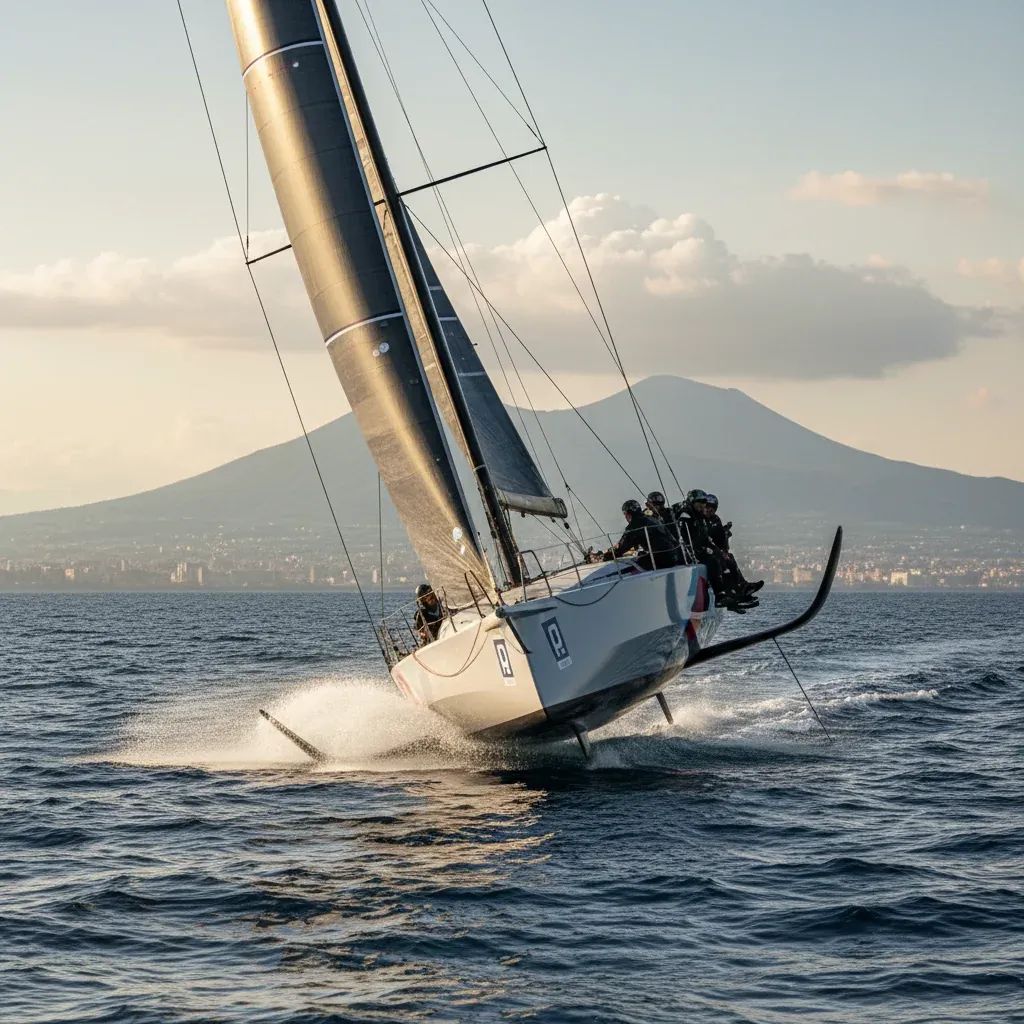
Racing will unfold in the Gulf of Naples, the natural amphitheater framed by Castel dell'Ovo, Posillipo, and Mount Vesuvius. Preliminary rounds employ AC40 foiling monohulls, while the final match and youth competitions use AC75s. Sky Italia holds exclusive broadcast rights, covering every race from Cagliari preliminaries through the July 2027 finale.
What This Transformation Actually Means for Naples Residents
For those living in Campania, the America's Cup isn't merely sailboat racing. It's the forcing mechanism for infrastructure that might otherwise take a decade to materialize.
Immediate practical changes: Bagnoli's waterfront is transitioning from abandoned industrial ruin to functioning public space by late 2026. The new residential units—3,000 homes—address Naples' chronic housing shortage in a location with genuine Mediterranean appeal. Road work around the former steel plant reduces congestion on key arterial routes. Sports facilities and family recreation areas, built for the competition, remain public assets afterward.
Economic signals: The fiscal incentives and government backing signal to private investors that Bagnoli is a legitimate development zone, not a perpetual cleanup site. That confidence can unlock secondary investment in hospitality, retail, and services that compound the America's Cup's direct impact.
Employment reality: For working-class Naples residents, 1,500–2,000 jobs in events, logistics, and hospitality provide genuine income pathways—particularly important given Campania's persistently high unemployment and youth emigration.
Environmental caveat: The capping methodology, while environmentally sound and legally defensible, does not eliminate contamination. It isolates it. Residents concerned with long-term health impacts should monitor the post-2027 remediation plan, particularly the schedule for addressing deeper seabed sediment and inland soil pollution that falls outside the America's Cup venue footprint.
The Symbolic Reckoning
For Sardinia, hosting the preliminary regattas in May 2025 signaled a return to Mediterranean prominence after years of hosting secondary sporting events. For Naples and Campania, the America's Cup represents generational infrastructure acceleration and a statement that the southern regions can compete for global attention and investment capital.
Whether that momentum survives beyond 2027 depends on political will and economic follow-through. Manfredi and Abodi have staked reputational capital on the claim that Bagnoli will be "fully returned to the city." Residents and activists will hold them to that promise. The €1.5 billion economic projection and 1,500–2,000 jobs remain meaningful only if they produce durable employment, not temporary event work.
As Naples approaches the July 2027 America's Cup and preparations accelerate throughout 2026, the infrastructure cranes and remediation barges tell a pragmatic story: sometimes the only way to break a 30-year stalemate is to invite the entire world to watch you fix it. Italy is banking that the America's Cup, and the eyes following it, will be worth the enormous bet.


