
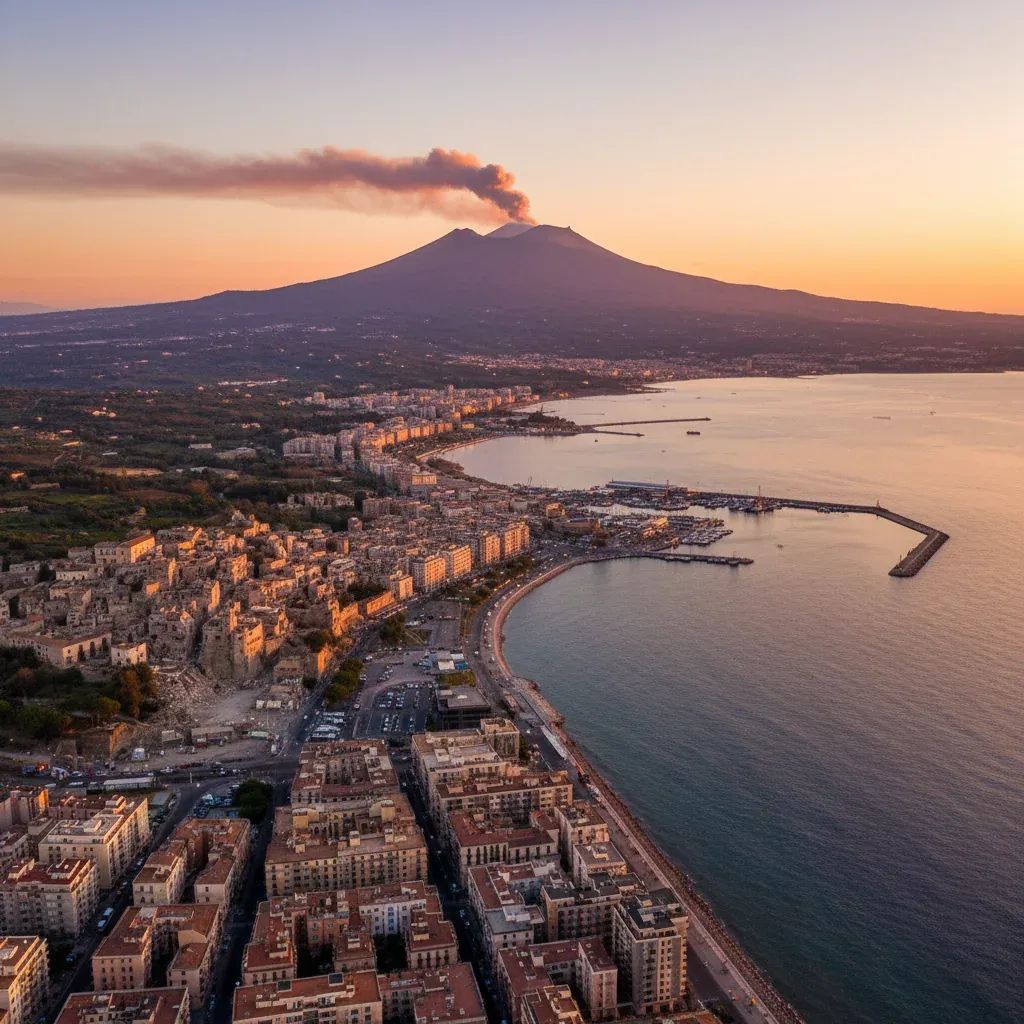
Italy's Naval Air Station Sigonella suspended flight operations in early July following a significant eruption from Mount Etna, temporarily halting air traffic at one of NATO's most strategically vital installations in the Mediterranean. The closure also forced the shutdown of Catania Fontanarossa Airport, Sicily's busiest airport, leaving thousands of residents and travelers stranded and disrupting the regional economy for days.
What Happened and When:
Mount Etna's Voragine crater intensified dramatically on July 5, 2026, generating an eruption column approximately 1.5 kilometers above the summit. Volcanic ash dispersed southward directly toward NAS Sigonella, located roughly 40 kilometers (25 miles) south of the volcano's peak—just outside Catania city. Italy's aviation authority issued a red alert for aviation, the highest warning level, automatically triggering airspace closures for both military and civilian flights.
The Istituto Nazionale di Geofisica e Vulcanologia (INGV), Italy's national geophysics and volcanology institute, recorded increased volcanic tremor around the Voragine crater. By afternoon, meteorological models consistently showed the ash cloud spreading south and southeast, making flight operations impossible until atmospheric conditions shifted.
Why This Matters:
• Flight operations suspended at NAS Sigonella after volcanic ash plumes reached 4,500 meters, closing the airspace for both military and civilian aircraft
• Catania Fontanarossa Airport also closed simultaneously, with dozens of flights canceled and approximately 3,500 passengers affected during the three-day closure
• NATO surveillance and drone missions were temporarily grounded, affecting intelligence operations across the Mediterranean and Middle East
• Local economy disrupted: Airport workers faced temporary layoffs, hotels filled with stranded passengers, and tour operators scrambled to reschedule itineraries
• Geologists predict continued activity through the remainder of 2026, with lava flows confined to Valle del Bove if effusion rates remain stable
What Residents Should Know
For Sicilians living near Catania and Etna, volcanic eruptions represent a recurring reality that blends natural spectacle with genuine disruption. The three-day closure of Catania Fontanarossa Airport left travelers stranded, forced airlines to cancel dozens of flights, and disrupted tourism—one of eastern Sicily's largest economic sectors.
Volcanic ash poses serious mechanical risks to jet engines. Even trace amounts can cause catastrophic failures, which is why aviation authorities adopt zero-tolerance policies when ash clouds enter flight corridors. This isn't excessive caution; it's a safety standard that protects passengers and crew.
If you live or work in the region during future eruptions, here's what to know:
• Air quality impacts: Volcanic ash can irritate respiratory systems. Residents with asthma or respiratory conditions should stay indoors when ash fall occurs and monitor local air quality alerts from regional health authorities
• Travel disruptions: Ash events can close airports with little warning. If planning travel during July-December, check volcanic activity reports from INGV and allow extra time for potential delays
• Work stoppages: Employees at Sigonella and Catania Airport may face temporary work interruptions. Local employers typically provide updates through official channels
• Support measures: Italy's civil protection service coordinated with airlines to rebook stranded passengers at no charge and provided emergency assistance at airport facilities
The Servizio Nazionale della Protezione Civile, Italy's national civil protection service, maintains a dedicated helpline and website with real-time volcanic activity updates. Following their guidance during eruptions ensures personal safety.
Sigonella's Strategic Role and Impact
NAS Sigonella functions as a critical logistics hub for NATO operations spanning from North Africa to the Middle East. The facility hosts surveillance systems and drone operations covering vast territories, and serves as one of the largest American drone bases outside the United States. When airspace closes—whether due to volcanic ash or other factors—aircraft must reroute to alternative bases, increasing flight times and fuel consumption while creating gaps in surveillance coverage.
The temporary closure demonstrated how natural hazards can disrupt critical military infrastructure, with ripple effects extending far beyond Sicily. Authorities across NATO recognized the operational vulnerability and adjusted contingency protocols accordingly.
Etna's 2026 Activity Pattern
The July eruption followed months of elevated volcanic activity. Beginning in January, lava emerged from a fissure in the Valle del Bove, producing slow-moving flows that remained contained within this natural depression on Etna's eastern flank. By late June, a new phase began near the Northeast Crater, sending lava toward the Valle del Leone.
INGV monitoring indicates that as long as lava effusion rates remain constant, flows will stay confined to the Valle del Bove, a natural basin that acts as a containment zone for most eruptions. However, ash emissions remain unpredictable. The Voragine crater has produced intermittent explosive activity throughout 2026, occasionally generating ash plumes tall enough to disrupt aviation—exactly what occurred in early July.
Geologists stress that Etna's behavior defies precise long-term forecasting. The volcano alternates between quiet periods and explosive episodes with minimal warning. INGV continuously monitors seismic activity, ground deformation, and gas emissions, publishing regular updates to help residents and authorities prepare for potential disruptions.
Coordinated Emergency Response
When natural disasters strike critical infrastructure, Italy activates integrated national protocols. The Ministero della Difesa (Ministry of Defense) works alongside the Servizio Nazionale della Protezione Civile, bringing together intelligence services, civil protection authorities, and local officials to manage the crisis.
Italian Armed Forces routinely support the national civil protection service, providing logistics, personnel, equipment, and communication networks during natural disasters. When volcanic ash closed Sigonella, this coordination ensured emergency protocols activated smoothly, communication with NATO partners remained transparent, and disruptions were minimized.
Looking Forward
As Etna continues its restless activity through the remainder of 2026, authorities will balance maintaining operational readiness with protecting personnel and aircraft from volcanic hazards. INGV will continue publishing regular volcanic activity updates, while aviation authorities maintain protocols to quickly close or reopen airspace based on ash dispersal forecasts.
For residents near the volcano, ongoing vigilance through official channels—monitoring INGV bulletins and civil protection alerts—remains the best approach to staying informed and safe. Sigonella and Catania Airport will continue facing periodic disruptions as Etna's unpredictable behavior demands, reminding Sicily that coexisting with Europe's most active volcano requires constant adaptation and preparedness.


