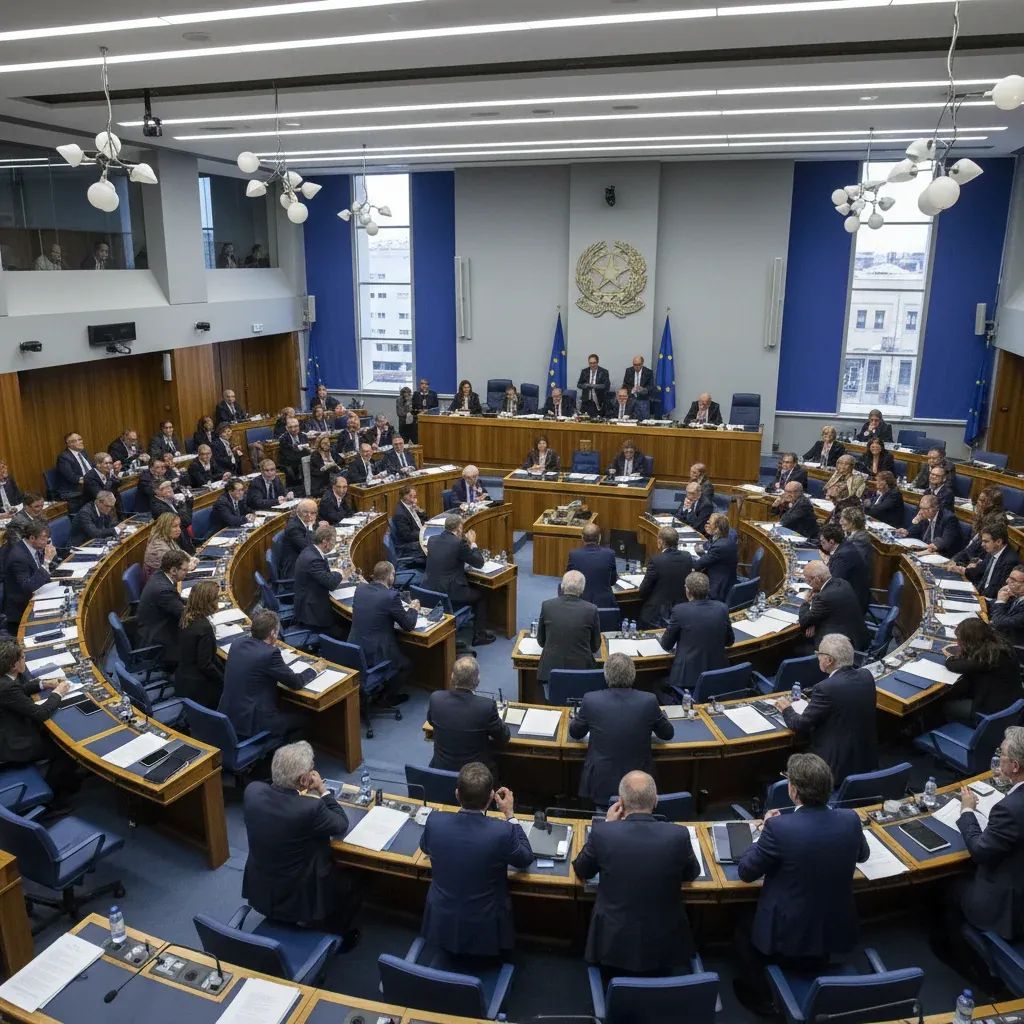
The Italian center-right coalition is engaged in a high-stakes turf war over who gets to select candidates for the next Milan mayoral election in 2027 and the Lombardy regional presidency in 2028, with party leaders now openly threatening to trade one office for the other.
Massimiliano Romeo, regional secretary of the Lega (League) in Lombardy and Senate caucus leader, has fired a warning shot at Ignazio La Russa, President of the Italian Senate and a senior figure in Fratelli d'Italia. After La Russa hosted a lunch meeting with prospective mayoral candidates and reportedly pushed for Maurizio Lupi as the coalition's choice for Milan, Romeo told ANSA that if La Russa wants to dictate the mayoral pick, the League will respond by "organizing dinners" to select the next Lombardy regional president—and that candidate "will certainly be from the League."
Why This Matters
• Power-sharing friction: The spat reveals deepening tensions within Italy's ruling coalition over who controls key electoral appointments in the country's wealthiest region.
• Milan 2027 at stake: Italy's financial capital, long governed by the center-left, is a coveted prize for the right-wing coalition, prompting public jockeying among allies.
• Lombardy succession looming: With current Governor Attilio Fontana term-limited after two consecutive mandates, the 2028 regional race is already shaping internal coalition dynamics.
• Symbolic escalation: Romeo's comment marks a rare public airing of intra-coalition bargaining, suggesting alliance unity may be more fragile than it appears.
The Milan Mayoral Scramble
The center-right coalition is scrambling to finalize a candidate for the Milan municipal elections scheduled for spring 2027. After 15 years of center-left governance in the city, the alliance sees a rare opportunity to reclaim Palazzo Marino, Milan's historic city hall. But the candidate selection process has become a source of internal friction rather than consensus.
La Russa, a Milan native and influential voice in Fratelli d'Italia, has been particularly active in convening potential contenders. Recently, he hosted a lunch at his home with several civic and political figures being floated as possible mayoral nominees. Among them was Maurizio Lupi, leader of the centrist Noi Moderati party and a former minister with deep roots in Milanese politics. La Russa's preference for Lupi has been widely reported, though Lupi himself has publicly urged the coalition to agree on a platform before rushing to name a candidate.
Other names circulating include Pietro Tatarella, a former Forza Italia official who has declared his availability; Carlo Cottarelli, an economist favored by Forza Italia but reportedly wavering due to coalition indecision; and Alessandro Spada, former president of Assolombarda (the Milan business association), whom the League supports. The Lega has even launched informal primary polling via street booths to gauge grassroots sentiment and strengthen its negotiating position within the coalition.
Romeo's pointed response to La Russa's maneuvering underscores the League's determination not to be sidelined in Milan—or anywhere else in Lombardy.
What This Means for Lombardy Residents
For voters and political observers in Lombardy, this public dispute is more than theater. It signals that the region's political future—and the policies that will govern its economy, infrastructure, and social services—may be decided less by electoral platforms than by backroom bartering among coalition partners.
Lombardy, Italy's economic powerhouse accounting for roughly 20% of national GDP, has been governed by the center-right for over 30 years. The next regional president, to be elected in 2028, will oversee one of Europe's most productive regions, managing everything from healthcare to transport to industrial policy. The stakes are enormous, and the League has made clear it expects reciprocity: concede Milan, and Lombardy becomes League territory.
The Lega's position is rooted in its historical strength in the region. Though Fratelli d'Italia has emerged as the coalition's leading party nationally, the League retains deep organizational networks and electoral clout in northern Italy. Romeo's appointment as regional secretary in December 2024 was widely interpreted as a move to consolidate League power ahead of these critical elections.
Names already circulating for the Lombardy regional presidency include Romeo himself, Massimiliano Salini (a Forza Italia MEP), and even Ettore Prandini, president of Coldiretti (Italy's main agricultural lobby), who is seen as a unifying "external" figure capable of appealing across party lines. Some reports have even mentioned La Russa as a potential candidate, though his role in the Senate makes this unlikely.
Coalition Dynamics and National Implications
The Milan-Lombardy standoff is emblematic of broader tensions within Italy's ruling coalition, which includes Fratelli d'Italia, Lega, Forza Italia, and smaller parties like Noi Moderati. While the alliance has governed nationally since the 2022 elections, regional and municipal contests have repeatedly exposed fault lines over candidate selection, policy priorities, and party hierarchy.
Fratelli d'Italia, led by Prime Minister Giorgia Meloni, is the coalition's dominant force at the national level and has sought to assert its influence in Lombardy as well. But the League, which has governed the region for decades, is unwilling to cede ground. Forza Italia, meanwhile, is pushing its own candidates and often finds itself squeezed between the two larger partners.
The May 2026 municipal elections across Lombardy served as a "test run" for these rivalries. The center-right consolidated control in several towns, but the results also highlighted competing claims to credit. Fratelli d'Italia proclaimed itself the coalition's "engine," while the League emphasized its enduring local roots.
The emergence of Roberto Vannacci—a controversial general who formed the Futuro Nazionale party and has attracted right-wing voters—adds another layer of uncertainty. His potential candidacy in future elections could siphon votes or complicate coalition math.
The Broader Political Context
Italy's political system has long rewarded negotiation and coalition-building, but the current arrangement is proving especially delicate. Unlike traditional center-left alliances, which historically divided candidacies by region or office with relative calm, the center-right coalition is more ideologically and geographically fragmented.
The Milan mayoral race is particularly symbolic. Italy's financial and fashion capital has been governed by the center-left since 2011, first under Giuliano Pisapia and then Giuseppe Sala. Reclaiming Milan would be a major political and psychological victory for the right. But the coalition's inability to quickly settle on a candidate—despite a target deadline of September 2026—suggests deeper coordination problems.
Romeo's comment about "organizing dinners" was delivered with a sardonic edge, but the message was clear: the League will not accept being dictated to. His phrasing—mirroring La Russa's "lunches"—was a deliberate rhetorical jab, signaling that informal gatherings can work both ways.
What Happens Next
The center-right coalition is expected to hold further meetings over the coming weeks to hammer out a Milan candidate. La Russa has proposed a structure pairing a political figure as mayoral candidate with civic advisors, though no consensus has emerged. Some within the League are pushing for a coalition-wide primary, which would be unprecedented for the Milan center-right.
For Lombardy, the regional race remains more than two years away, but the groundwork is being laid now. If the League succeeds in claiming the regional presidency in exchange for conceding Milan, it would mark a significant intra-coalition trade-off with lasting implications for governance in Italy's richest region.
Residents should expect more public sparring in the months ahead as these rivalries play out. Whether the coalition can settle its internal disputes without damaging its electoral prospects remains an open question.