
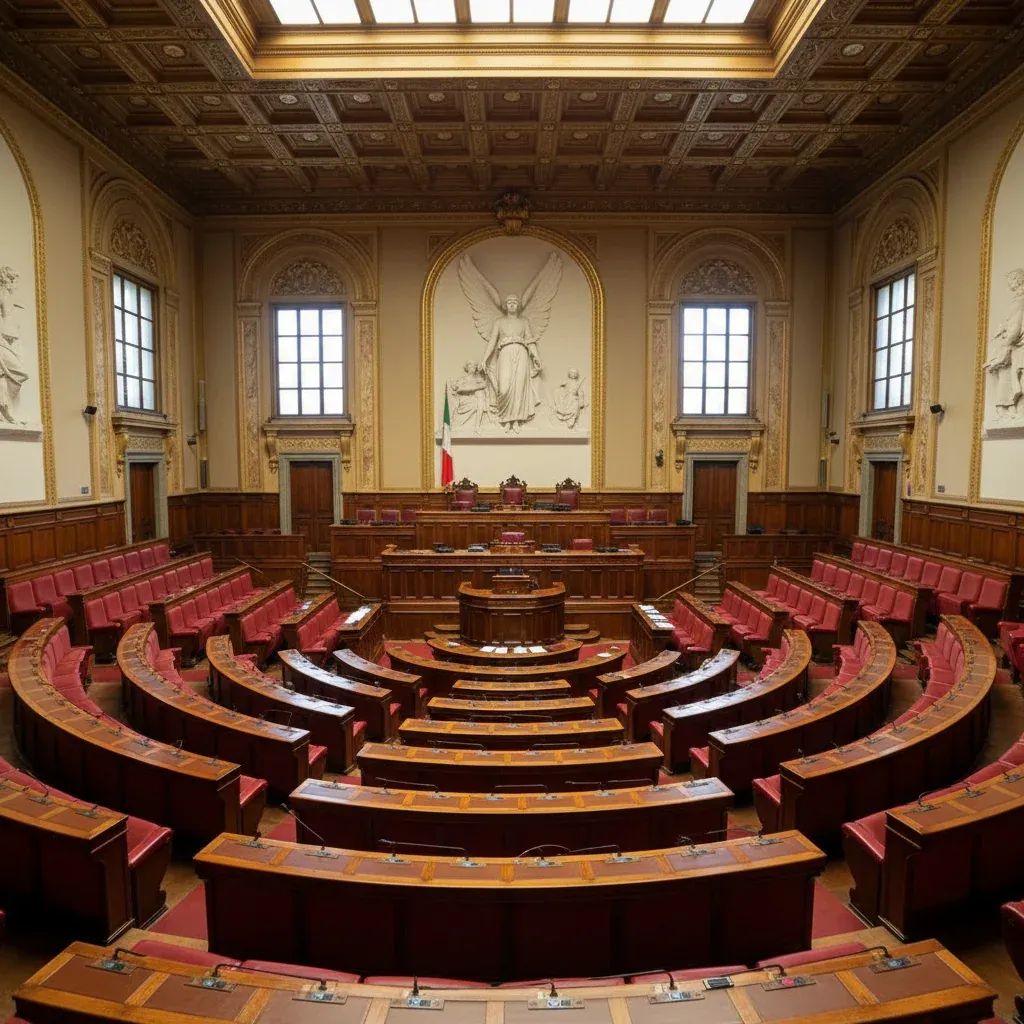
Italy's Senate is set to reopen a fierce political battle next week over voter preference lists in a new electoral law, even as a controversial "anti-fragmentation" clause threatens to force the country's smaller political parties into survival mode—or oblivion.
Why This Matters
• Senate examination begins next week (Tuesday/Wednesday) on an electoral reform already approved by the Chamber, but the fight over preference voting is far from over.
• Smaller center-left parties face effective elimination unless they merge, thanks to a new rule that blocks their votes from counting toward coalition totals.
• Noi Moderati will reintroduce a preference-voting amendment, reigniting tensions within the ruling coalition and raising the stakes for a potential Chamber revote.
Preference Battle Heads to Palazzo Madama
The Italian Senate's Constitutional Affairs Committee will take up the so-called "Stabilicum" electoral law starting midweek, according to statements from Fratelli d'Italia (FdI) Senator Andrea De Priamo, who chairs the panel. The Chamber of Deputies narrowly approved the bill on July 16 with 217 votes in favor, but preference voting was excluded after an FdI-backed amendment failed by a single vote—188 against, 187 in favor. That razor-thin margin left Italy's center-right coalition bruised and the door open for another attempt in the upper house.
Maurizio Lupi, leader of the small coalition partner Noi Moderati, confirmed his party will propose a fresh amendment to reintroduce preference ballots. "We want an electoral system that guarantees stability and governability, which are essential for facing new geopolitical challenges and supporting the economy," Lupi said. "At the Senate, Noi Moderati will bring back the preference issue to return the choice of representatives to citizens." He emphasized, however, that the government's immediate priority remains "completing the project of changing Italy, such as lowering taxes for young people."
The stakes are high. Under the current text, voters cannot express candidate preferences; instead, they face blocked lists in multi-member districts. If the Senate modifies the bill, it would trigger a third reading in the Chamber—a minefield for the government, where secret ballots and narrow margins previously upended the preference provision.
The Russo Amendment: A Trap for the Left?
Beyond the preference controversy lies a technical time bomb embedded in the electoral law: the so-called Russo amendment, drafted by Forza Italia lawmaker Paolo Emilio Russo. Officially aimed at reducing fragmentation, the clause changes how coalition vote totals are calculated for the 70-seat bonus in the Chamber and the 35-seat bonus in the Senate, which are awarded to any coalition or list crossing 42% of valid votes nationwide.
Previously, under the Rosatellum system, all coalition-linked lists that cleared a modest 1% threshold contributed their votes toward the total, even if they failed to win seats. The new rule is harsher: only lists above 3%—plus the single "best loser" below that mark—count toward the coalition's aggregate. Votes for other micro-parties are discarded entirely.
Lorenzo Pregliasco of YouTrend, a leading Italian polling firm, explains the practical effect: "It incentivizes aggregation of centrist parties. If the small ones don't merge, there's a risk of losing around 2 percentage points." That's enough to tip a close election.
"Without Us, the Broad Left Cannot Win"
The amendment has ignited accusations that it was designed to cripple the center-left campo largo (broad field), where fragmentation is endemic. Riccardo Magi, leader of the liberal +Europa party, called the provision "incredible—written by the majority but only targeting the center-left." He termed it a "forced choice" that substitutes for organic political dialogue and urged the Senate to correct the text.
Matteo Renzi, founder of Italia Viva and a polarizing figure in Italian politics, sees opportunity. Speaking at the Casa Riformista summer festival in Rome, he declared: "Without us, the broad left does not win. The math is not up for debate." He signaled openness to hosting smaller centrist parties under the Italia Viva/Casa Riformista banner, one of the few symbols exempt from signature-collection requirements. "If I return to Parliament, it will be with the Italia Viva and Casa Riformista slates," he said.
But Carlo Calenda, leader of the centrist Azione party, rejected Renzi's overtures in blistering terms. "Matteo, your only plan is to find a taxi—and I say this as a former taxi driver—to your next chair," Calenda retorted in a public statement. "To do this, you don't hesitate to genuflect to Conte, AVS [Green-Left Alliance], and the entire Lavrov camp, only to betray them the next day, unless they restore the possibility for you to be paid by foreign autocrats. The problem is that this time not even your historic voters will follow you." Calenda added: "Do us the courtesy of keeping us out of your convulsions. We will remain where voters put us: in the center."
The personal animosity reflects deeper divisions. Constitutional law scholar Stefano Ceccanti points out that the Russo amendment disproportionately strengthens parties exempt from signature collection—Italia Viva on the left, Noi Moderati on the right—creating structural advantages before a single ballot is cast.
Constitutional Concerns and the Road Ahead
Legal experts have raised red flags over potential constitutional violations. The Russo clause could produce a paradoxical outcome: a coalition with more total votes losing the majority bonus because too many of its smaller lists fall below 3% and their votes are excluded. Critics argue this distorts democratic representation and may violate principles of equality of suffrage enshrined in Italy's Constitution.
Senate President Ignazio La Russa brushed aside concerns, noting that parliamentary chambers are entitled to amend each other's work. "If someone doesn't like that process, they should reform the Constitution," he said. But ANPI, the Italian partisans' association, and other civic groups have already announced plans to challenge the law before the Constitutional Court once enacted.
Meanwhile, tensions within the ruling coalition extend beyond electoral mechanics. FdI's Giovanni Donzelli is pushing an amendment to a separate justice-and-immigration decree that would expand wiretap authority to combat organized crime, framed as a tribute to the anniversary of anti-Mafia judge Paolo Borsellino's assassination. Forza Italia's Giorgio Mulè flatly rejected it: "A rule that introduces the legitimacy of dragnet wiretaps cannot pass. We do not accept impositions, not even if they come from the anti-Mafia front."
Some insiders speculate that a bargain could be struck: FdI moderates its wiretap push in exchange for Forza Italia acquiescence on preferences at the Senate. But the math remains treacherous. Unlike the Chamber, Senate votes are not secret, making defections more difficult. If the bill is modified and returns to the Chamber, however, the government faces another roll of the dice in a body where its majority proved fragile.
What This Means for Residents
For Italians concerned about democratic representation, the next few weeks will determine whether voters retain any say in choosing individual lawmakers or simply pick from pre-selected party lists. The preference question is more than procedural: it affects whether candidates must campaign on local issues and personal accountability, or merely ride national party brands.
For smaller political movements and their supporters, the Russo amendment represents an existential threat. Voters who prefer niche ideological platforms—environmental advocacy, civil liberties, regional autonomy—may find their ballots mathematically irrelevant unless those movements consolidate. This could reshape Italy's political center, forcing a merger among +Europa, Progetto Civico di Onorato, and potentially Azione or Italia Viva, depending on who blinks first.
Finally, the broader reform introduces a 42% threshold for a 70-seat Chamber bonus and 35-seat Senate bonus—a significant prize that could lock in governments for full terms or, conversely, produce legislative gridlock if neither bloc clears the bar. The law also eliminates single-member districts entirely, moving to pure proportional representation with blocked lists, and mandates that coalitions publicly name their prime ministerial candidate at the time of list deposit, though the name will not appear on the ballot.
On a practical note, the law does include one universally supported provision: out-of-town voters who have lived in their current municipality for at least 9 months will be able to cast ballots locally for national, European, and referendum elections, easing logistical burdens for students, workers, and expatriates.
September Showdown Looms
Even as the Senate debate unfolds, the center-left opposition is already looking past the electoral law to the fall campaign season. Green-Left Alliance (AVS) leaders Angelo Bonelli and Nicola Fratoianni announced that Democratic Party (PD) Secretary Elly Schlein and Five Star Movement (M5S) leader Giuseppe Conte will join them on stage at the AVS national festival on September 8 in Rome, a symbolic show of unity.
Fratoianni insisted the coalition has already agreed to scrap the Meloni government's pledge to raise military spending to 5% of GDP, a key point of contention. The shared platform, according to Schlein, will prioritize a minimum wage, parental leave parity, measures to strengthen public healthcare, and relief on utility bills. Whether that fragile alliance can survive the forced-merger dynamics of the new electoral rules remains an open question.
For now, all eyes turn to Palazzo Madama. The Constitutional Affairs Committee meets next week, and the full Senate vote could come within days. If Noi Moderati, Lega, and Forza Italia senators unite behind a preference amendment, the government will face a choice: accept the change and risk another Chamber vote, or dig in and accept blocked lists as the price of coalition survival. Either way, Italy's electoral architecture—and the balance of power among its fractured political tribes—hangs in the balance.


