
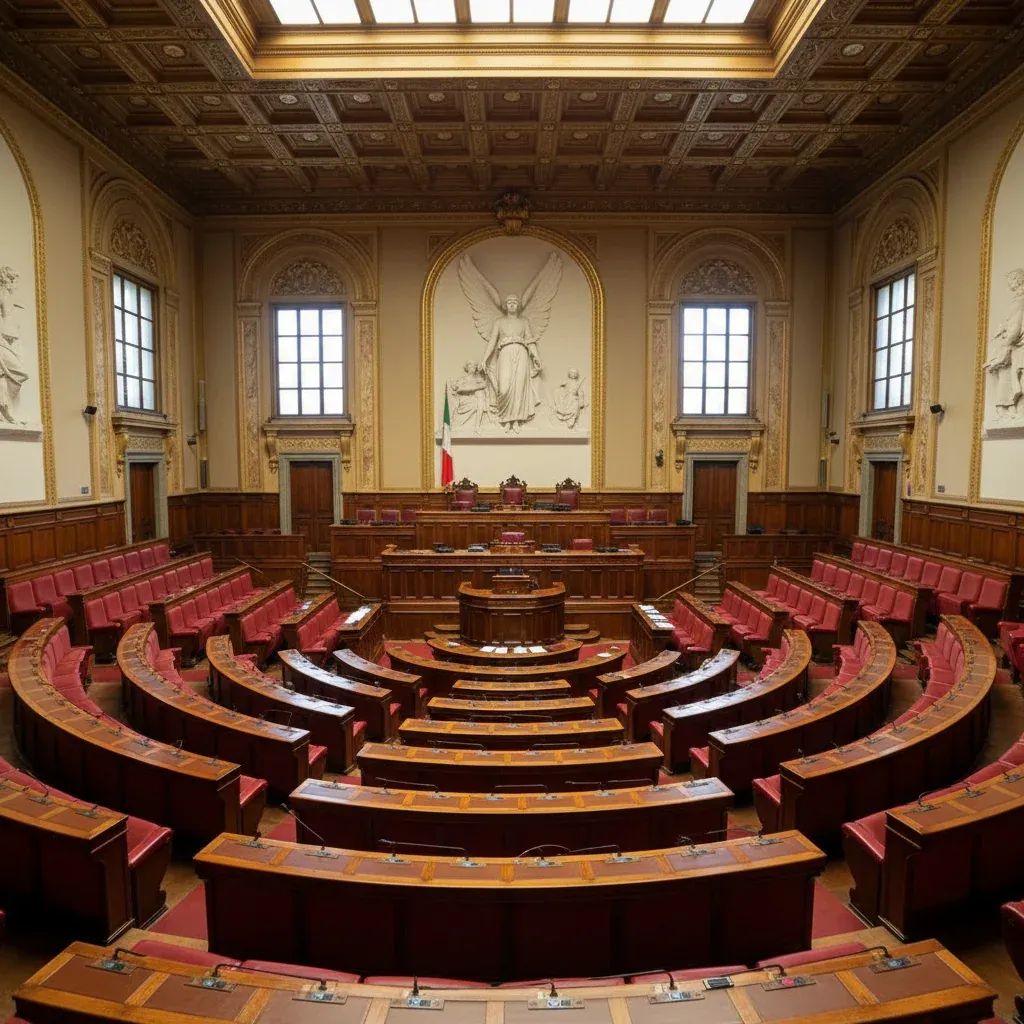
Fratelli d'Italia advocates for restoring voter preference votes in Italy's electoral reform debate, seeking to rebalance power toward citizens and away from party leadership—a position that contrasts with the current legislative proposal under discussion in the Italian Parliament.
Why This Matters
• Electoral control: Under the current system, party leadership determines who sits in Parliament through blocked lists; preference votes would allow citizens to choose individual candidates.
• Stability concerns: The governing coalition is discussing proposals that include mechanisms intended to ensure stable government formation, though the specific architecture remains under debate.
• Timeline: Electoral reform discussions continue in Parliament, with potential legislative action expected.
The Push for Voter Choice
Giovanni Donzelli, national organizational chief for Fratelli d'Italia (FdI), outlined his party's position during the Festa Tricolore gathering in Apice, a town in the Sannio region of Campania. Speaking alongside Senator Domenico Matera and fellow lawmakers Sergio Rastrelli and Marco Cerreto, Donzelli argued that Italians deserve both a stable government and the right to select their own representatives. "We back a system that guarantees governability and returns the choice of representatives to voters," he stated. "That's why we'll work toward a reform that introduces preference votes and ensures stability for the country."
This position reflects an ongoing debate within Italian politics, as preference voting remains absent from the national electoral framework. Meanwhile, citizens are accustomed to marking individual choices in municipal, regional, and European Parliament elections, creating a discrepancy that has become a point of discussion.
Why Preference Voting Matters for Residents
For people living in Italy, the presence or absence of preference votes in national elections shapes how representation functions:
Accountability: When voters can select individual candidates, elected officials owe their seat directly to constituents rather than to party gatekeepers. This territorial link traditionally makes representatives more responsive to local concerns—a dynamic especially important in provinces outside major urban centers.
Party democracy: Preference systems foster candidate competition and open candidate selection processes. Blocked lists concentrate influence in party leadership circles, where decisions about candidate placement are made centrally.
Legitimacy: The gap between European elections—where Italians mark preferences—and national polls, where they cannot, fuels public discussion about electoral systems and democratic participation.
The European Context
Across the European Union, many countries employ open or flexible lists. In Finland, Poland, and Slovenia, personal votes can determine which candidates are elected; party order can be overturned by voter choice. Austria, Belgium, the Netherlands, Norway, Sweden, the Czech Republic, and Lithuania use flexible lists, where predefined candidate sequences can shift if candidates receive sufficient voter support. Ireland and Malta employ ranked-choice voting systems in multi-seat constituencies.
By contrast, Germany, Spain, France, Greece, and Portugal maintain blocked lists for certain elections. Italy's current national electoral framework aligns with this more restrictive approach, a position that contrasts with the country's preference tradition at the subnational level.
Risks and Historical Context
Preference voting brings both opportunities and challenges. Historical analysis of Italian politics shows that candidate-to-candidate competition within the same party can create incentives for targeted constituency benefits. The balance between personal accountability and programmatic coherence remains a central consideration in electoral system design.
Critics raise concerns that preference systems can weaken party discipline and shift focus from policy platforms to individual candidate campaigns. Conversely, supporters argue that preference voting increases democratic participation and representative accountability.
The Inland Areas Agenda
Donzelli also acknowledged a separate legislative proposal championed by Senator Matera: a bill intended to strengthen representation of small provinces and inland areas (aree interne) in regional governance structures. "It's a serious issue that deserves in-depth study," Donzelli said. "It's a valid proposal that should be carefully evaluated in the next legislature. We will certainly return to it—this is work Senator Matera will carry forward, as he was the first to believe in it."
Matera, who serves as FdI provincial coordinator for Sannio, has positioned himself as an advocate for depopulated inland zones. He has introduced legislative proposals aimed at reversing emigration trends and supporting economic activity in marginal territories, reflecting growing government attention to rural depopulation challenges.
Impact on Voters and the Path Forward
For expatriates, residents of cities, and inhabitants of small towns alike, the outcome of ongoing electoral reform discussions will determine whether future ballots offer expanded voter choice or maintain current structures. The tension reflects a broader dilemma in Italian constitutional politics: how to engineer stable government without sacrificing democratic participation, and how to restore trust in representative institutions while managing historical vulnerabilities.
The parliamentary debate will shape the electoral framework Italians encounter in future general elections and the composition of the Parliament that emerges from them.


