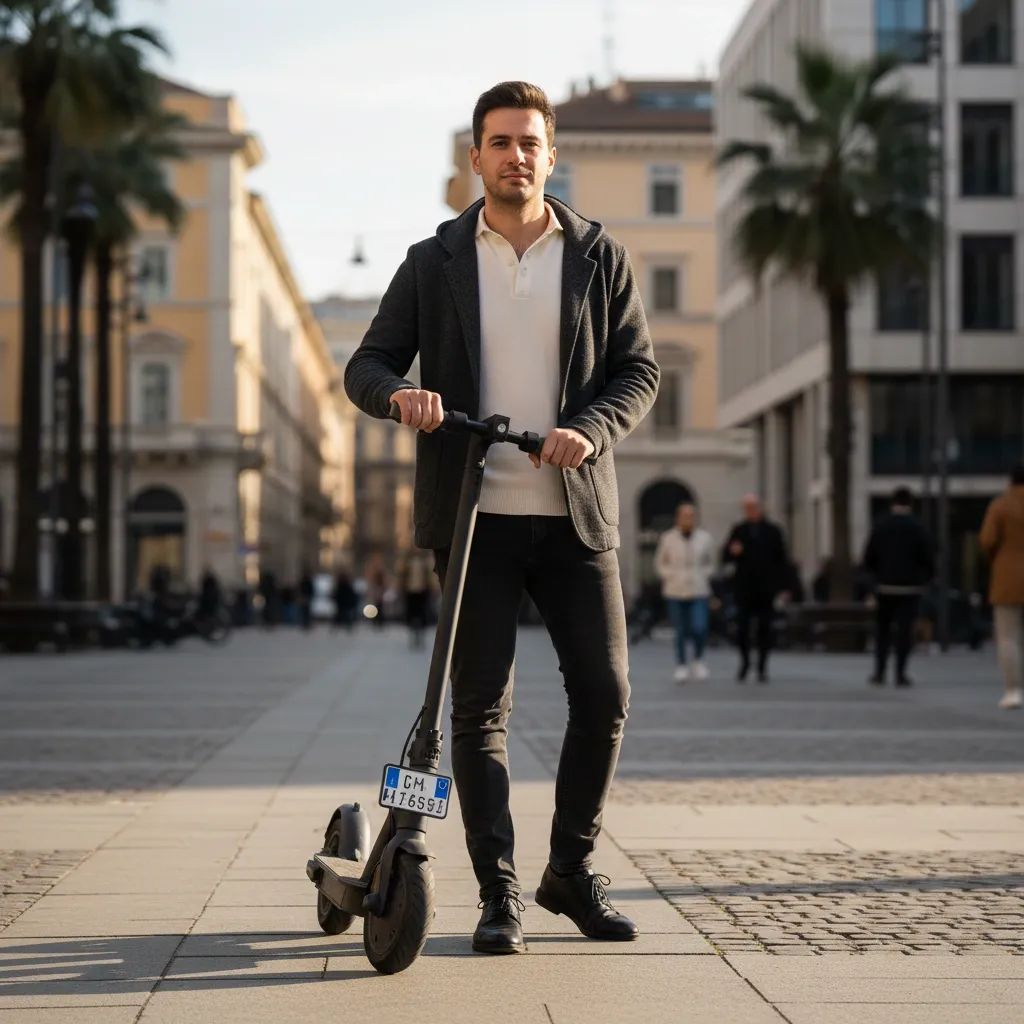
The Italy Ministry of Transport's mandatory civil liability insurance for electric scooters has gone live, triggering a wave of economic concern across the shared mobility sector as operators face premium hikes up to 500% compared to their previous coverage—all while barely 13% of privately owned scooters have obtained the required identification plates.
Why This Matters
• Shared scooter operators now pay around €100 per vehicle annually, versus roughly €35–55 for individual owners—despite fleet vehicles being GPS-tracked, speed-limited, and maintained daily.
• Only 133,135 identification plates have been issued for roughly 1 million scooters nationwide, leaving most private riders technically uninsured and liable to fines of €100–400.
• The insurance burden could force 2,000 jobs out of the market as companies like Bit Mobility report cost spikes from €136,000 to over €2.2M per year for an 8,500-unit fleet.
As of today, any electric scooter operating on Italian roads without a registered liability policy and identification sticker is subject to immediate confiscation. The enforcement window follows months of preparation since the Italy Parliament reformed the Highway Code in late 2024, aligning domestic law with EU Directive 2021/2118 and reclassifying e-scooters as motorized vehicles.
The Compliance Gap Widens
Data from the Italy Ministry of Infrastructure and Transport reveals the scale of the challenge: by the end of June, barely one in ten privately owned scooters had secured the adhesive identification tag—a six-digit code affixed to the rear fender or steering column—that serves as the vehicle's de facto license plate. Without it, no insurer can issue a valid policy.
Luigi Licchelli, president of Assosharing, the trade body representing shared mobility operators, frames the situation starkly: "If you subtract our 60,000 fleet vehicles from the total pool, private owners account for barely 73,000 compliant scooters out of 940,000. The rest are ghost vehicles."
Fleet operators, by contrast, entered the deadline fully compliant. Every shared scooter already carries a plate, GPS tracker, automated speed governor, and geofencing software that halts propulsion at pedestrian zone boundaries. Yet the regulatory shift treats them identically to private riders who may lack helmets, indicators, or even functioning brakes.
Pricing Asymmetry Sparks Industry Alarm
The economic friction centers on premium structures that penalize commercial fleets. Individual scooter owners can purchase baseline third-party liability coverage for as little as €35 annually, with policies topping out around €150 when supplementary guarantees are added. Those figures align with standard consumer motor insurance, scaled for low-power vehicles.
Operators report a different reality. Quotations submitted to Bit Mobility, a mid-sized provider, ranged from €100 to €260 per scooter—replacing the €16 non-motor liability policies they carried under the previous regulatory framework. For the company's 8,500-unit fleet, that translates to an annual insurance bill between €850,000 and €2.2M, compared to the prior €136,000 outlay. Insurance, previously accounting for under 2% of revenue, now consumes nearly 30%.
Assosharing contests the logic behind the disparity. "Zero serious accidents have been recorded on shared scooters since 2021," Licchelli notes. "The severe crashes involve private vehicles—the ones nobody inspects. Technology delivers safety, not the policy itself. This pricing model punishes the compliant and rewards the reckless."
Consumer advocacy group Consumerismo No Profit warns the cost surge will migrate directly to users, raising per-minute rental fees across Italy's major cities and potentially shrinking access to a transport mode that has become integral to first- and last-mile connectivity in congested urban centers like Milan, Rome, and Turin.
What This Means for Residents
If you own a private scooter: Riding without both the identification plate and a valid policy exposes you to fines starting at €100, vehicle seizure, and personal liability for any third-party damage. Standard home or family liability policies (RC Capofamiglia) do not satisfy the legal requirement—the coverage must be a dedicated scooter RC policy electronically linked to your plate code via the SITA platform managed by ANIA, Italy's insurance association.
If you rely on shared scooters: Expect fare increases as operators pass through insurance costs. Some companies may reduce fleet sizes or withdraw from smaller markets where revenue cannot absorb the new expense structure. Milan has already revoked Bird Rides Italy's operating license for administrative non-compliance, signaling municipalities will not tolerate shortcuts.
If you're involved in an accident: For the next two years, the Italy Insurance Supervisory Authority (IVASS) has suspended the direct compensation system (risarcimento diretto) used for car collisions. Claimants must file directly with the at-fault party's insurer, a slower process that may complicate settlement, especially given the absence of historical claims data for scooters.
Regulatory Context and Broader Measures
The liability mandate caps a series of tightening measures introduced since December 2024. Helmet use is now compulsory for all riders, not just minors. Speed limits remain 20 km/h on roadways and 6 km/h in pedestrian zones, with electronic enforcement enabled on fleet scooters. Minimum riding age is 14, and vehicles must display front and rear lights plus directional indicators. Passenger carriage is forbidden.
The reforms mirror steps taken in Germany, which mandated scooter liability insurance in 2019, and Spain, where a similar obligation took effect in January 2026. France classifies e-scooters as motorized land vehicles, requiring third-party coverage from the outset. Italy's delayed adoption reflects both administrative complexity—integrating Ministry of Transport databases with insurer platforms—and industry pushback over costs.
The Road Ahead
IVASS and Italy's Antitrust Authority have launched a joint investigation into pricing practices within the scooter insurance segment, a move Assosharing welcomes as overdue scrutiny. The inquiry will examine whether underwriting criteria reflect actual risk profiles or if commercial fleets are being subjected to unjustified surcharges relative to private owners.
Meanwhile, compliance remains patchy. The Italy Revenue Guard has begun spot checks in Rome and Naples, targeting riders without visible plates. Anecdotal reports suggest enforcement varies widely by municipality, with smaller towns lacking the personnel to conduct systematic sweeps.
For the shared mobility sector, the stakes extend beyond balance sheets. Operators employ roughly 2,000 people nationwide in roles spanning vehicle maintenance, customer support, and street operations. If margins collapse under insurance pressure, those positions vanish—along with a transport option that has proven popular among residents seeking affordable, low-emission alternatives to taxis and private cars.
The regulatory intent—protecting pedestrians and clarifying liability when accidents occur—faces little opposition. The execution, however, has generated friction that pits compliance against commercial viability, leaving both operators and private riders navigating a system still finding its equilibrium.