
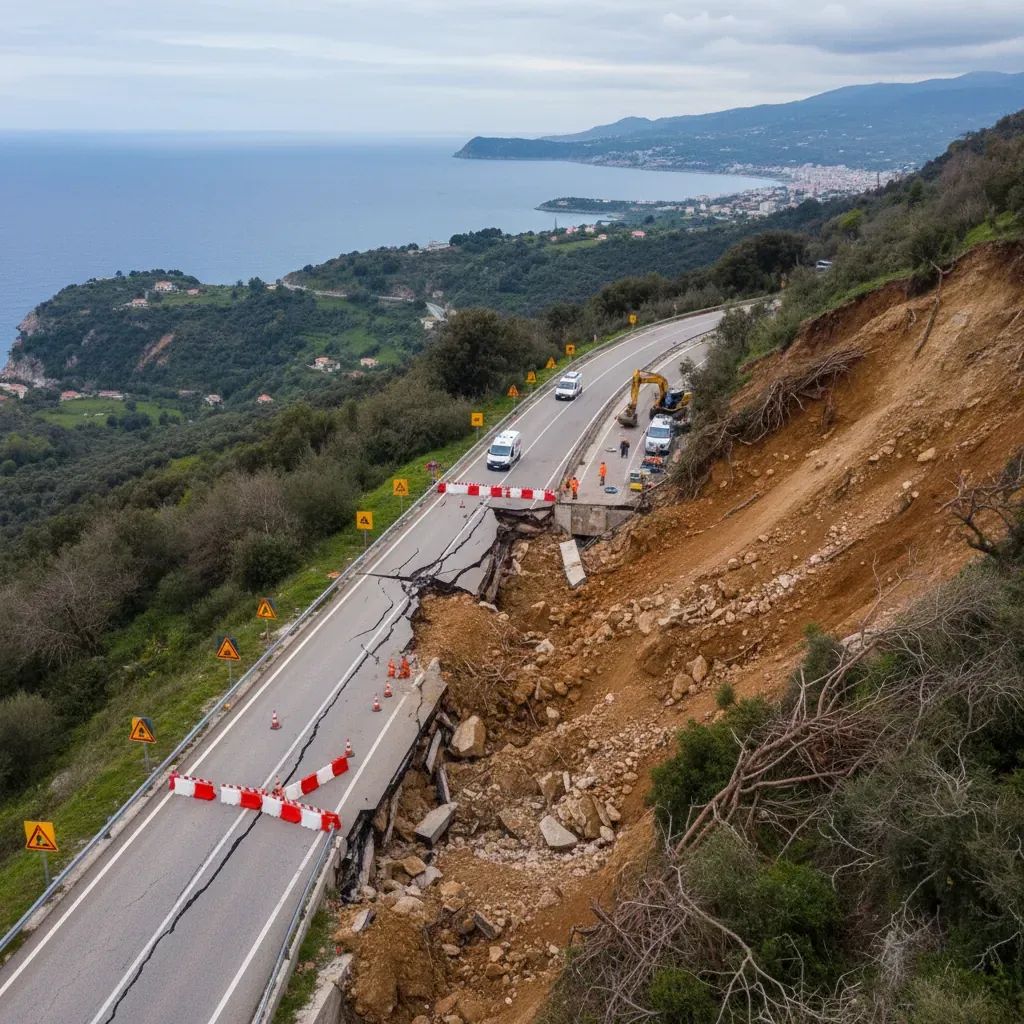
The Italian Civil Protection Department has warned that A14 highway and Adriatic rail traffic will remain severed for weeks—possibly months—as an ancient, 4-kilometer landslide near Petacciato, Molise continues to move, effectively splitting Italy's north-south transport corridor and stranding thousands of commuters, truckers, and residents along the Adriatic coast.
Why This Matters:
• Transport paralysis: The A14 motorway is closed between Vasto Sud and Termoli in both directions, while the Adriatic railway line between Termoli and Montenero di Bisaccia remains suspended—no trains, no trucks, no clear detour.
• Economic squeeze: Molise's industrial hub in Termoli faces mounting logistics costs; the SS16 state road is also out due to a separate bridge collapse on the Trigno River, leaving no viable alternative route for heavy vehicles.
• Evacuations: Around 50–60 residents have been removed from homes in Via del Progresso, Via 4 Novembre, and Contrada Torre as engineers monitor ground movement in real time.
• Long-term instability: The landslide, driven by pressure-charged aquifers in Plio-Pleistocene grey-blue clays, has reactivated cyclically for over a century; even a €27 M drainage project now out to tender cannot guarantee permanent stabilization.
A Century-Old Geological Time Bomb
The Petacciato landslide is no ordinary slope failure. Documented since the early 1900s, the mass movement stretches four kilometers inland and plunges deep into layers of waterlogged clay that lose cohesion the moment groundwater pressure rises. Beneath the surface, sandy aquifers under artesian pressure pump water upward through fissures, lubricating rotational slip planes and nudging entire blocks of fractured sandstone toward the Adriatic.
Recent heavy rainfall—common between January and March, when water tables peak—triggered the latest surge on April 7. Unlike a sudden rockfall, this is a slow, relentless creep: the kind of motion that buckles rail tracks, cracks asphalt, and renders any hasty repair futile. "Until the landslide stops moving, no infrastructure restoration is possible," Fabio Ciciliano, head of the Italian Civil Protection Department, told the emergency coordination committee convened in Rome. "If anyone expects the A14 and railway back in five to seven days, they are mistaken. We are talking about weeks, if not months."
What This Means for Residents and Business
For anyone living, working, or shipping goods through Italy, the closure translates into immediate friction. Intercity and regional trains on the Bari–Pescara axis are cancelled or rerouted; passengers face hours-long delays and inadequate bus replacements that lack capacity—and accessibility features—for elderly or disabled travellers. Pensioners from Molise who rely on the Isernia–Rome line to reach specialist hospitals in the capital now find themselves cut off, a situation advocates describe as a "violation of universal accessibility."
The disruption hits hardest in Termoli, home to automotive plants, warehouses, and logistics hubs. With the A14 severed and the SS16 impassable, freight must detour inland via narrow provincial roads never designed for articulated lorries, adding hours and hundreds of euros per trip. The Italian Ministry of Infrastructure has waived tolls on the affected A14 stretch, but that offers scant relief when the road itself is off limits. Civil Protection officials are now exploring emergency ferry services for heavy goods vehicles—a measure of just how constrained land routes have become.
Local businesses warn that prolonged isolation will erode investor confidence and accelerate the economic decline already visible across Molise, one of Italy's least-connected regions. Tourism, too, stands to suffer: would-be visitors deterred by the logistical maze are choosing destinations with reliable access.
Why the Landslide Keeps Coming Back
Petacciato's chronic instability is rooted in geology, not poor maintenance. The hillside is built from Plio-Pleistocene grey-blue clays, a sedimentary formation notorious for absorbing water and losing shear strength. When winter rains saturate the soil, pore-water pressure climbs, effectively buoying soil particles apart and reducing friction along pre-existing slip surfaces. Sandy lenses trapped within the clay act as pressurized reservoirs, forcing water upward and outward—a natural pump that never shuts off.
Over the decades, the slope has fractured into a jigsaw of sandstone blocks and clay wedges, each moving at slightly different rates in a complex roto-translational creep. Surface features—back-tilted benches, fresh scarps, waterlogged depressions—betray the unceasing motion below. Engineers stress that this is not a design flaw to be fixed but an intrinsic characteristic of the material: you can slow it, manage it, monitor it, but eradicating the hazard entirely may be impossible.
The €27 M Stabilization Gambit
Recognizing that ad-hoc patches will not suffice, the Commissioner for Hydrogeological Risk in Molise has greenlit a €27 M intervention (some reports cite a broader €40 M+ envelope) designed by the engineering firm Technital. Tenders for construction are currently open.
The centerpiece is a network of large-diameter drainage wells drilled deep into the landslide mass to intercept and depressurize the aquifers feeding the slip zone. By lowering the water table and bleeding off pore pressure, engineers hope to restore enough friction to halt—or at least drastically slow—the creep. Complementary measures include:
• Soil nailing and anchored meshes on upper scarps near residential areas, reinforced with vegetation to bind the surface.
• Ground anchors (tiranti) at the crown of the slide, just above the Petacciato town center.
• Real-time monitoring arrays—inclinometers, piezometers, GPS benchmarks—to track slope behavior and validate the effectiveness of drainage.
Yet geotechnical studies caution that even state-of-the-art drainage may not reach the deepest failure surface, which could lie tens of meters below the well screens. In that scenario, the project buys time and reduces risk but does not eliminate the root cause. Ongoing surveillance and periodic maintenance will remain essential for decades.
No Easy Detours, No Quick Fixes
The simultaneous failure of multiple routes has exposed a chronic infrastructure deficit in southern Italy. The SS16 Adriatica, normally the first fallback when the A14 closes, is itself severed by the Trigno River bridge collapse. Inland alternatives—narrow, winding, and poorly lit—cannot safely accommodate the volume or weight of diverted traffic. Queue times on approach roads have ballooned; local mayors report gridlock in towns never meant to serve as through-routes.
Rail passengers face similar constraints. The Adriatic line is the only electrified, double-track corridor along the coast; the only other link from central Molise to the high-speed network at Benevento lies disused and overgrown. Bus substitutions stretch journey times by hours and offer no guarantee of a seat, much less step-free boarding.
Civil Protection planners are now weighing whether to charter short-sea ferries to move trucks between Termoli and ports farther north or south—an expensive stopgap that underscores the absence of resilient land alternatives.
Timeline and Next Steps
Fabio Ciciliano has been explicit: residents, hauliers, and rail operators should brace for weeks minimum, possibly several months, before even partial reopening. The landslide must first stabilize on its own or be coaxed into quiescence by emergency drainage; only then can engineers assess damage to the rail bed and highway subgrade and begin reconstruction.
In the meantime, the Italian Ministry of Infrastructure and Autostrade per l'Italia are coordinating daily traffic bulletins, while Trenitalia continues to publish revised timetables for Intercity and regional services. Evacuated families in Petacciato are being housed in temporary accommodations, with local authorities promising that no one will be allowed home until slope-monitoring data confirm conditions are safe.
The €27 M stabilization contract, once awarded, will take additional months—if not years—to complete, meaning that even after the immediate crisis passes, Petacciato will remain a closely watched flashpoint on Italy's transport map. For a region already grappling with demographic decline and economic marginalization, the landslide is both a geological event and a symbol of deeper infrastructure neglect.


