
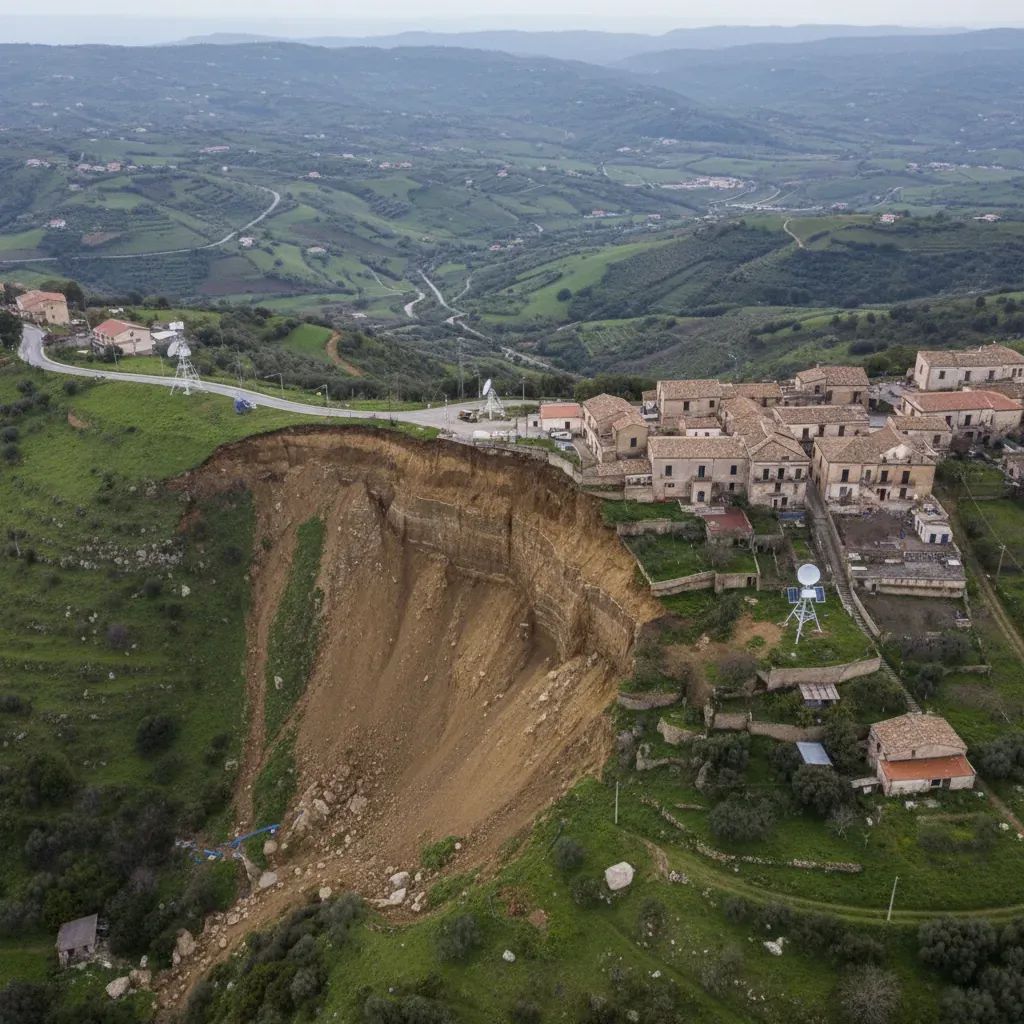
President Visits Sicily's Fractured Town as Ground Continues Its Slide into the Plain
President Sergio Mattarella arrived in Niscemi on Monday morning, stepping directly into a landscape where 350 million cubic meters of earth had already vanished. Over four kilometers of hillside, the southern flank of this Sicilian municipality has begun its inexorable collapse toward the Gela plain—not all at once, but continuously, millimeter by millimeter. The geological reality confronting residents and the state apparatus alike is stark: large portions of Niscemi cannot be rebuilt, and the terrain itself demands permanent human withdrawal from entire neighborhoods.
Why This Matters
• More than 1,600 people remain displaced with permanent return to many homes ruled out entirely—entire districts including Sante Croci, Trappeto, and via Popolo have been declared permanent evacuation zones; 880 buildings face demolition.
• Emergency rent assistance of approximately €800 per household began disbursement on February 23, though historical precedent suggests families may wait 15 years or more for full compensation claims—residents displaced by a 1997 event in the same municipality did not receive settlements until 2012.
• The slope continues moving toward Gela—satellite monitoring detects ongoing subsidence of 15 to 25 meters along the failure's crown; the historic Belvedere lookout, a landmark for generations, has vanished entirely.
A Community Bearing Witness to Its Own Unraveling
When Mattarella's entourage entered Niscemi's central plaza, residents responded with sustained applause—not celebratory, but insistent. Some had traveled considerable distances to position themselves there, clutching documents, photos of lost homes, and the raw desperation of people hoping that the presence of the head of state might somehow alter their trajectory. The president moved through the crowd with visible deliberation, exchanging words with individuals whose lives had been bifurcated into before and after.
Architect Roberto Palumbo, having lost his home to a 25-meter chasm that opened beneath his property during the January catastrophe, recounted his exchange with Mattarella. The president's message was direct: "We are present and working for Niscemi. I recognize this is difficult. Your life existed here. My presence today signals that state commitment remains substantive." Palumbo expressed surprise at the personal engagement. "He made plain that we are not forgotten," Palumbo said, a statement whose significance lay not in its originality but in its rarity—governments do not often appear in person when solutions remain impossible.
The optics of the visit masked a far grimmer operational reality. Fabio Ciciliano, appointed by the Italy Cabinet as extraordinary commissioner for the Niscemi emergency and serving concurrently as chief of the Italy Civil Protection Department, has already informed residents that delocalisation is not a proposal to be negotiated but a geological inevitability. Families whose homes occupy the active scarp—the zone where the earth continues to slip—will not return. Period.
The Infrastructure and Bureaucratic Collapse
The landslide severed critical provincial roads. The SP10 and SP12, which traditionally connected Niscemi to Gela and carried both commerce and residents seeking work or services, now exist only as fractured asphalt and impassable stretches. The SP11, linking Niscemi to Vittoria, remains the single viable corridor to Gela—a chokepoint that has transformed daily logistics into a puzzle. Schools remain shuttered pending structural assessments. Water systems have been compromised. The Italian Army established emergency access routes, carving new passageways through the landscape, but the underlying message is unavoidable: Niscemi's connectivity to the outside world has been fundamentally degraded.
Approximately 1,500 to 1,600 people are in emergency accommodation arrangements. Some live with relatives. Others occupy transient spaces—bed-and-breakfast rooms, community reception centers, the Pio La Torre sports facility temporarily converted into housing. The Italy Sicilian Regional Government has identified 16 residential units for relocation, with initial placements rolling forward through late February and March. On February 23, the first disbursement batch comprised 252 families receiving approximately €800 each from the CAS fund (Contributo di Autonoma Sistemazione), a rent-support mechanism that can extend up to €900 monthly per household for twelve months. An additional 190 families await their turn in the coming weeks.
Yet the machinery of recovery is grinding slowly. Compensation for victims of Niscemi's 1997 landslide took fifteen years to materialize. No official has publicly guaranteed acceleration this time around, despite increased mobilization at both national and regional levels.
Geological Mechanics: Water, Clay, and the Inevitability of Collapse
Niscemi's catastrophe was not a random geological event but the predictable outcome of specific hydrogeological conditions colliding with extreme weather. The town sits atop permeable sand deposits that rest uneasily on Pliocene-era clay and marl layers. During normal conditions, the clay remains stable. When torrential precipitation—in this case, delivered by Cyclone Harry in late January—infiltrates the sand and reaches the clay beneath, the physics change entirely. Saturated clay loses its structural integrity, functioning instead as a lubricant. Groundwater pressure increases. The resistance of the material declines precipitously. The massive mass above begins to slide.
The failure that ensued is classified as a roto-translational slide—a rotational movement combined with translational displacement involving incomprehensible volumes of earth. Two distinct slip surfaces are visible in satellite imagery collected by the Italy Space Agency in early February. The primary scarp stretches approximately four kilometers across the town's southern exposure. Ground subsidence measured between 15 and 25 meters represents not merely architectural damage but erasure of topography itself.
Most troubling to geologists is the retroactive progression of the failure. Rather than concluding with a single catastrophic event, the landslide is creeping backward toward the town center, threatening additional structures and infrastructure with each passing week. The Italy National Institute of Geophysics and Volcanology (INGV) has deployed real-time seismic sensors and deployed satellite interferometry technology capable of detecting millimeter-scale shifts. University of Palermo research teams conduct daily assessments within the restricted zone. All confirm the same unsettling conclusion: the movement persists.
This is not Niscemi's first encounter with such instability. Documented landslides occurred in 1790 and 1997—historical evidence that the underlying geology has a recurring pathology. The 1997 event displaced hundreds and prompted initial stabilization proposals. Those interventions were never adequately funded or executed. The Benefizio stream corridor, where surface and subsurface drainage systems might have reduced saturation, received earmarked funds that were redirected or never deployed. Decades of what planners term negligent inaction created the conditions for catastrophe.
Financial Architecture and the Shortfall
The Italy Cabinet has committed approximately €1 billion in total emergency response funding for Cyclone Harry and its cascading disasters. Of this, €150 million has been specifically directed to Niscemi, designated for controlled demolition of unsafe structures, soil stabilization efforts, compensation for destroyed homes and businesses, and temporary housing support. An additional €100 million in initial emergency funds was released from the Prime Minister's Office in the immediate aftermath. The Italy Sicilian Regional Government has mobilized €680 million for broader cyclone recovery and hydrogeological remediation across Sicily.
Despite these figures, preliminary damage assessments place overall losses from Cyclone Harry and the Niscemi landslide at approximately €2 billion across Sicily alone, with Niscemi representing a critical portion. The reconstruction demand far exceeds readily available resources. That reality has forced a fundamentally different approach: rather than attempting full restoration of the built environment, planning now centers on permanent relocation coupled with controlled demolition of approximately 880 buildings deemed uninhabitable or too dangerous for occupancy.
Ciciliano coordinates a multi-agency mechanism drawing together state engineers, university research teams, the Italy Space Agency, and regional administrators. The Italy Ministry for Civil Protection and Maritime Policy has established a formal study commission tasked with dissecting the geological evolution of the failure, determining why prevention funding historically sat dormant, and proposing systemic changes to how Italy approaches hydrogeological disaster management nationally.
A National Vulnerability Made Visible
Niscemi functions as a microcosm of a broader Italian fragility. Approximately 94.5% of Italy's municipalities face hydrogeological risk. Around 1.28 million Italians reside in areas classified as high or very high landslide danger. In Sicily specifically, roughly 93,000 residents inhabit acute slide-risk zones. Historical patterns reveal that infrastructure investments designed to mitigate such threats have been fragmented, underfunded, or poorly executed—a cascade of individual negligences that accumulate into societal vulnerability.
The bitter irony is that Niscemi's vulnerability was documented. Engineers and regional administrators identified the instability sector years ago. Funds were earmarked for specific interventions. Yet these allocations were never deployed effectively or were diverted to competing priorities. The Italy Prosecutor's Office in Gela has opened a formal investigation into culpable disaster and damages, probing not merely the immediate geological causes but the administrative decisions—and more significantly, the non-decisions—that allowed preventable risk to accumulate. Specific questions center on why authorized safety funds were not deployed and why warnings from the 1997 event were not translated into mandatory structural interventions.
The Real Test: What Unfolds Over Months and Years
Mattarella's four-hour visit provided acknowledgment. The handshakes and conversations offered emotional reassurance to a community gripped by displacement and loss. Yet the genuine measure of state commitment will manifest not in presidential appearances but in concrete outcomes: the pace at which families are successfully relocated, the speed of compensation processing, the efficacy of soil stabilization efforts, and crucially, whether the investigations into administrative responsibility yield accountability or disappear into bureaucratic silence.
For the immediate term, engineers and civil protection authorities have identified technical priorities. Deep subsurface drainage systems must reduce groundwater saturation in the clay layers beneath unstable zones. Rapid channeling of rainwater away from compromised areas is urgent. Continuous satellite and ground-based monitoring must detect any acceleration in slide velocity. Permanent relocation coupled with controlled demolition of buildings occupying the active scarp is inevitable.
Beyond emergency response lies a more fundamental philosophical imperative. Italy's planning apparatus must transition from reactive crisis management to proactive risk governance. This requires smarter territorial zoning that respects hydrogeological realities, stricter building codes in vulnerable areas, and systematic maintenance of prevention infrastructure before crises unfold.
For Niscemi's residents, the months ahead remain characterized by uncertainty. Rental assistance is being disbursed in tranches. Engineers continue their monitoring. Demolition planning is underway. Relocation arrangements are being finalized for families whose homes lie on the active failure zone. Yet beneath their former neighborhoods, the earth continues its imperceptible slide toward Gela—a geological reality that no amount of state support can arrest, only manage.
Niscemi waits. The ground moves on.


