
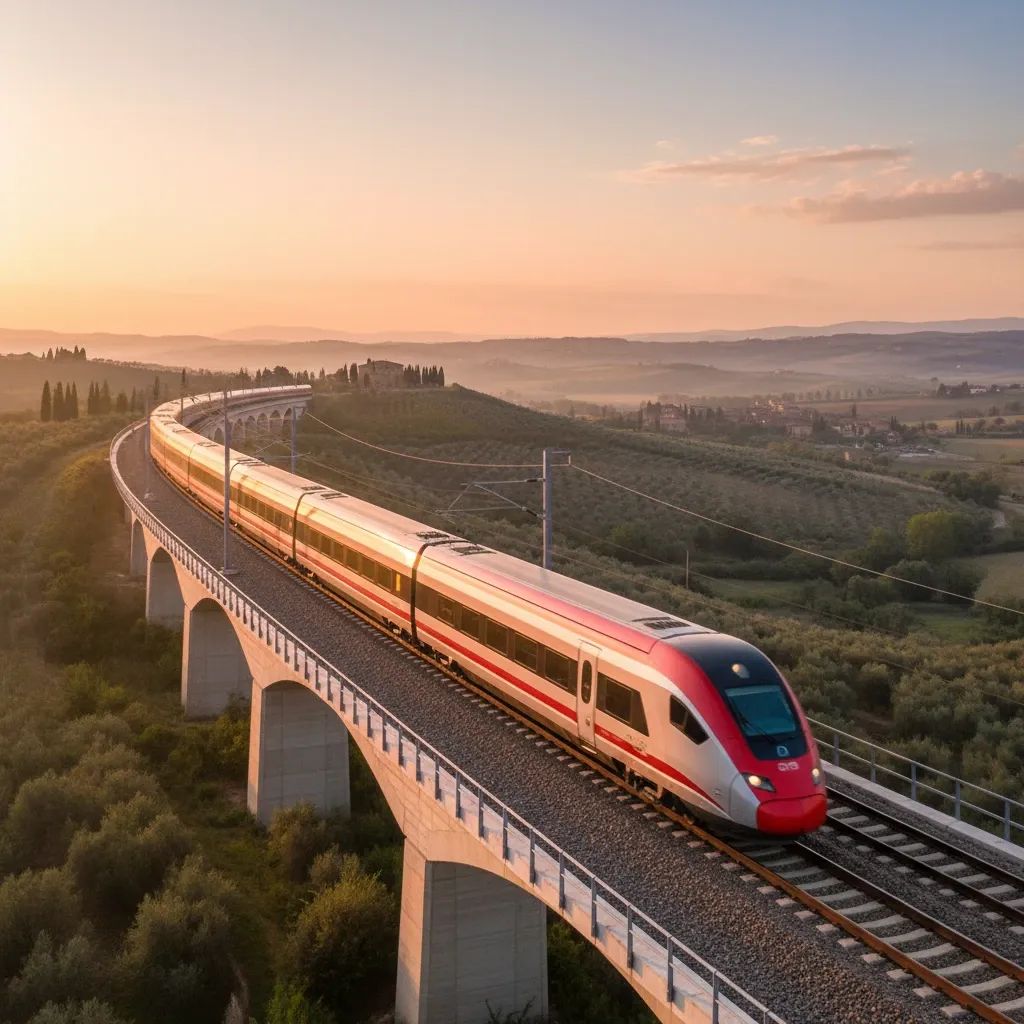
The Italy rail holding FS Italiane has used a rare public interview to confirm that its multibillion-euro construction programme will stay on track despite rising material prices and recent vandalism, a stance that could determine how quickly commuters see new high-speed links and safer stations.
Why This Matters
• €18.5 B already spent in 2025 and another €177 B budgeted through 2034: the largest transport outlay in Italy’s history
• 35 % fall in serious on-site injuries credited to digital safety tools—good news for passengers and workers alike
• Body-cams and real-time video analytics to appear on every major route by end-2026
• Builders hit by surging steel and concrete costs may get fresh price-adjustment rules in the 2026 Budget Law
Inside the Conversation
Speaking for nearly an hour on the ANSA Incontra livestream, Group Chief Executive Stefano Antonio Donnarumma fielded questions from ANSA’s editorial staff about everything from railway sabotage to Olympics deadlines. He called the recent damage to fibre-optic lines in Lombardy “a deliberate blow at the country’s image in a showcase year,” noting that Milan-Cortina 2026 depends on an immaculate timetable.
While Donnarumma’s tone was measured, his numbers were crisp: 20 B € in revenue and 3.5 B € in EBITDA by 2029 remain locked in, he said, even as international expansion pushes leverage higher.
The Safety Overhaul
Italy’s rail regulator ANSFISA recorded 103 significant incidents in 2024, the lowest in a decade. FS wants that figure “as close to zero as humanly possible,” Donnarumma said. Key measures include:
• ERTMS rollout on 1,400 km of track by 2025, covering the entire core network by 2040.
• Predictive maintenance driven by sensors and Building Information Modelling—already trimming unplanned stoppages.
• Full body-cam deployment for FS Security personnel; live feeds pipe into a national control room that coordinates with the Italy State Police.
• A new decree on tunnel safety that harmonises Italian galleries with updated EU norms.
Thanks to these steps, severe workplace accidents fell 35 % in 2025, and punctuality for high-speed services ticked up to 77 %.
Ballooning Construction Costs – and How FS Plans to Pay the Bill
Contractors building the Verona-Brennero base tunnel and Naples-Bari upgrade have seen invoices soar. Donnarumma acknowledged the “caro materiali” squeeze but insisted no flagship project will be mothballed. What keeps the cash flowing?
Automatic price-revision clauses expected in the 2026 Budget, extending the 2022 "Decreto Aiuti" mechanism indefinitely.
€320 M top-up from the Italy Ministry of Infrastructure to offset 2024-2025 inflation shocks.
Talks with Emirati and Qatari funds for up to €7 B in co-investments once PNRR money fades.
An internal 5 % efficiency drive to shave operating costs without trimming headcount.
Strategic Plan 2025-2029 at a Glance
The Piano Strategico published last December breaks down as follows:
• €50 B to extend high-speed tracks south of Salerno and west of Turin.
• €40 B for ANAS roads, especially the Salerno-Reggio Calabria corridor.
• €2 B in digital upgrades: cybersecurity, 5G train-to-ground connectivity, and ticketing integration.
• A target of 1 GW of solar capacity via the new subsidiary FS Energy, aimed at slashing traction power costs.
Internationally, FS will launch a Paris–Brussels Frecciarossa and bid for German ICE slots by 2028, chasing 14 M cross-border passengers a year.
What This Means for Residents
• Faster north–south journeys: Rome–Reggio Calabria in under 4 hours by 2029.
• More reliable regional services: predictive maintenance already cuts breakdowns; commuters in Apulia and Veneto should see fewer cancellations next winter.
• Ticket prices stable—for now: FS says higher build costs will not spill into fares before 2027, but urban lines may introduce peak-hour surcharges if energy markets spike again.
• Safer stations: expect visible body-cams, upgraded lighting and AI-based crowd alerts in the 30 busiest hubs by Christmas 2026.
View from Unions, Analysts, Travellers
Labour federation Fit-Cisl cautiously welcomed the investment bonanza but warned it will fight "any back-door privatisation". Credit agencies are split: Fitch upgraded FS to BBB+, while S&P trimmed the stand-alone score, worried about debt. Consumer groups praised the new smart-refund scheme—QR codes on 250,000 seats promise reimbursement in 48 hours—but asked for a cap on summer peak fares.
Here is the reality: if the money holds, Italy could leapfrog much of Europe on rail tech within a decade. If cost inflation outpaces the new safeguards, passengers may end up footing the bill. For now, Donnarumma’s message is clear: "We can deliver both safety and speed—just don’t cut the funding mid-journey."


