
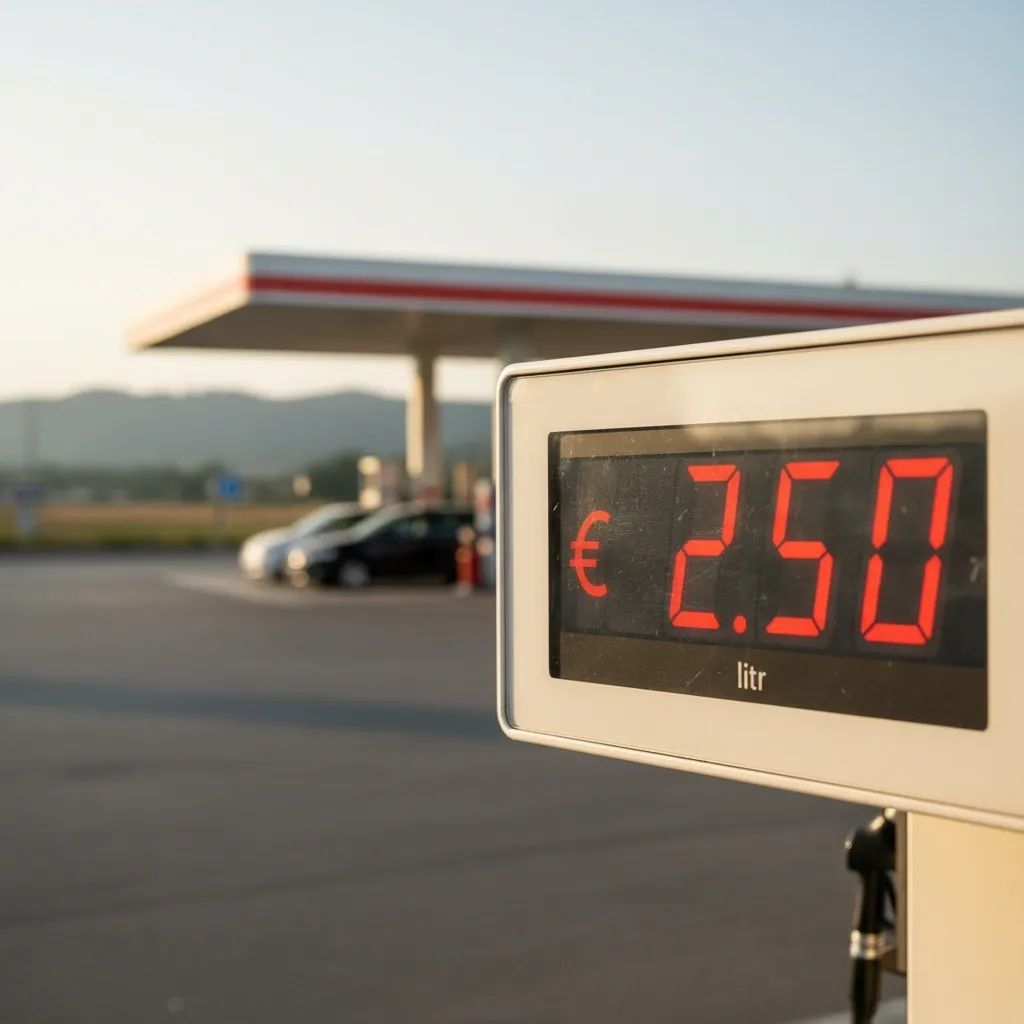
Italy's Ministry of Enterprise and Made in Italy has escalated enforcement measures across the petroleum supply chain after pump prices surged 20 cents per liter within days of Middle Eastern conflict escalations—a timeline that gas station operators and consumer advocates call economically implausible and evidence of coordinated speculation.
Why This Matters
• Price spike: Gasoline hit 1.744 €/L on highways and 1.854 €/L on autostrade, the highest levels in recent months. Diesel topped 1.8 €/L, marking a significant increase since earlier this year.
• Financial burden: Average households face an additional 200 € per year in fuel costs alone, not counting downstream price hikes on goods transported by truck.
• Enforcement action: Italy's Finance Police (Guardia di Finanza) has received roughly 20 case files from Mister Prezzi, the government's price watchdog, targeting unexplained margin spikes upstream in the refining and wholesale sectors.
• Weekly oversight: The Ministry's Rapid Intervention Commission now convenes every Friday to track energy pricing anomalies and coordinate responses.
Gas Station Operators Demand Government Intervention
Trade associations representing Italy's fuel station managers—FAIB and FEGICA—used unusually sharp language during an emergency commission meeting chaired by Minister Adolfo Urso. Their statement challenged the credibility of oil companies' explanations, noting that fuel sold to consumers could not have been purchased at current international spot prices, given normal inventory cycles.
"The speculation exists and everyone can see it," the operators said in a joint press release, pointing to overnight price adjustments that far exceeded changes in benchmark crude indices like Brent or West Texas Intermediate. They argue that major oil brands hide behind international pricing indices to justify retail hikes that don't align with actual supply-chain costs.
The operators called on the Ministry of Enterprise to invoke regulatory powers, including a temporary return to controlled pricing and the activation of a mobile excise tax mechanism. Under that framework, Italy would automatically reduce fuel excise duties when VAT receipts balloon due to inflated pump prices—essentially clawing back windfall government revenues to cushion consumer wallets.
Upstream Margins Under Scrutiny, Not Pump Operators
Minister Urso clarified that widespread speculation at the retail level has not been detected. The 20 cases flagged by Mister Prezzi and now under review by the Finance Police are concentrated in upstream segments—refiners and wholesale distributors—not the corner service station.
Oil majors adjusted their recommended pricing immediately after international refined product quotations rose, even though no real shortage of refined product on the market has materialized, according to the Ministry. International gasoline and diesel futures climbed significantly, but retail price hikes in Italy exceeded international benchmarks in some branded networks.
FIGISC, a major industry association representing station operators, reported that gross industrial margins for self-service gasoline and diesel have compressed considerably in recent weeks, reinforcing operators' claims that profits are being captured higher in the supply chain, not at the pump.
What This Means for Residents
For most drivers, the immediate impact is straightforward: higher fill-up costs. Gasoline prices are now at elevated levels, and diesel—the dominant fuel for commercial fleets and many passenger vehicles—has crossed 1.8 €/L, a significant increase. On certain stretches of autostrade and in urban hubs, fuel costs are particularly steep.
Consumer groups ADOC and Federconsumators have labeled the increases "unacceptable" and called for forensic audits of pricing models. Federconsumators calculated that, adjusting for the euro-dollar exchange rate and crude oil quotations, diesel should cost considerably less than current retail levels—a gap they attribute to speculative mark-ups.
Beyond direct fuel expenses, transport-dependent sectors face cost pressures that cascade into grocery prices, logistics fees, and service charges. The 200 € annual burden per household cited by consumer advocates includes both pump spending and secondary inflation from higher freight costs.
Enforcement Tools and What You Can Do
Italy's Guardia di Finanza is authorized to inspect contracts, audit margin structures, and cross-check invoices throughout the distribution chain. The Finance Police operate under directives from both the Minister of Economy and Finance and the Minister of Enterprise, granting them sweeping access to commercial records.
In parallel, the Autorità Garante della Concorrenza e del Mercato (AGCM)—Italy's antitrust watchdog—can launch formal investigations into cartel behavior or abuse of dominant market position. EU competition law permits fines up to 10% of a company's global annual revenue for violations such as price-fixing or market allocation.
For residents: You can report suspected price gouging to Mister Prezzi (the government price watchdog hotline) or file complaints with consumer associations ADOC and Federconsumators. The Ministry's weekly Friday oversight meetings are designed to rapidly identify and address anomalous pricing. Enforcement results are expected within the coming weeks.
Profit Picture: Stations Versus Majors
Station operators typically earn 1 to 2% of the pump price per liter in gross margin. After covering labor, utilities, and overhead, net monthly income for a single-site operator is modest. Return on investment for a new station typically spans 5 to 8 years.
In contrast, large integrated oil companies have reported expanding profits driven by improved refining margins. This divergence—compressed margins for retail operators, expanding profits for integrated majors—fuels suspicion that refiners and wholesalers are exploiting geopolitical volatility to widen spreads without corresponding cost increases.
Political and Regulatory Outlook
Prime Minister Giorgia Meloni has signaled a willingness to raise taxes on entities deemed to be profiteering from energy turmoil. Minister Urso's immediate strategy involves parallel tracks: intensified audits by the Finance Police to detect fraud or collusion, and sustained pressure on oil majors to justify pricing decisions publicly. If voluntary compliance falters, the Ministry has indicated it possesses regulatory tools to impose temporary price controls—a step rarely taken in liberalized EU markets but not without precedent during emergencies.
For now, Italy is testing whether enhanced transparency and enforcement can discipline the market. The coming weeks will determine whether oil companies adjust their margins voluntarily or whether the government escalates intervention.


